
- Publisher:mzadmin
- Published on:2026-11-02
- Pageviews:2366
Concrete utility poles buried underground for decades—why don't they get ruined by soaking?
Walking along rural paths or city outskirts, concrete utility poles that have stood for decades are everywhere. Their upper halves endure wind and sun, while their lower halves are buried year-round in damp soil, sometimes even soaked in groundwater-rich layers. A natural question follows: wood rots when soaked, iron rusts when soaked—so why do concrete utility poles buried underground for decades seem unharmed? The concrete utility pole's "soak resistance" comes from the precise coordination of materials science, structural design, and manufacturing processes. It is not that they never age; rather, within their design life, the rate of deterioration is kept at an extremely low level.
The main body of a concrete utility pole is concrete. Ordinary concrete is not absolutely impermeable, but the concrete used in utility poles differs from ordinary building mixes starting from its mix proportions. To resist the intrusion of groundwater and corrosive media in the soil, during production the water-cement ratio is kept at a low level and high-efficiency water reducers are added, so that after hardening the concrete forms an extremely dense structure. The lower the porosity, the fewer channels exist for external water and ions to penetrate.
More critical is the manufacturing process. Ring-shaped concrete utility poles generally adopt centrifugal forming: a steel mold loaded with a steel reinforcement cage and concrete mix rotates at high speed on a centrifuge, and under centrifugal force the excess water and air bubbles in the concrete are forcibly expelled, while aggregate and cement paste are thrown toward the mold wall and packed tightly. After this process, the compactness of the concrete far exceeds that of ordinary vibration-formed concrete. The low permeability brought by high compactness makes it difficult for groundwater to penetrate deep into the pole and reach the steel reinforcement.
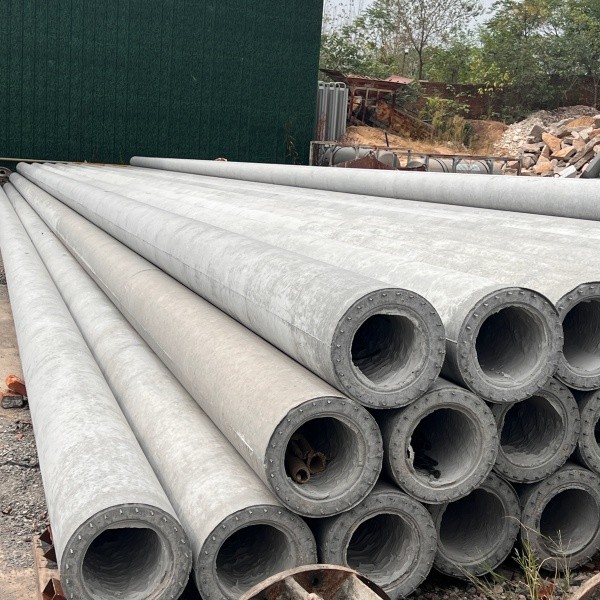
Concrete itself is water-resistant; what is truly vulnerable to water is the steel reinforcement inside. Once steel rebar contacts moisture and oxygen, it corrodes and expands, eventually cracking the concrete cover and leading to structural failure. The pole's countermeasure is to set a sufficiently thick and sufficiently dense concrete barrier between the rebar and the outside world.
Relevant standards have clear requirements for the net protective layer thickness of rebar, and actual designs often leave more margin than the minimum standard. This layer of concrete not only physically blocks moisture—its highly alkaline environment also allows a passivation film to form on the rebar surface, so that even if trace moisture penetrates, the rebar will not easily initiate corrosion. Only when the concrete undergoes "carbonation"—where carbon dioxide in the air gradually neutralizes the concrete's alkalinity—does the passivation film fail. In the buried environment, however, there is no air circulation, so the carbonation process is extremely slow. Calculations based on a design life of sixty years show that the carbonation depth of the pole is far from enough to threaten the rebar within the service period.
Soil corrosion is a slow process, not instantaneous destruction. Soil does contain corrosive ions such as sulfates and chlorides, and their attack on concrete is a long process measured in years. Research indicates that the degree of soil corrosion on concrete depends on the concrete's own compactness and strength, as well as the concentration of corrosive media in the soil and the degree of water saturation. High-strength, high-compactness concrete has significantly stronger resistance to such chemical attack. In other words, what the pole fears is not "wetness" but "loosely wet." A high-strength pole made by centrifugal forming has far greater resistance to soil chemical attack than ordinary concrete components.
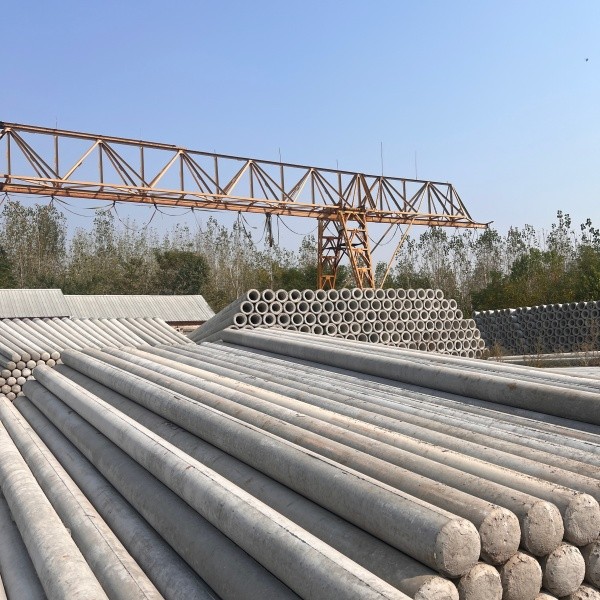
Of course, this does not mean all poles remain intact. Differences in actual service life depend largely on production quality and construction practices. Poles using inferior cement or insufficient rebar may show problems in about ten years. If the base plate and clamping plates are not installed according to specifications during construction, causing the pole to sink, tilt, or bear uneven stress at the base, its service life may also be cut short prematurely. But under normal production and construction conditions, a design life of several decades is well-founded.
So, concrete utility poles buried underground for decades are not "ruined by soaking" because they are immune to water, but because from the very beginning they are made dense enough, protected thoroughly enough, and age slowly enough. Moisture and corrosive ions in the soil are indeed acting continuously—it is just that the pace of this contest has been slowed by the dense structure of the concrete and the thick barrier around the rebar to a scale measured in decades. Those old poles standing for half a century are the silent and reliable proof of this materials logic.
