



- Publisher:mzadmin
- Published on:2026-10-14
- Pageviews:3368
Centrifugal Forming vs. Static Forming: Which Is More Suitable for a Concrete Utility Pole?
A concrete utility pole is an indispensable part of power transmission and distribution infrastructure. It is widely used in urban and rural power grids, railway power supply, and communication lines. However, many people do not know that even among concrete utility poles, the forming processes can differ significantly. At present, the two main process routes in the industry are centrifugal forming and static forming. Each has its own strengths and weaknesses in terms of principle, quality performance, production efficiency, and application scenarios. This article will help you understand the characteristics of these two processes and how to make a reasonable choice under different requirements.
Centrifugal Forming: A Mature and Mainstream High-Efficiency Process
Centrifugal forming is currently the most widely used process in the production of concrete utility poles. Its principle is not complicated: a steel mold filled with a concrete mixture is placed on a centrifuge, and the mold rotates around its own longitudinal axis at high speed. Under centrifugal force, the concrete is evenly thrown toward the inner wall of the mold, and excess water and air are discharged, giving the concrete relatively high density and strength. The centrifugal forming process is usually divided into three stages: low-speed distribution, medium-speed transition, and high-speed compaction. The rotation speed gradually increases from more than one hundred revolutions per minute to four or five hundred revolutions per minute or even higher. The core advantages of this process are high density and fast production efficiency. During centrifugation, a large amount of excess water is discharged, reducing the water-cement ratio of the concrete and significantly improving the strength and impermeability of the pole. From distribution to initial forming, the entire centrifugal operation usually takes about half an hour, which can meet the needs of large-scale engineering construction.
However, centrifugal forming also has some problems that cannot be ignored. First, during centrifugation, the concrete repeatedly impacts the inner wall of the steel mold, causing relatively large wear on the mold and lowering mold utilization, which indirectly increases production costs. Second, the centrifugal process tends to cause internal and external segregation of the concrete, with coarse aggregate concentrated in the outer layer and cement paste concentrated in the inner layer. This segregated structure may cause longitudinal cracks and affect the long-term durability of the pole. In addition, centrifugal motors consume relatively high amounts of energy and generate high noise, placing relatively high demands on the production environment and operators.
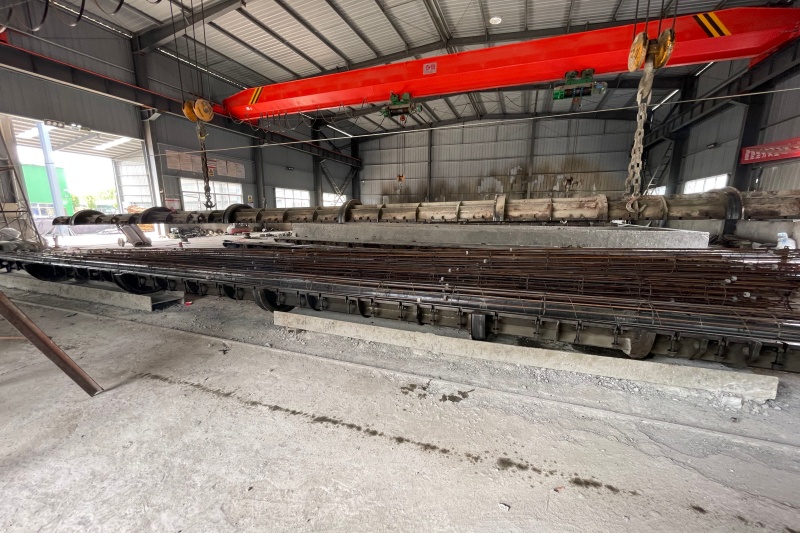
Static Forming: How an Emerging Route Solves Traditional Pain Points
Static forming is another process route that has gradually developed in recent years. It was mainly designed to address the above-mentioned problems of centrifugal forming. Its core idea is to use self-compacting concrete and rely on the concrete's own fluidity to fill the mold, completing dense forming without centrifugal rotation. Vertical molds are usually used. Self-compacting concrete is poured into the mold cavity and, after steam curing, demolded to form the pole. The most prominent advantage of static forming is that it eliminates the inherent defects of the centrifugal process. Because the high-speed centrifugation step is omitted, the mold is no longer subject to repeated impact and friction, and utilization is significantly improved. At the same time, self-compacting concrete fills by its own weight, so centrifugal segregation does not occur, effectively avoiding quality problems such as exposed reinforcement on the inner wall, laitance, and longitudinal cracks. Noise and energy consumption are also greatly reduced, making the production environment more friendly.
In terms of materials, static forming can also be combined with fiber-reinforced self-compacting concrete and non-metallic reinforcement materials. Studies show that replacing traditional steel reinforcement with glass fiber reinforced polymer can make a concrete utility pole corrosion-free and significantly reduce life-cycle maintenance costs. In addition, the lightweight advantage of ultra-high performance concrete is also prominent. Its weight is only one-half to one-quarter that of an ordinary concrete utility pole, which is beneficial for transportation and installation. Of course, static forming currently also has certain limitations. Because it relies on the self-weight of self-compacting concrete for forming, it has relatively high requirements for concrete mix design and raw material quality, and process control is not easy. In addition, vertical mold production still lags behind horizontal centrifugal production lines in mass production efficiency. At present, it is more suitable for projects with specific quality requirements or special application scenarios.
Which Is More Suitable? The Key Lies in the Scenario and Requirements
So, which process is more suitable for a concrete utility pole? The answer is not simply which one is better, but rather a judgment based on specific needs. If your project pursues large batches, high efficiency, and low cost, and the application scenario is a conventional distribution line, centrifugal forming, with its mature industrial chain and efficient production pace, remains the most practical choice at present. Many concrete utility pole manufacturers still use centrifugal processes as their main production lines, and relevant technical specifications are mainly formulated for centrifugal forming. However, if the project has higher requirements for durability, corrosion resistance, or lightweight performance, such as use in coastal high-humidity, high-salt environments, heavily corrosive industrial areas, or the need to reduce pole weight to lower transportation and installation difficulty, static forming combined with self-compacting concrete or ultra-high performance concrete shows unique advantages. Especially when non-metallic reinforcement materials are used, static-formed concrete utility poles can fundamentally eliminate steel reinforcement corrosion and extend service life.
From the perspective of industry development trends, the two process routes are not opposed to each other but are complementary and coexisting. Centrifugal forming is continuously upgrading through automated production lines and steam-curing-free technology to reduce energy consumption and production costs. Static forming, driven by ultra-high performance concrete and new reinforcement materials, is constantly expanding its application boundaries. In the future, concrete utility pole manufacturers may flexibly configure both processes according to different product lines and customer needs, achieving the optimal balance between efficiency and quality. Ultimately, choosing a suitable forming process requires comprehensive consideration of multiple factors, including project scale, service environment, quality requirements, production costs, and delivery cycles. Understanding the principles and characteristics of the two processes is the first step toward making an informed decision. For ordinary distribution projects, centrifugal forming remains a mature and reliable choice. For projects with special durability or lightweight requirements, static forming deserves close attention. Both processes have their own value. The key is to apply the right technology to the right scenario.
