



- Publisher:mzadmin
- Published on:2026-10-07
- Pageviews:2462
The Engineering Behind Concrete Poles: Why They Last 50+ Years
When you drive along a rural road or through the outskirts of a city, you have probably seen those grayish-white concrete utility poles. They stand silently by the roadside, holding up a web of power lines. Few people stop to wonder: why can these seemingly ordinary concrete columns withstand wind, sun, frost, rain, and even typhoons and earthquakes for decades? The answer lies in the combined action of materials science, structural mechanics, and manufacturing technology.
First, concrete provides chemical protection for the steel reinforcement. The core of a concrete utility pole is a steel reinforcement cage plus a concrete outer cover. The steel carries tensile force, while the concrete carries compressive force, and the two work together. However, steel will corrode when exposed to moisture and oxygen. The cleverness of concrete is that it provides a highly alkaline environment. After cement hydration, the pore solution often has a pH above 12.5, causing a dense passive film to form on the steel surface and isolate it from corrosive media. Therefore, concrete is not only a physical barrier but also a chemical shield. Carbon dioxide in the air can penetrate and carbonate the alkaline substances, lowering the pH. When carbonation reaches the steel surface, the passive film is destroyed and corrosion may begin. Durability design is essentially about slowing the advance of the carbonation front.
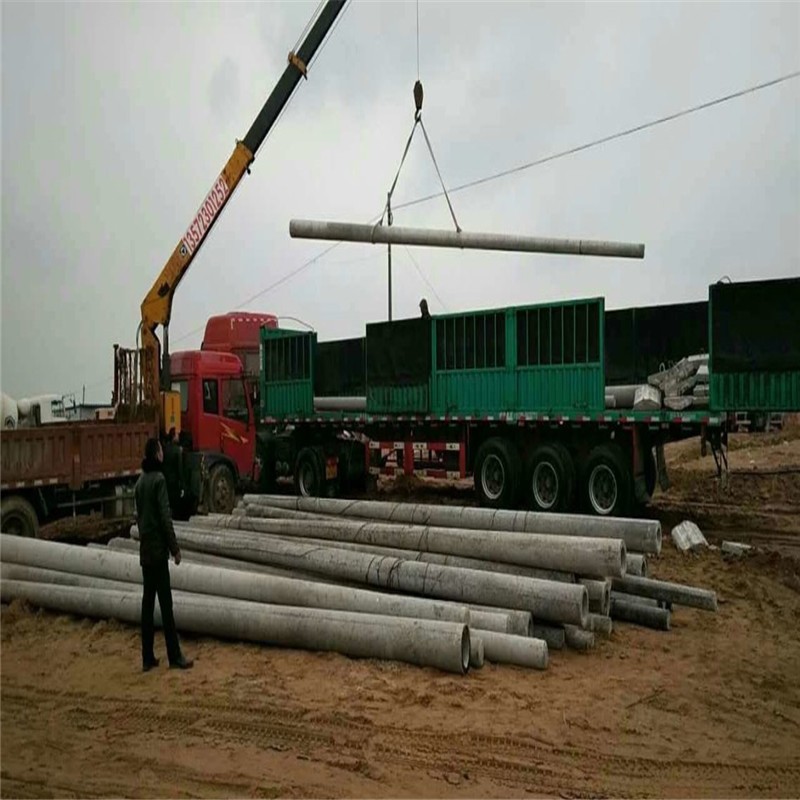
Second, centrifugal casting makes the concrete dense. Concrete utility poles are formed by centrifugal casting. The steel mold rotates at high speed, and the concrete is thrown toward the mold wall by centrifugal force. Excess water and air bubbles are squeezed out, forming a ring-shaped cross-section with uniform wall thickness and a very dense texture. Dense concrete has low porosity, making it difficult for carbon dioxide, chloride ions, and moisture to penetrate. Centrifugal casting also increases compressive strength. Prestressed concrete utility poles usually require a concrete strength grade of no less than C50, higher than the C30 commonly used in general buildings. The higher the strength, the denser the concrete, the better the impermeability, and the slower the carbonation.
Third, prestressing keeps cracks from appearing in time. Concrete has high compressive strength but weak tensile strength. When a pole is subjected to a bending moment caused by wind or conductor tension, the tensile side is prone to cracking. Cracks allow moisture and corrosive media to enter, increasing the risk of steel corrosion. Prestressing technology solves this problem. During manufacturing, high-strength steel wires are pre-tensioned before concrete is poured. After the concrete hardens, the tension is released, and the rebound of the steel wires places the concrete under sustained compressive stress. The tensile stress generated by external loads must first offset this pre-compressive stress before the concrete can crack. Therefore, under normal working loads, the pole hardly cracks. For partially prestressed poles, crack width under standard loads is controlled to within 0.1 mm, blocking the invasion path at its source.
Fourth, strategies are used against carbonation and chloride ion attack. In a general atmospheric environment, carbonation dominates. Engineering practice uses Portland cement with a strength of no less than 42.5 MPa, controls the water-binder ratio below 0.35, uses a high-efficiency water reducer to lower porosity, and provides a steel reinforcement cover of no less than 15 mm, often designed as 17.5 mm in practice. The thicker the cover, the longer it takes for carbonation to reach the steel. In chloride-rich environments such as salt lakes and coastal areas, the attack is more complex. Chloride ions penetrate the cover, destroy the passive film, and once the cover fails, the corrosion rate accelerates. For such environments, mineral admixtures can be added, or ultra-high performance concrete can be used, whose charge passed can be as low as below 40 coulombs, giving it far greater resistance to chloride ion penetration than ordinary concrete.
A service life of more than 50 years is not merely an estimate; there are prediction methods for it. The ISO 15686 series of standards provides factor-based service life prediction, taking into account component quality, design, construction, environment, and maintenance. Practical verification also supports this. Through a large-scale survey of in-service poles, the Japanese electric power industry set the standard service life of concrete utility poles at 65 years, meaning that only after reaching that age does the damage ratio exceed 10%. There are also cases in different regions of poles still in operation after more than 60 years. These data show that under normal design and use conditions, the durability potential of concrete utility poles can exceed 50 years.
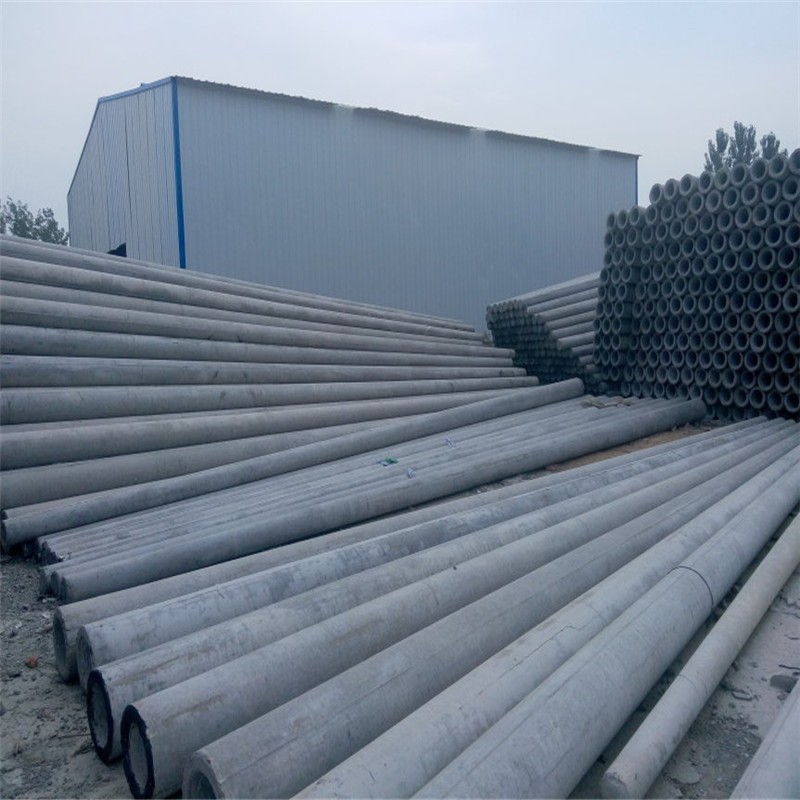
The long life of a concrete utility pole is no accident. Highly alkaline concrete protects the steel, centrifugal casting produces high density, prestressing controls cracks, and durability design adapts to different environments. These four mechanisms work together layer by layer to form a precise assurance system. It is precisely this coordination of engineering principles that allows a concrete utility pole to stand steadily in the outdoor wind and frost for decades, always supporting the current-carrying path.
