



- Publisher:mzadmin
- Published on:2026-09-26
- Pageviews:9819
Structural Parameters and Application Scope of Equal-Diameter Concrete Utility Poles
Equal-diameter concrete utility poles have a constant diameter along their entire length. Unlike tapered poles, which are thick at the base and thin at the top, they rely more on guy-wire support and precise section bending moment calculation. According to GB/T 4623—2014, their diameters mainly cover 300–550 mm, wall thicknesses are usually 30–60 mm, and standard section lengths include 3 m, 4.5 m, 6 m, and 9 m, making it easy to combine them into different pole heights. Because the cross-section does not change with height, the bending resistance of each section of the pole body is constant. During design, the most unfavorable section bending moment must be accurately identified; it cannot naturally attenuate through taper as with tapered poles. This feature gives equal-diameter poles greater advantages in working conditions requiring guy wires or the installation of complex equipment at the pole top.
Reinforcement determines the performance level. Reinforced concrete equal-diameter poles, designated DG, have longitudinal main bars evenly arranged around the annular section, with no fewer than eight bars. Their concrete strength grade is generally not lower than C40, commonly C50. Prestressed concrete equal-diameter poles, designated DY, use high-strength steel wires or strands, and their concrete strength grade is generally not lower than C50. Partially prestressed poles combine the two, improving crack resistance with only a limited increase in steel consumption, but their production process is more complex. For a typical Φ400 equal-diameter pole with a wall thickness of 50 mm and C50 concrete, the main reinforcement consists of 18 Φ14 Grade II deformed steel bars, with a reinforcement ratio of about 0.65%, balancing load-bearing capacity and process feasibility. Manufacturing mostly adopts centrifugal casting, followed by steam curing to obtain dense concrete, and the steel reinforcement cover must meet durability requirements. Mechanical evaluation is based on the cracking inspection bending moment. For a tapered pole with a tip diameter of 190 mm and a length of 15 m, the highest Class J cracking moment is about 42.88 kN·m. Because the equal-diameter pole does not reduce its cross-section, its bending capacity is higher at the same diameter, making it irreplaceable in terminal poles, angle poles, and substation gantries.
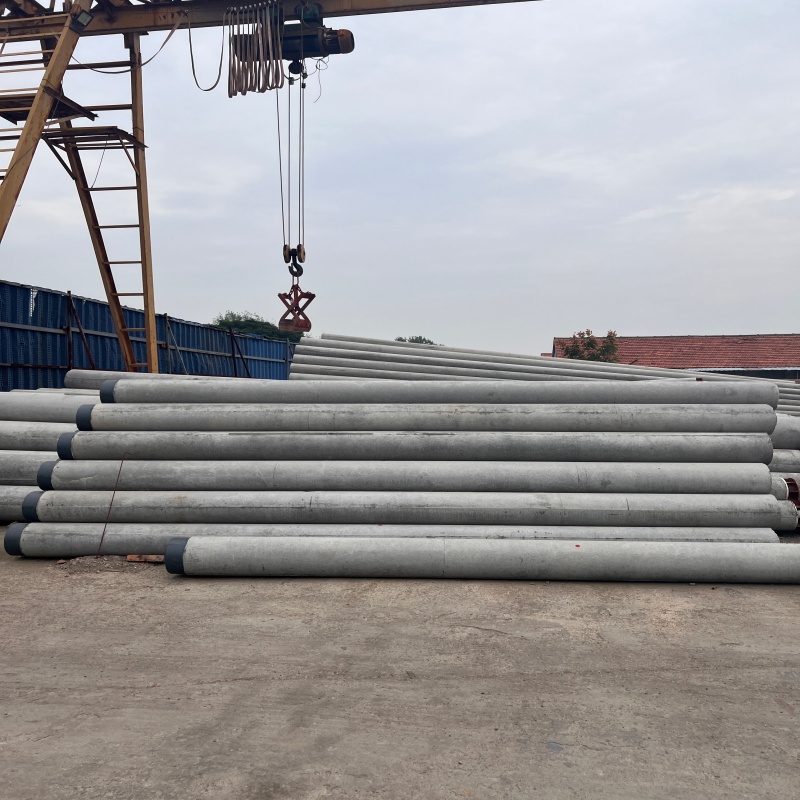
In application, equal-diameter concrete utility poles are suitable for substations of 220 kV and below, as well as 35 kV, 110 kV, and 220 kV lines. Substation gantries require equal height and equal diameter, with standardized connections, and guy-wire space is often limited. The flange connections and fixed-length sections of equal-diameter poles facilitate assembly, modification, and expansion. Common specifications include 300 mm, 9 m with a 12Φ16 lower section and 300 mm, 4.5 m with an 18Φ16 upper section, with reinforcement varying according to load differences. In communications, their extendable nature is utilized: each section is 6 m, and by welding and stacking flange plates or steel plate rings, they form 18 m or 24 m pole bodies. These replace traditional steel towers for mountainous and rural base stations, offering lower investment and a shorter construction period, and wind tunnel tests show resistance to wind speeds of 60 m/s. Communication aerial crossing poles also often use 300 mm equal-diameter poles to withstand additional loads at large crossings. In urban network renovation and temporary lines, equal-diameter poles also reduce life-cycle costs because they can be disassembled and reused.
Overall, equal-diameter poles do not pursue the natural matching of tapered poles. Instead, they trade a constant cross-section and standardized connections for predictable load-bearing and assembly efficiency. When selecting models, one must comprehensively consider load grade, guy-wire conditions, foundation type, transportation, and hoisting capacity. They are suitable for scenarios requiring guy-wire support or complex equipment installed at the pole top. As power grids and communication infrastructure develop toward standardization and modularization, equal-diameter concrete utility poles will still maintain stable applications in specific working conditions.
