

- Publisher:mzadmin
- Published on:2026-09-23
- Pageviews:2487
Protective Mechanism of Concrete Cover on Concrete Utility Pole Structures
The steel reinforcement in concrete utility poles can remain uncorroded over decades of service, mainly because the concrete cover builds a triple protection system: chemical passivation, physical barrier and alkalinity maintenance. Once this system is weakened, steel corrosion becomes unavoidable, and the load-bearing capacity of the pole declines accordingly.
The first role is chemical passivation. Cement hydration produces a large amount of calcium hydroxide, maintaining the pore solution at a strongly alkaline pH of 12.5 to 13.5. Under such conditions, a dense passive film only a few nanometers thick forms spontaneously on the steel surface, mainly composed of oxides such as Fe2O3 and Fe3O4. This film separates the steel from corrosive media and keeps it in a passive state. However, the passive film is not indestructible. Carbon dioxide in the air diffuses along capillary pores and reacts with calcium hydroxide to form calcium carbonate, lowering the pH. When the carbonation front reaches the steel surface, the pH of the pore solution can drop to 8.5 to 9.0, the passive film becomes unstable, and the steel enters electrochemical corrosion. The volume of corrosion products is much larger than that of the original steel, and their expansion cracks the concrete cover. The cracks then provide channels for water and oxygen, forming a vicious cycle. The thicker the cover, the longer the path for carbonation to reach the steel, and the later the time to corrosion initiation.
The second role is physical barrier. The concrete cover has a certain thickness and density, which can delay the ingress of chloride ions, moisture and carbon dioxide. Chloride ions have a small radius and strong activity, can penetrate defects in the passive film and cause localized pitting corrosion, and are not consumed themselves, acting as a continuous carrier of corrosion current. The ability of the cover to retard chloride ingress depends on its thickness and density. Corrosion studies of poles in the tidal flat area of Shengli Oilfield show that increasing cover thickness and improving density can enable pole durability of more than 20 years.
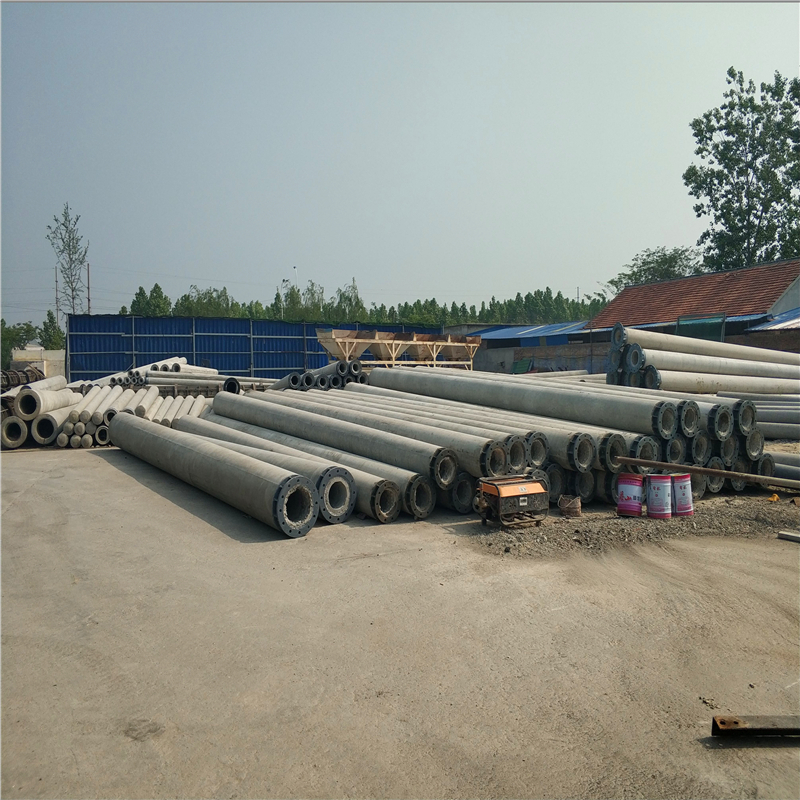
For concrete utility poles, the cover has special significance. Centrifugal molding makes the concrete significantly denser than ordinary cast concrete, so the minimum cover thickness of a pole can be controlled at 15 mm, lower than the 25 mm requirement for general exposed beams and columns. However, centrifugal processing also imposes the constraint of limited wall thickness, so the cover cannot be increased arbitrarily. In actual production, the cover thickness of main reinforcement is usually controlled at no less than 20 mm at the tip, no less than 25 mm at the middle, and no less than 30 mm at the base, with tolerances not exceeding +5 mm/-3 mm. Protective effectiveness must be maximized within the limited thickness through density and alkalinity.
The protective mechanism can be summarized as the triple synergy of chemical passivation, physical barrier and alkalinity maintenance. The alkaline environment is the prerequisite for the existence of the passive film, dense concrete is the material basis for maintaining the alkaline environment over the long term, and cover thickness buys time for the first two. All three are indispensable. Concrete utility poles are exposed to outdoor environments for long periods, enduring sunlight, rain and cycles of temperature and humidity, so carbonation proceeds much faster than in indoor components. Therefore, strictly controlling cover thickness, ensuring concrete density and maintaining curing quality directly determine whether a concrete utility pole can resist steel corrosion within its design service life.
