

- Publisher:mzadmin
- Published on:2026-09-22
- Pageviews:6501
Key Points for Selecting Concrete Utility Poles in Urban Distribution Projects
In urban distribution projects, concrete utility poles are the most basic supporting components. Urban roads are narrow, underground pipe networks are dense, and populations are concentrated, placing higher demands on line safety, construction convenience, and urban landscape. Therefore, when selecting utility poles, price alone should not be the only consideration; pole length, tip diameter, load-bearing type, foundation conditions, appearance quality, and later operation and maintenance must be comprehensively considered.
First, determine pole length and tip diameter. For 10 kV distribution lines, 12 m, 15 m, and 18 m concrete poles are commonly used. A 12 m pole is mostly used for single-circuit lines, while a 15 m pole can be used for single-circuit or double-circuit lines. In terms of tip diameter, Φ190 mm is suitable for single-circuit lines, and Φ230 mm is suitable for double-circuit lines. For low-voltage lines, poles of 10 m or more should be used, and the span should generally be controlled at 40 to 50 m. If the pole length and tip diameter are too small, the conductor-to-ground distance will be insufficient and the load-bearing capacity will be inadequate; if they are too large, costs will increase, and conflicts with underground pipelines, street trees, and buildings may occur.
Second, consider the load-bearing type of the pole. According to the reinforcement method, concrete poles are divided into prestressed, non-prestressed, and partially prestressed types. Prestressed poles have good crack resistance and are mostly used for tangent poles; non-prestressed poles have greater load-bearing capacity and are suitable for angle poles, terminal poles, crossing poles, and other positions with larger loads. Along urban roads, prestressed concrete poles should not be used; angle poles, terminal poles, and crossing poles should use non-prestressed concrete poles. All poles should comply with the national standard GB/T 4623, Ring-shaped Concrete Poles. Foundation configuration is equally important. Concrete poles should be equipped with base plates and clamp plates, and the burial depth should be determined according to geological conditions. Generally, the burial depth of a 12 m pole should be no less than 1.9 m, and that of a 15 m pole should be no less than 2.3 m. Backfill should be compacted every 300 mm. In urban areas, underground pipe networks are intertwined and passages are narrow, so pole foundations should be as compact as possible and avoid gas, water supply, and communication pipelines to prevent mutual interference during construction and operation.
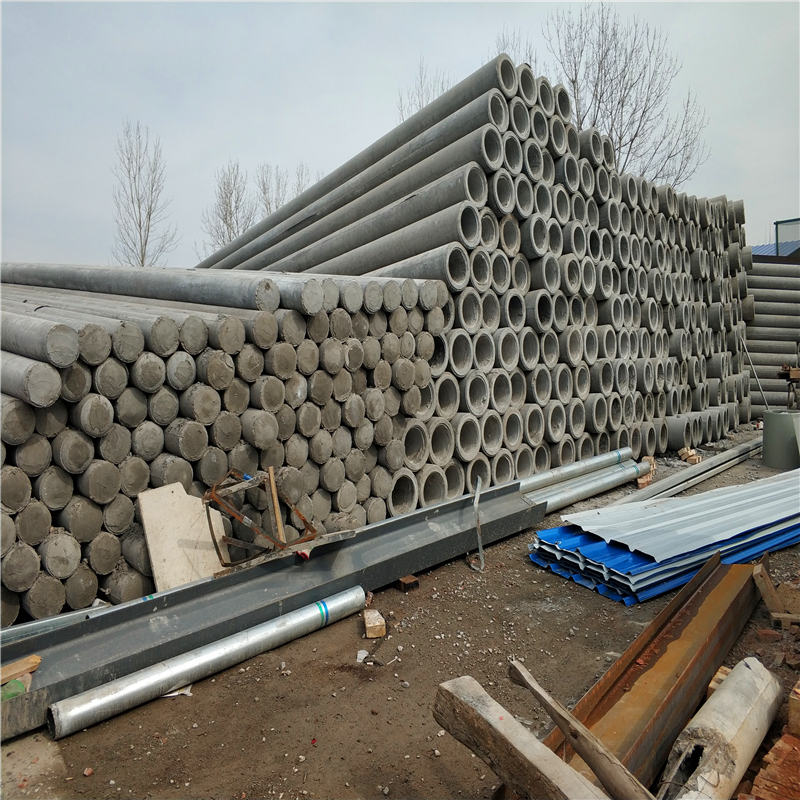
At the intake stage, appearance quality must be strictly controlled. The pole surface should be smooth and flat, with uniform wall thickness, and there should be no defects such as exposed reinforcement, grout leakage, or honeycomb. Ordinary reinforced concrete poles should have no longitudinal cracks, and the width of transverse cracks should not exceed 0.05 mm. The allowable deviation of the overall pole length is from minus 40 mm to plus 20 mm, and the bending of the pole body should not exceed 1% of the pole length. Poles with quality problems must not be used. For pole positions in urban areas where guy wires cannot be installed, ultra-high performance concrete poles or steel poles can be used instead. Ultra-high performance concrete poles have high strength and good durability, making them suitable for heavy-load transmission and distribution lines and areas where transportation and installation are difficult, and helping solve the problem of narrow passages when erecting lines along urban roads. Urban distribution projects should also pay attention to the intensive design of line corridors, follow the principle of "multiple circuits and multiple uses on one pole," improve pole utilization, reduce the number of poles and towers, and better integrate power facilities into urban space.
