



- Publisher:mzadmin
- Published on:2026-09-22
- Pageviews:4288
Inspection of Exposed Rebar in Concrete Utility Poles
Exposed rebar means that the steel reinforcement inside a utility pole is directly exposed to the air because the outer concrete protective layer has fallen off or cracked. Concrete protects the rebar in two ways: first, physical protection, like a hard suit of armor, isolating it from external impact; second, chemical protection. The alkaline environment inside the concrete allows a dense oxide film to form on the surface of the rebar, preventing rust. The dangers of exposed rebar are no exaggeration. After rebar rusts, its volume expands, cracking the concrete that once tightly enclosed it. This causes cracks to grow larger, accelerates the spalling of the protective layer, and creates a vicious cycle. So how do we conduct an "exposed rebar health check" for utility poles? Inspection work is generally divided into two levels: routine patrol inspection and professional testing.
First is routine visual inspection, the most basic and most important step. Inspectors check pole by pole along the line, focusing on the "key parts" of the pole: the base near the ground, the groundwater level fluctuation zone above ground, and areas with cracks or damage on the pole body. During inspection, carefully observe whether there are rust-colored water stains or rust spots on the concrete surface; these are early signals of internal rebar corrosion. At the same time, use hands to touch or binoculars to check whether there is concrete spalling, exposed rebar, and whether the exposed rebar has already shown obvious corrosion or a reduced cross-section. For exposed rebar near the ground, also check whether the rebar is being corroded more rapidly by moisture and chemicals in the soil.
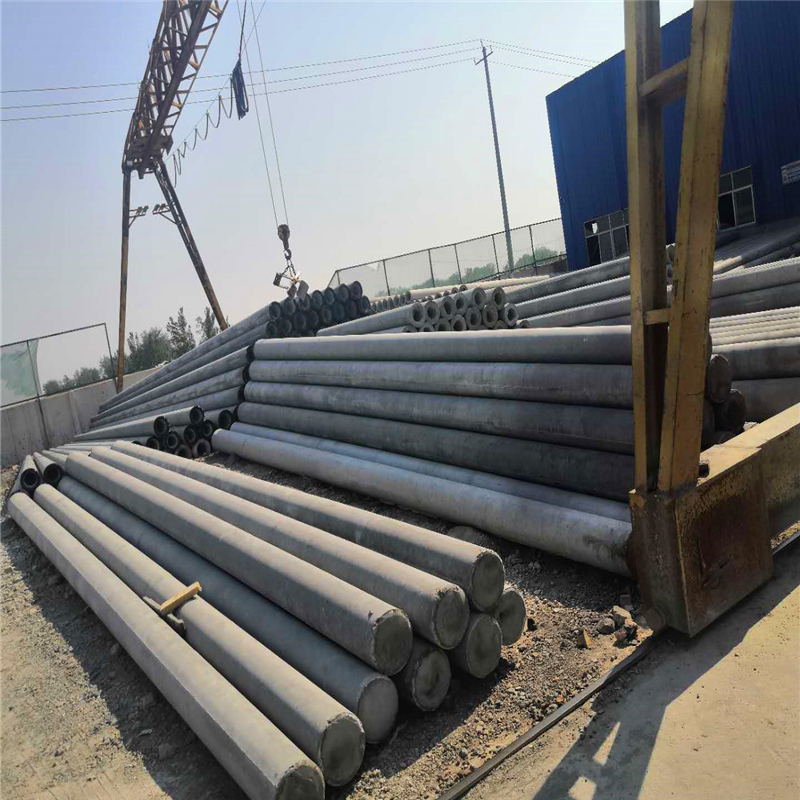
Second is professional instrument testing. When visual inspection finds suspected problems or when safety assessment is needed for old utility poles, more sophisticated equipment is required. For example, a rebar corrosion meter can be used to measure the resistivity or potential difference of the concrete to determine the corrosion activity of the internal rebar; a rebound hammer or ultrasonic detector can be used to assess the concrete strength and protective layer thickness and determine whether it still has sufficient load-bearing capacity. For rebar that is already exposed, a vernier caliper is also used to measure the remaining diameter of the rebar and calculate its cross-sectional area loss rate, thereby scientifically determining whether the pole can still remain in service or must be replaced immediately.
After inspection comes handling. For minor exposed rebar and early corrosion, the usual practice is to chisel away loose concrete, remove rust and apply anti-rust treatment to the rebar, and then use high-strength repair mortar to restore the protective layer. For utility poles with severe exposed rebar, rebar cross-sectional loss exceeding a certain proportion, and strength that cannot be restored through repair, they must be resolutely replaced; no one should take chances. The safety of utility poles concerns the stability of the power grid and, more importantly, the life safety of every person.
