



- Publisher:mzadmin
- Published on:2026-09-21
- Pageviews:2575
How Are Joints of Concrete Utility Poles Handled?
A concrete utility pole is often limited by length during transportation and construction, so it needs to be manufactured in segments and spliced on site. The joint is the weak link of the entire pole. Improper handling will directly weaken its load-bearing capacity and may even cause a pole collapse accident.
At present, the splicing of concrete poles in engineering mainly adopts steel ring welding. The steel rings are embedded in the ends of the pole segments. During splicing, the two steel rings are aligned and centered, with a weld gap of 2 to 5 mm left in between, and the misalignment should not exceed 2 mm. Arc welding is preferably used. Before welding, rust and dirt at the weld gap and nearby areas must be removed. The operation must be carried out by a qualified welder, and after welding, the welder's stamp code must be marked at the specified position for traceability. When the steel ring thickness is greater than 6 mm, a V-shaped groove is required for multi-layer welding. The joints of multi-layer welds should be staggered, and the crater should be filled when closing the weld. The weld should present a smooth fine fish-scale pattern with a certain reinforcement bead, and there must be no defects such as cracks or lack of fusion on the appearance.
The most intuitive inspection indicator of welding quality is bending degree. After welding, the pole is placed on the ground for inspection. The bending of both the segment and the whole pole should not exceed 0.2% of the corresponding length. If the limit is exceeded, it must be cut off, straightened, and rewelded. Statistics show that for every 20 joints welded, about 1 exceeds the bending tolerance, and reworking one joint takes about 2 to 3 times the time of normal welding. This indicator is so strict because bending introduces an additional bending moment, causing the joint to bear greater stress than the design value under actual loading.
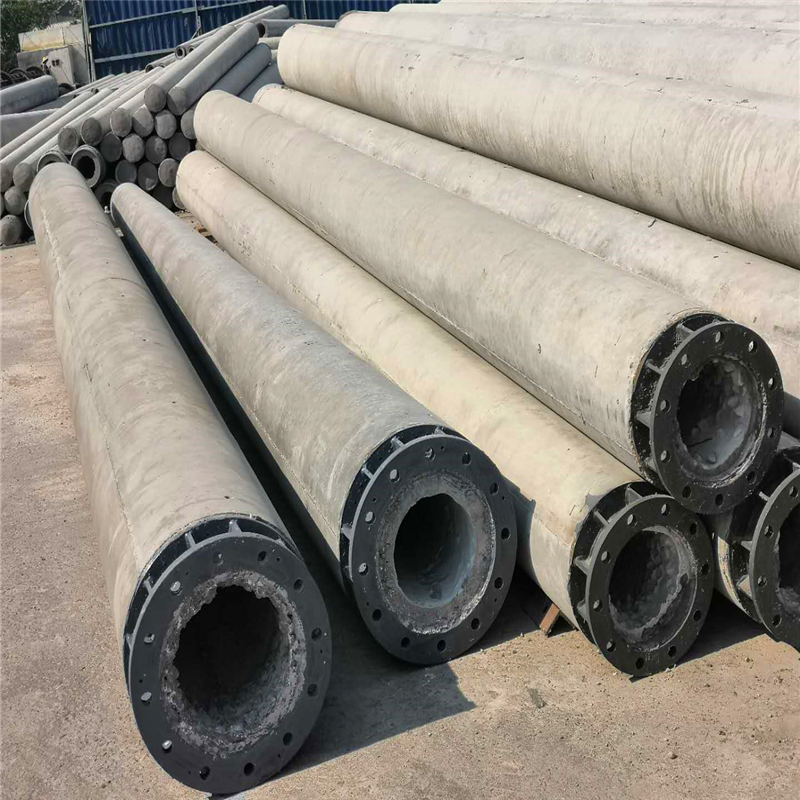
The strength requirement of the joint is equally clear: the joint strength must not be less than 95% of the section load-bearing capacity at the joint. The connection between the main reinforcement and the connector should be welded, and the welding quality must comply with the corresponding specifications. For prestressed concrete utility poles, the force mechanism of the joint is more special. Test studies show that under bending load, the failure mode of prestressed concrete pole joints is mostly tensile cracking of concrete while the joint steel ring does not yield, showing brittle failure characteristics. The strain of the joint steel ring roughly conforms to the plane section assumption. Based on serviceability limit state design, the pole has an average safety margin of about 1.2 from collapse failure. This means that the joint design itself has a margin, but once the steel ring corrodes or the weld has defects, the margin will be rapidly consumed.
Joint anti-corrosion is another key link. The steel ring and weld are exposed to the atmosphere for a long time and are the first part of the entire pole to corrode. Operating experience shows that the steel rings and flanges at pole joints are relatively severely corroded. For early flange structures, rust removal is difficult, and the corrosion rate is faster. Anti-corrosion treatment is usually divided into two steps: after welding and cleaning the welding slag and oxide layer, apply anti-rust paint or carry out anti-corrosion treatment according to design requirements; in areas with severe corrosive environments, epoxy glass fiber reinforced plastic can be used to wrap the steel ring and the connection between the concrete and the steel ring, using glass fiber cloth as the reinforcing material and resin as the adhesive to form an anti-corrosion layer that blocks water vapor. In recent years, some technical solutions have added an external fastening hoop with a conical flow guide platform at the joint, using a sealing arc groove to prevent external water vapor from entering the connection surface, thereby delaying corrosion from the source.
