



- Publisher:mzadmin
- Published on:2026-09-21
- Pageviews:9165
How Is the Load-Bearing Capacity of a Concrete Utility Pole Calibrated?
The load-bearing capacity of a concrete utility pole is not a simple "how many kilograms" figure, but a set of technical parameters determined jointly through design calculations and destructive tests. Load-bearing capacity calibration is a bridge connecting design theory and engineering safety. Only poles that have undergone rigorous test verification and field evaluation can steadily support the lifeline of the power grid during long-term operation.
In the design stage, engineers first calculate the loads that the pole body will bear in actual operation according to line span, conductor type, local wind speed and ice-coating conditions. These loads include conductor self-weight, wind pressure, ice weight, broken-conductor tension, etc., and are ultimately converted into the maximum bending moment borne at the pole root. Based on this bending moment, the reinforcement scheme, concrete strength grade and pole body dimensions are determined. Taking a common 190 mm tip-diameter non-prestressed concrete pole as an example, the proof bending moment of a 10 m pole is about 87 kN·m, that of a 12 m pole is about 117 kN·m, and that of a 15 m pole can reach 147 kN·m. These values come from structural calculations, not empirical estimates.
After the design values are determined, they must be verified through mechanical property tests. According to the national standard for circular concrete poles, tests are usually carried out after 28 days of curing. The pole root is fixed in a horizontal cantilever manner, and a tensile force perpendicular to the pole axis is applied at a point 600 mm from the pole top. Load, deflection and crack width are recorded in real time through load sensors and displacement meters. Loading is divided into three steps: first, preloading with one small load level to check the device and instruments, then unloading to zero; second, increasing the load step by step according to a certain proportion of the proof bending moment, holding each level for 3 to 5 minutes, and taking readings after deformation stabilizes; finally, continuing to load up to the load-bearing capacity proof bending moment or even higher, observing crack development until the specimen fails.
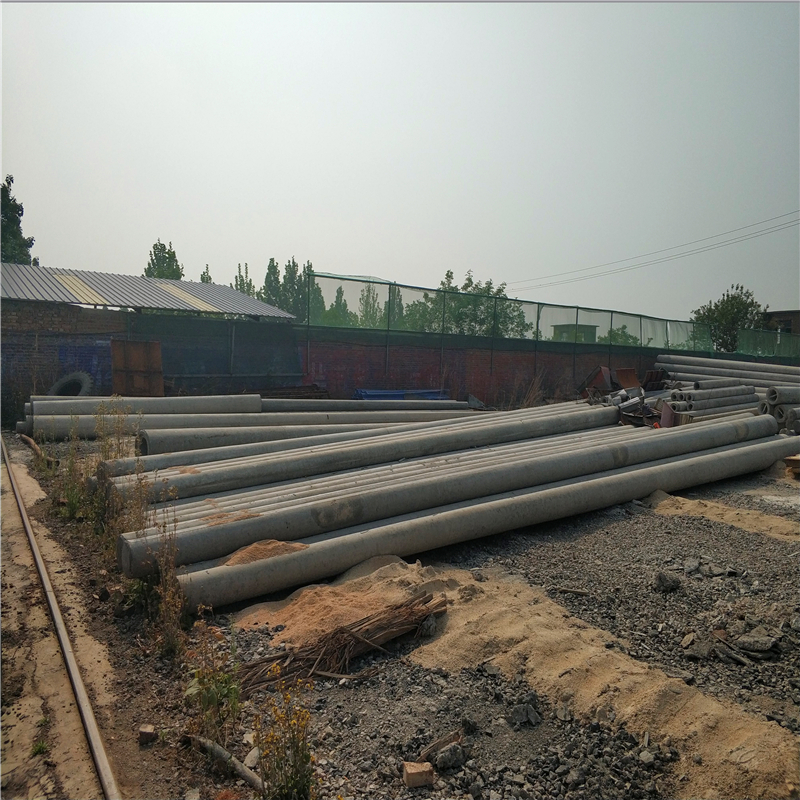
Three core indicators must be judged in the test. The cracking resistance proof bending moment requires that the pole show no visible cracks under the specified load, which is the bottom line for ensuring durability. The load-bearing capacity proof bending moment requires that under this bending moment, the crack width in the tension zone not exceed 0.20 mm, and that neither crushing of concrete in the compression zone nor tensile rupture of reinforcement occur. Deflection requires that the pole-top displacement be controlled within the range allowed by the standard; excessive deflection means insufficient stiffness and will affect the electrical safety distance of the line.
For prestressed concrete poles, the calibration logic has additional considerations. Prestressing tendons establish compressive stress in the concrete in advance, so that when the pole bears external loads, the prestress must first be offset before tensile stress is generated. Therefore, its cracking bending moment is significantly higher than that of an ordinary reinforced-concrete pole of the same specification. However, once the prestressing tendons corrode or their anchorage fails, the load-bearing capacity drops sharply, and calibration must pay special attention to whether the effective prestress meets the standard. For old poles already in operation, the actual load-bearing capacity is often lower than the design value due to concrete carbonation, reinforcement corrosion and loose foundations. Field calibration usually adopts non-destructive methods, such as applying a certain horizontal force and measuring pole-top displacement to back-calculate the current stiffness, then combining visual inspection and material testing to comprehensively evaluate the residual load-bearing capacity.
