



- Publisher:mzadmin
- Published on:2026-09-16
- Pageviews:5174
How to Choose the Length of a Concrete Utility Pole
Concrete utility poles all look like "just a pole," but why are some 8 meters, some 12 meters, and some even 15 meters? Choosing the length is not a decision made off the top of one's head — it is an addition problem made up of five variables.
The total length of a concrete utility pole equals the burial depth plus the above-ground portion. Burial depth is the first variable, and also the easiest to remember: it is generally calculated as one-sixth of the pole length, and this "one-sixth burial" rule applies to poles under 15 meters, but the shallowest must not be less than 1.5 meters. An 8-meter pole is buried 1.5 meters, a 10-meter pole 1.7 meters, and a 12-meter pole 1.9 meters — this correspondence has a fixed table in construction manuals. The burial depth of transformer platform poles and load-bearing poles must be increased further, to no less than 2 meters. The above-ground portion involves four accounts to calculate. The distance from the crossarm to the pole top is the first: for low-voltage lines in horizontal arrangement it is about 0.3 meters, while for triangular arrangement it is 0.6 to 0.9 meters — the higher the voltage level and the more complex the arrangement, the greater this margin. The second is the distance between crossarms: when multiple circuits are erected on the same pole, the vertical spacing of each layer of crossarms has mandatory regulations, and the higher the voltage, the greater the spacing. The third is conductor sag. Conductors naturally droop between two poles, and this droop must be calculated according to the maximum sag when determining pole height, not according to the slack state at normal temperature. For low-voltage lines at a 45-meter span, the sag is about 0.6 to 0.75 meters, and the larger the span, the greater the sag. The fourth is the safety distance from conductors to the ground, which is the bottom line of bottom lines: for 10 kV lines in residential areas it is required to be no less than 6.5 meters, and for low-voltage lines no less than 6 meters.
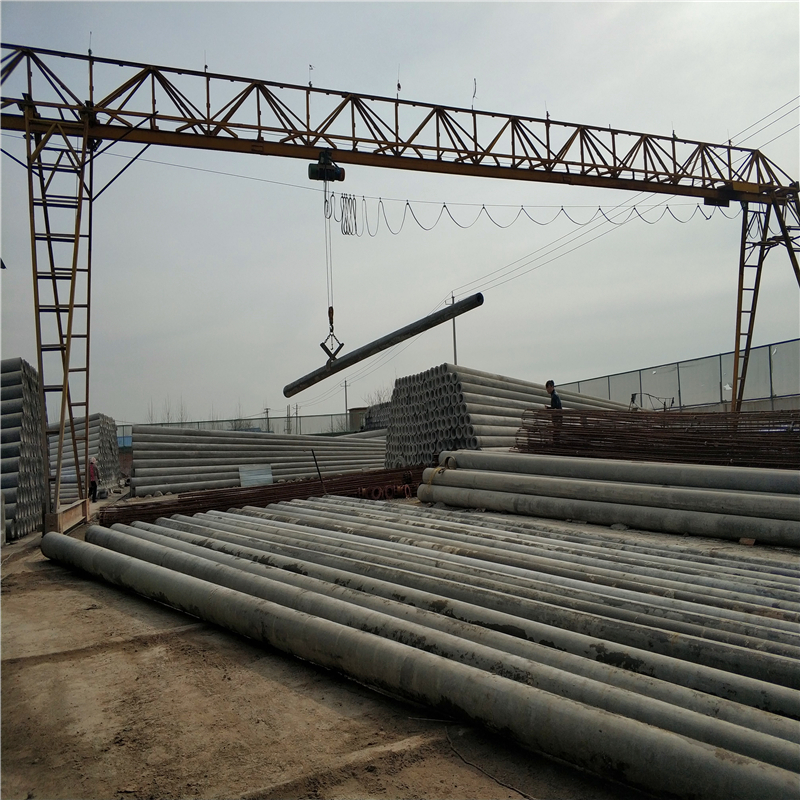
Adding these figures together allows one to work backward to determine what length of pole to choose. Rural low-voltage lines generally use 8-meter poles, which is sufficient; if there is a road crossing, a need to attach streetlights, or multiple layers of lines, then it must be upgraded to 10 meters. High-voltage distribution lines start at 10 meters, and crossing poles or poles with high- and low-voltage lines erected together use 12 meters or even higher. The 12-meter concrete utility pole commonly seen in cities is actually the standardized choice after calculating the accounts of "1.9 meters buried + crossarm spacing + sag + 6 meters to ground." Therefore, choosing pole length is essentially choosing a safe corridor between the lowest point of the conductor and the ground. The wider the corridor, the taller the pole required, and the deeper it must be buried.
