

- Publisher:mzadmin
- Published on:2026-09-16
- Pageviews:917
Packaging Methods for Exporting Concrete Utility Poles
A concrete utility pole, from leaving the factory to arriving at an overseas construction site, often has to go through at least three transshipments: land transport, port storage, loading onto the ship, ocean shipping, unloading, and then land transport again. Every lifting and transfer operation is a potential source of damage to the pole body. Under the traditional export model, the damage rate of concrete utility poles once reached as high as 30% to 40%. This means that out of every ten poles shipped, three to four could be scrapped en route. Export packaging methods are the technical means that exist to solve this pain point.
The export transportation of concrete utility poles is first constrained by container dimensions. The internal length of a standard international container is usually about 11.9 meters, so concrete utility poles under 12 meters (such as the 11.65-meter specification) can be loaded directly into containers for transport. Poles exceeding this length can only be shipped in bulk on bulk carriers, and bulk shipping precisely places higher demands on the robustness of packaging. This is because on a bulk carrier there is no rigid outer shell of a container to provide protection, and the pole body directly faces wave-induced tossing and lifting collisions. At present, the most mature mainstream solution in the industry is channel steel frame packaging. Its structural logic is to weld channel steel into a square frame, wrap the pole body inside the frame with curved wood wedges or rubber pads, and fix the round concrete utility pole embedded in the frame. The technical value of this design lies in two aspects: first, it transforms the easily rolling cylinder into a square unit that can be stably stacked, fundamentally eliminating the risk of free rolling during transport; second, the curved wrapping layer simultaneously acts as a shock absorber and buffer, reducing the probability of pole body cracking caused by collisions. The channel steel material itself is sturdy and durable, capable of bearing the weight of multi-layer stacking, and has become a widely recognized standard packaging in international projects.
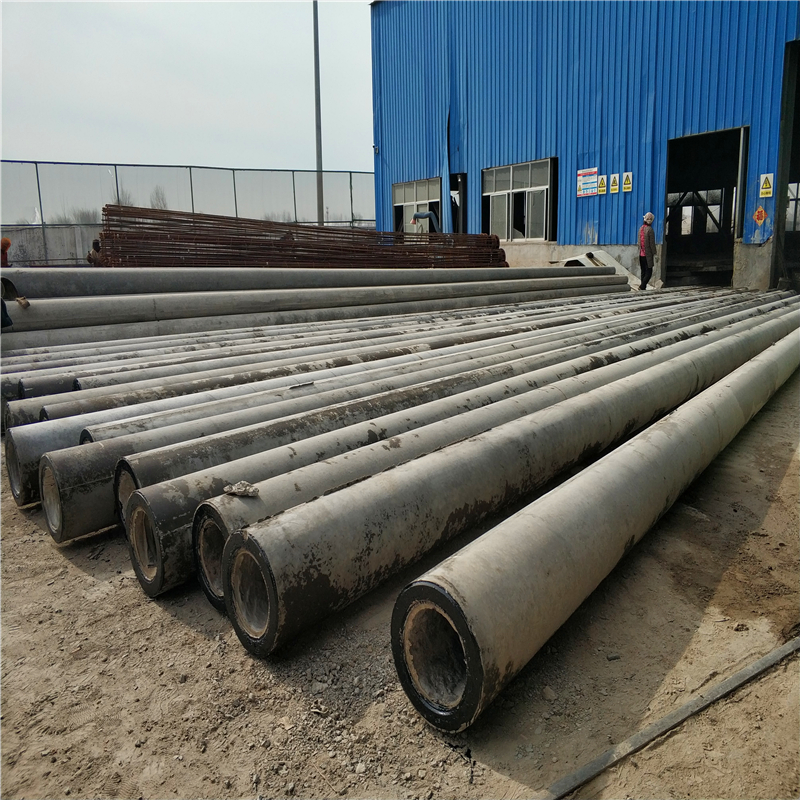
Another more economical solution is simple bundling with steel wire ropes or packaging straps. This method is low in cost and fast to operate, but its robustness factor is insufficient, and during long-distance ocean shipping it is prone to loosening of the bundles and scattering of the poles due to tossing. Therefore, it is usually only suitable for short-distance land transport or scenarios with a high tolerance for damage, and it has gradually been phased out in export ocean shipping. The manufacturing process of packaging frames is also continuously iterating. Zhejiang Yongda Electric Power Industrial Co., Ltd. once developed a wrap-around anti-rolling and anti-cracking packaging frame targeting the defects of traditional straw bundling packaging and obtained a patent for it. This packaging frame forms contracting tension on the pole body through curved wood wedges, so that the pole body is always wrapped flatly and tightly, and the anti-cracking effect during transport is significantly improved. In practical application, the company's export of tens of thousands of concrete utility poles to Angola achieved zero damage. It is worth noting that the choice of packaging solution also needs to take into account the quarantine regulations of the importing country. If wooden frames or wood dunnage are used, they must undergo fumigation treatment and be marked with pest control treatment labels; otherwise, they may be refused entry at the destination port or required to be re-treated. This is also one of the reasons why more and more export projects are turning to metal packaging frames such as channel steel, which both avoids the quarantine threshold of wooden packaging and achieves higher structural strength.
