

- Publisher:mzadmin
- Published on:2026-09-14
- Pageviews:1074
How to Inspect the Quality of Concrete Utility Poles
The first step is visual inspection. Inspectors examine each pole's surface one by one: prestressed poles are not allowed to have any circumferential or longitudinal cracks, while ordinary reinforced concrete poles may have minor circumferential cracks, but the width must not exceed 0.05 mm. The joint seam must not leak slurry, the pole body must not expose steel reinforcement, and the outer surface must not have honeycombing. Some minor defects can be repaired before use, such as pitting with an area not exceeding 5% of the surface area per meter of length, or local impact damage with a depth not exceeding 10 mm, but the repaired pole must still meet service requirements. Visual inspection relies on experience and standards — a skilled inspector can tell at a glance from the slurry marks at the joint seam whether the pole was "evenly formed" during centrifugal casting.
Dimensional deviations are judged with tools. The allowable deviation for the overall length of a pole is "-40 mm to +20 mm," the outer diameter deviation is controlled within -2 to +4 mm, and the wall thickness deviation is -2 to +10 mm. These figures may seem lenient, but they actually force the production process to be precise: uneven material distribution during centrifugal casting, mold wear, or concrete shrinkage — any problem in any step will make the dimensions "speak."
What truly determines a pole's fate is its mechanical performance. Once erected, a pole mainly bears lateral bending moments from wind, as well as longitudinal loads from conductors and fittings. During testing, the pole is mounted on supports like a cantilever beam, and then load is applied gradually at the tip. Three key checkpoints are critical: first, when loaded to the "cracking test moment," prestressed poles must not develop cracks, and the crack width in ordinary reinforced concrete poles must be less than 0.20 mm; second, after unloading, residual cracks must not exceed 0.05 mm; third, when loading continues to the "ultimate load test moment," the pole must not show tensile steel rupture, crushing of concrete in the compression zone, or deflection exceeding specified limits. Only a pole that survives these three tests qualifies as structurally sound.
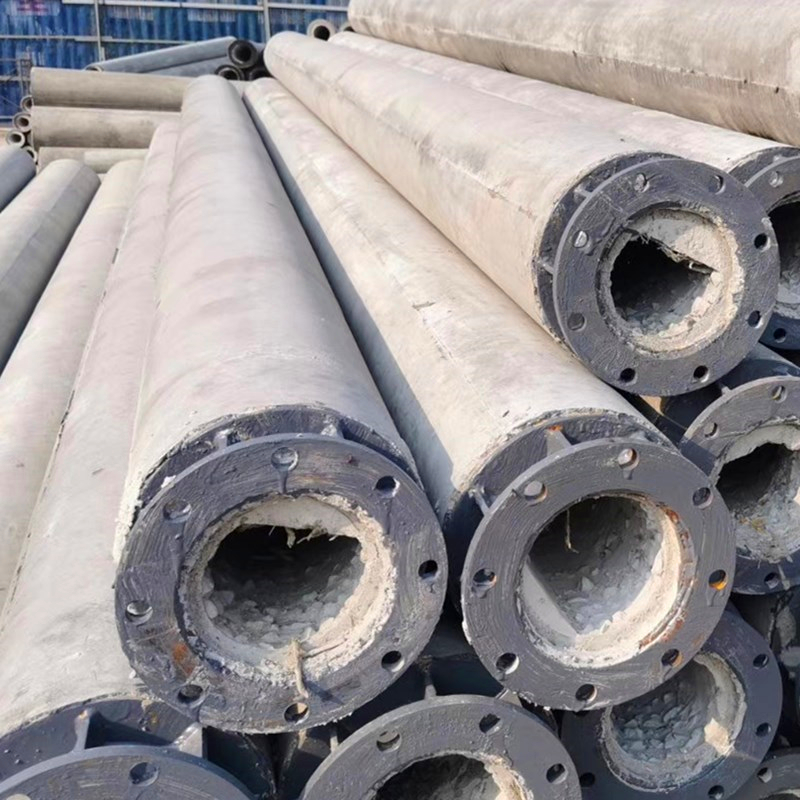
Concrete strength and steel reinforcement cover are the foundation behind it all. The compressive strength of pole concrete is typically required to be no less than 40 MPa, and high-strength poles may even require C60 or above. The thickness of the concrete cover over the steel reinforcement must not be less than 20 mm — this is the first and most important barrier against steel corrosion. If the cover is too thin, the steel will soon be "pushed open" by rust expansion; the pole may look intact on the outside, but it has already loosened inside.
