

- Publisher:mzadmin
- Published on:2026-09-11
- Pageviews:9128
Why Are Power Poles Made Tapered?
Cement power poles can be seen everywhere along the roadside, and almost all of them are tapered—thicker at the bottom and thinner at the top—rather than cylindrical with a uniform diameter from top to bottom. This seemingly inconspicuous design actually embodies multiple considerations involving mechanics, materials, and construction. The core reason is force. A power pole stands on the ground and mainly bears wind loads and conductor tension. These forces act on the top of the pole and the crossarm, and are transmitted downward through the pole body. The closer to the ground, the greater the bending moment it bears. In other words, the base bears the most stress, while the tip bears the least. If it were made into a uniform cylinder, the entire pole would have to be reinforced according to the maximum stress at the base in order to meet the strength requirements there, and the tip would waste material. When made tapered, with a thick base and a thin tip, it exactly follows the pattern of bending moment decreasing from bottom to top, using material where it is most needed, saving material and reducing self-weight.
Second, it is related to the manufacturing process. Cement poles generally use centrifugal molding: a steel reinforcement cage is placed into a steel mold, concrete is poured in, and the steel mold is rotated at high speed. Under centrifugal force, the concrete adheres to the mold wall and is densely formed, naturally creating a hollow cavity in the middle. If the pole body were of uniform diameter, the friction between the entire pole and the mold during demolding would be large, and the surface would easily be damaged. When made tapered, the diameter at the tip is smaller, so demolding resistance is lower, and lifting and transportation are also more convenient. In addition, there is stability. A power pole is buried underground and fixed by its foundation and the surrounding soil. A tapered pole has a lower center of gravity and a larger cross-section at the base, giving it stronger resistance to overturning. With the same burial depth, a tapered pole is harder to pull out or push over than a uniform-diameter pole, especially for pole positions under greater stress such as angle poles and terminal poles.
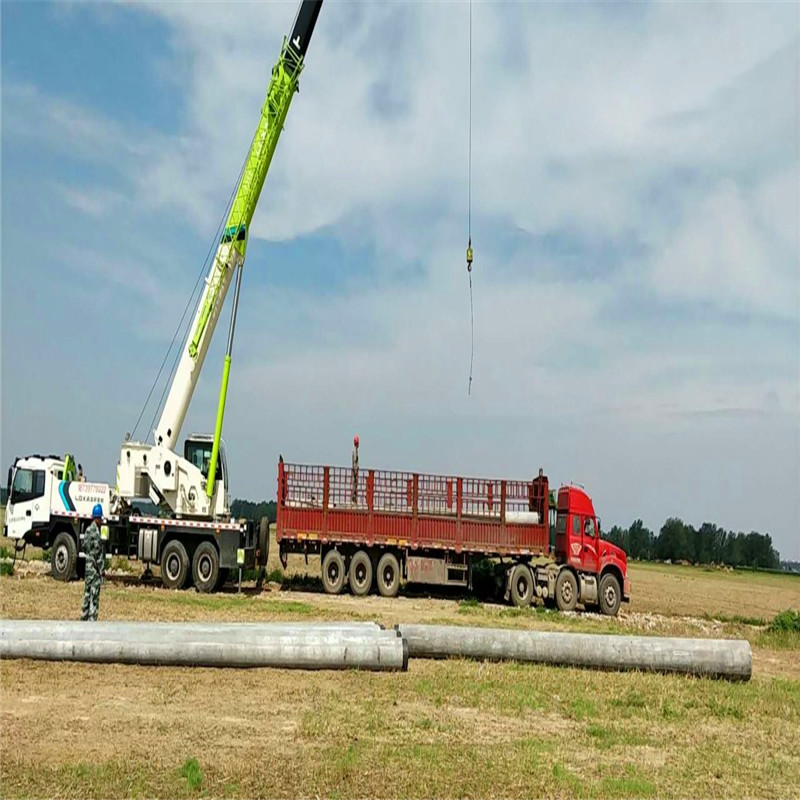
From an economic perspective, tapered poles are lighter in self-weight and use less steel and concrete, and transportation and hoisting costs also decrease accordingly. For distribution network projects involving thousands upon thousands of poles, this saving becomes quite considerable when accumulated. Of course, tapered does not mean the more tapered the better. If the taper is too small, the material-saving effect is not obvious; if the taper is too large, the tip becomes too thin, and its strength is insufficient when installing crossarms and insulators. Therefore, national standards specify the tip diameter, root diameter, and taper. A common taper is about 1:75, that is, for every 1 meter downward, the diameter increases by more than ten millimeters. This ratio is the result of repeated trade-offs among strength, process, and construction convenience. Therefore, making power poles tapered is not an aesthetic choice, but the result of the combined action of force patterns, centrifugal process, stability, and cost.
