



- Publisher:mzadmin
- Published on:2026-09-08
- Pageviews:2375
The Dialectic of Rigidity and Flexibility: An Analysis of the Underlying Causes of Concrete Pole Bending
In the vast network of power transmission, concrete poles are the most common yet often overlooked cornerstone. They stand tall in open fields and mountains, enduring wind, rain, and temperature fluctuations. However, an engineering phenomenon that cannot be ignored is that some poles undergo bending deformation during service. This is not merely a change in geometric form, but involves deeper principles of materials science, structural mechanics, and manufacturing processes.
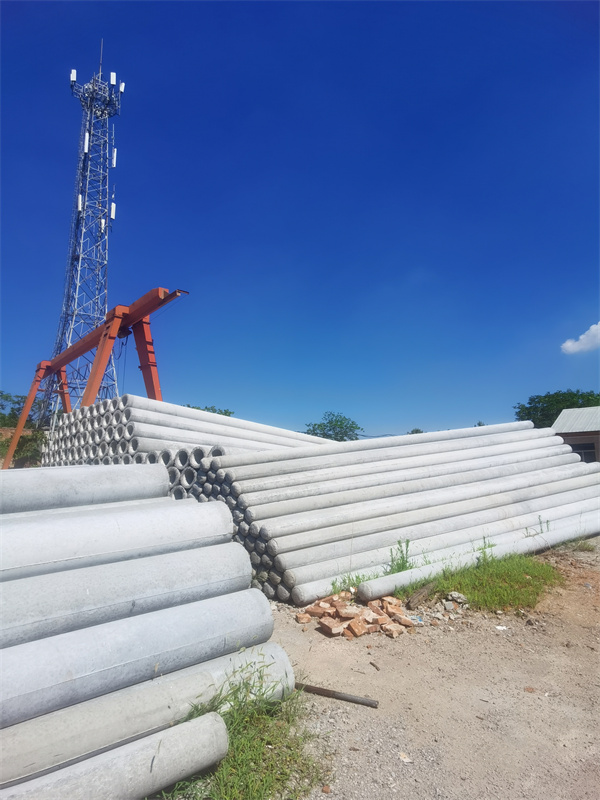
Mechanical Properties and External Loads
From the perspective of structural mechanics, a concrete pole is essentially a typical cantilever member. With its base fixed, the shaft bears the combined effects of wind loads, conductor tension, and its own weight. Studies have shown that for the widely used tapered hollow poles, when subjected to a concentrated load at the free end, the maximum normal stress does not appear at the base, as intuition might suggest, but often occurs at the mid‑span or upper‑mid section of the shaft. This means that if there is a weak point in the material strength at that location, microscopic damage may first appear at this peak stress point, and over time, accumulate into macroscopic bending deformation.
Prestress and Internal Defects
The internal root causes of bending are often deeply embedded in the production process. In the manufacture of prestressed poles, the length error of high‑strength steel wires during cutting is the primary factor leading to shaft bending. If the prestressing steel wires within the same pole are of unequal length, the resulting prestress after tensioning will be uneven. When this unbalanced internal force is released after concrete hardening, it directly causes the pole to bend toward the side with lower stress. In addition, if the steel reinforcement cage itself has material quality issues, such as steel corrosion or insufficient strength, it cannot provide adequate skeletal support for the pole. Under long‑term loads, the pole may undergo plastic deformation due to inadequate structural integrity.
Physical Erosion and Chemical Attack
The harsh outdoor environment serves as a catalyst for pole bending. Long‑term infiltration of rain and moisture is a major trigger. When micro‑cracks develop on the pole surface due to temperature changes or loading, water seeps into the interior through these fissures. This not only softens the concrete material but also corrodes the internal steel reinforcement. The expansion of corroded steel increases volume, further aggravating concrete cracking, forming a vicious cycle of "cracks – water ingress – corrosion – crack propagation." This ultimately reduces the overall stiffness of the pole, making it prone to bending under external forces.
