



- Publisher:mzadmin
- Published on:2026-09-07
- Pageviews:9424
The More Steel Reinforcement in a Concrete Utility Pole, the Higher Its Strength?
First, we need to clarify the concept of "strength." What the general public often understands as "strength" is typically a vague notion of "robustness," but in structural engineering, it is subdivided into compressive strength, flexural strength, shear strength, and so on. Concrete naturally excels in compression, yet its tensile capacity is extremely weak and it is highly prone to cracking. The role of steel reinforcement is precisely to be embedded in the tensile zone of the pole to compensate for concrete's shortcomings. Does adding steel reinforcement without limit significantly enhance the ultimate load-bearing capacity of the pole? The answer is no—and it can even be counterproductive. What truly determines the strength of a utility pole is the scientific "reinforcement ratio" and a reasonable "prestressing" strategy. Modern high-strength poles largely adopt prestressing technology, which involves tensioning the steel bars before casting concrete, so that the concrete is subjected to pre-compressive stress, thereby actively counteracting the tensile stresses induced by external loads. This design achieves higher crack resistance and load capacity with less steel—and that is the essence of the engineering technique. This involves two core engineering principles: "over-reinforced failure" and "composite action."
First, regarding "over-reinforced failure." When a utility pole withstands fierce winds or cable tension, it behaves like a cantilever beam. As the external load gradually increases and eventual failure occurs, the ideal failure mode should be: the steel in the tensile zone is first stretched to the point of permanent deformation but not rupture, which then causes the concrete in the compression zone to be crushed. This "tension-first, compression-later" failure process is slow and provides warning signs—it is a "ductile failure." However, if too much steel reinforcement is provided, the neutral axis shifts downward, and the compressive stress in the concrete compression zone soars sharply. At this point, the steel has not yet approached its tensile capacity, yet the brittle concrete has already been crushed abruptly, causing the pole to snap instantaneously. This "over-reinforced failure" gives no warning whatsoever and is a major taboo in structural design. Therefore, more steel is not always better—there is a "maximum reinforcement ratio" red line that must not be crossed.
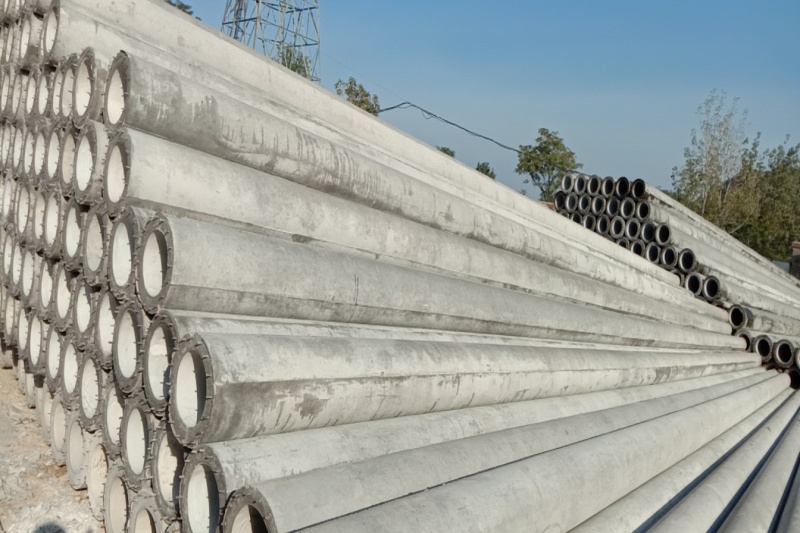
Second, regarding "composite action" and economy. The reason concrete and steel can work together effectively relies on their similar coefficients of thermal expansion and the bond strength between them. However, excessive reinforcement makes the cross-section too congested; the concrete cannot be adequately compacted by vibration, and the bond between aggregate and cement paste actually deteriorates, leading to internal micro-voids and defects. This not only weakens the concrete's own compressive strength but also reduces the anchorage force between the steel and the concrete. In other words, when there is too much steel, the concrete cannot "grip" it properly—the two materials act independently rather than forming an effective composite material. From an economic standpoint, steel is far more expensive than concrete. Blindly increasing the rebar content only drives up costs, while the pole's load capacity hits a bottleneck—or even regresses—due to over-reinforcement.
