



- Publisher:mzadmin
- Published on:2026-09-05
- Pageviews:9436
How Long Does It Take to Manufacture a Concrete Utility Pole?
From the perspective of the complete production process, the manufacturing of concrete utility poles primarily involves several core steps: steel reinforcement cage fabrication, concrete batching and mixing, mold assembly and grouting, centrifugal forming, steam curing, demolding, and subsequent natural curing. The preliminary operations—such as steel bar cutting, heading, rolling and welding into cages, mold assembly, concrete pouring, and centrifugal rotation—are highly efficient on modern automated production lines. Relying on mature mechanized processes, the entire forming operation typically takes only a few hours. In fact, leading production workshops in the industry can achieve a cycle as fast as six minutes per pole, from mold assembly to centrifugal forming completion.
The real determining factor in the overall production cycle is the curing process. After forming, the pole must undergo sufficient curing so that the concrete strength can steadily increase to its designed specifications. Currently, regular manufacturers generally adopt steam curing to accelerate this process. After the pole is placed into the curing kiln with its mold, four stages must be strictly executed: pre‑curing (static resting), heating, constant‑temperature holding, and cooling. Taking a typical steam‑curing regime as an example, the temperature is first raised evenly over one hour, then maintained at approximately 90°C for three hours, followed by one hour of cooling. The entire steam‑curing cycle takes about five hours. The purpose of steam curing is to rapidly enhance the early strength of the concrete, allowing the molds to be turned over sooner for the next production batch—this is a key technical measure to ensure supply efficiency.
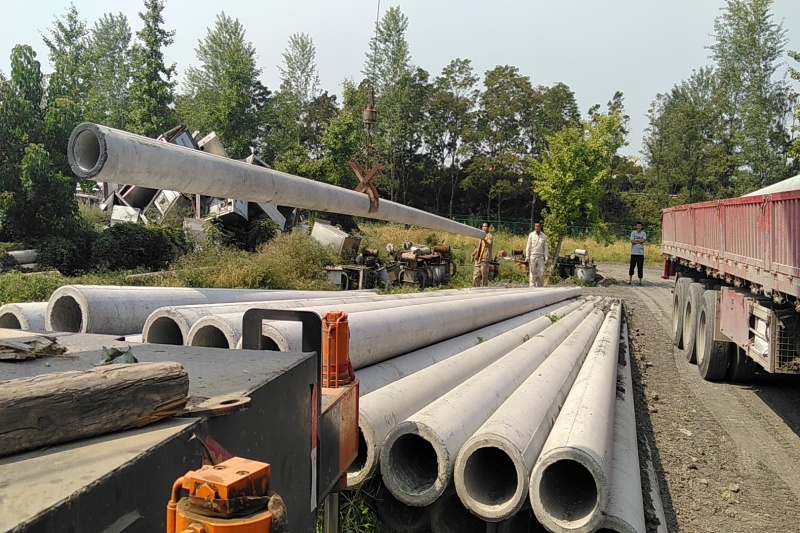
However, once the steam curing is completed and the pole is demolded, the production cycle is not yet finished. At this point, the concrete strength usually reaches about 80% of its design strength. Although it already possesses some structural capacity, there remains a gap before reaching the peak design strength. After demolding, the poles must continue to undergo moisture curing or water‑ponding curing in the finished‑product storage yard, ensuring that the cement hydration reaction proceeds continuously and that strength steadily increases. According to the physical characteristics of concrete materials, a complete curing cycle takes approximately 28 days to reach the final strength standard—this is also the benchmark age specified in national standards for concrete strength assessment. Of course, for projects with tight deadlines, some products may be shipped early, provided that the strength has been verified by actual test data to have reached the required design grade. But this is only permissible when supported by measured results.
Therefore, the production cycle for concrete utility poles cannot be judged solely by the few hours of forming operations; the curing phase is the critical factor that determines product quality and delivery time. The delivery schedules offered by reputable manufacturers will inevitably allow sufficient time for both steam curing and the necessary post‑curing period. This is not only a commitment to product quality but also a responsibility for engineering safety. By choosing a regular manufacturer with complete curing facilities and testing capabilities, the release time of each pole is documented and traceable, ensuring that project schedules can be truly and reliably guaranteed.
