

- Publisher:mzadmin
- Published on:2026-09-05
- Pageviews:7759
Concrete Utility Pole Wall Thickness Matters for Wind Resistance
In the construction of transmission lines and communication base stations, concrete utility poles serve as core supporting components, and their wind resistance directly affects the operational safety of lines under extreme weather conditions such as typhoons and storms. One of the key structural parameters determining a pole's wind resistance is precisely its wall thickness.
The influence of wall thickness on a pole's flexural capacity can be understood from the perspective of material mechanics. A utility pole essentially functions as a cantilever beam structure; when subjected to wind loads, the bending moment at the root of the pole is greatest. Its flexural stiffness is directly related to the section moment of inertia. For annular sections, increasing wall thickness means that the concrete is distributed closer to the outer edge, resulting in a larger section moment of inertia and a significant improvement in bending resistance. Taking a 10-meter prestressed pole with a top diameter of 190mm as an example, for every 5mm increase in wall thickness, the section flexural capacity can be enhanced by approximately 12% to 15%. This means that under the same design wind speed, a pole with standard wall thickness can safely withstand greater horizontal thrust while maintaining an adequate safety margin.
National standards provide explicit requirements in this regard. According to GB/T 4623-2014 "Circular Concrete Poles," poles of different top diameters and lengths have corresponding minimum wall thickness standards. For a 10-meter pole with a top diameter of 190mm, the standard wall thickness is generally 50mm to 55mm, while similar products with a top diameter of 150mm have a wall thickness of approximately 40mm. Insufficient wall thickness directly leads to two problems: first, the section modulus decreases, causing the bending stress under wind loads to increase significantly, making the pole prone to transverse cracks or even fracture at the point of maximum bending moment; second, the concrete cover becomes thinner, rendering the reinforcement more vulnerable to corrosion from external agents, accelerating rust expansion cracking and creating a vicious cycle.
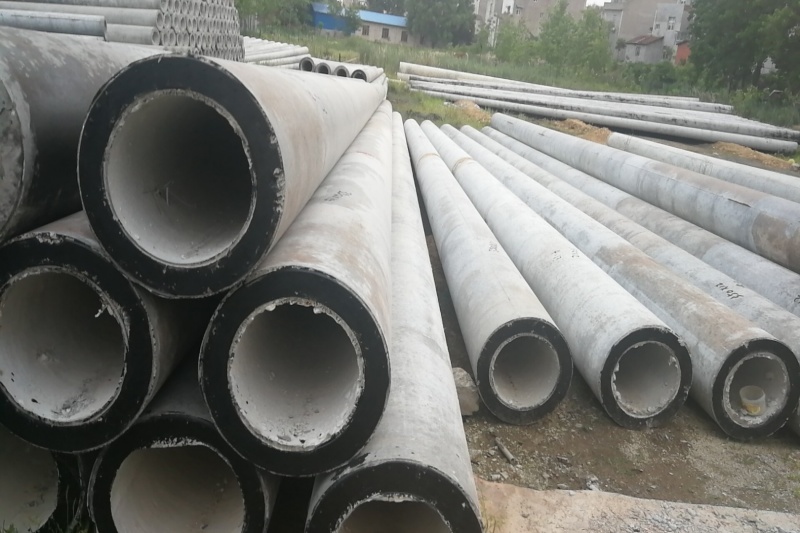
However, thicker walls are not always better. Excessive wall thickness significantly increases self-weight, complicating transportation and erection while also raising raw material costs. The application of prestressing technology is precisely intended to balance this contradiction — by applying tension to the reinforcement to induce compressive prestress in the concrete, it is possible to maintain or even improve crack resistance and load-bearing capacity with a relatively reduced wall thickness. Therefore, the wall thickness design of qualified poles seeks an optimal balance between structural safety, economy, and construction convenience, rather than blindly adding thickness.
For purchasers, it is essential to measure wall thickness with calipers during acceptance inspection to ensure compliance with design requirements and the permissible deviation range stipulated by national standards. Poles with insufficient wall thickness, even if they have a smooth appearance, are substandard products resulting from cost-cutting measures and should never be used in typhoon-prone areas. Choosing products from reputable manufacturers with standard-compliant wall thickness and proper manufacturing processes is the fundamental strategy for ensuring long-term safe operation of power lines.
