

- Publisher:mzadmin
- Published on:2026-09-04
- Pageviews:7499
What Is an 8-Meter 150-Diameter Prestressed Cement Power Pole?
The name "8-meter 150-diameter prestressed cement power pole" contains its core specifications: a length of 8 meters and a top outer diameter of 150 millimeters. This is a ring-shaped concrete pole manufactured using prestressing technology. Though simple in appearance, it is a widely used component in global power distribution networks and telecommunication infrastructure.
Why Prestressed?
Ordinary concrete poles generate tensile stress along the shaft when subjected to strong winds or cable tension. Since concrete is weak in tension, it tends to crack under such stress. Prestressing technology offers an elegant solution: during manufacturing, the internal steel reinforcement bars are stretched under high tension before concrete is poured. After the concrete hardens to sufficient strength, the tension on the steel is released. The steel then contracts, imposing a lasting internal compressive force on the concrete. This pre-compression effectively counteracts the tensile stress that occurs during service, significantly delaying the formation of cracks. This technique greatly improves the pole's crack resistance, load-bearing capacity, and durability compared to ordinary concrete poles. Moreover, by fully utilizing high-strength steel, it saves approximately 30% to 40% of steel material while also reducing self-weight, making transportation and installation easier.
Dimensions and Manufacturing
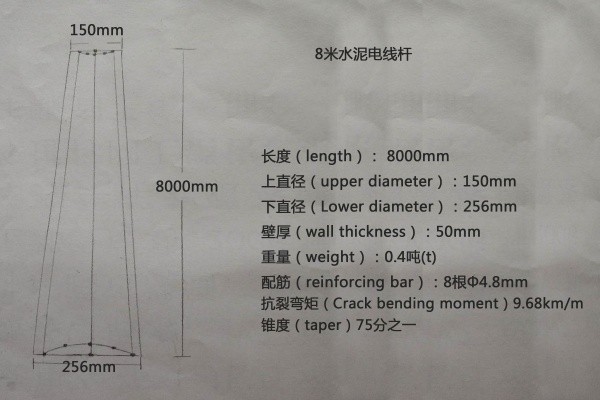
For the specific 8-meter length and 150-millimeter tip diameter, these poles are typically tapered, with a slightly thicker base and a thinner top. Under standard configurations, the base outer diameter is about 257 millimeters, with a wall thickness of roughly 50 millimeters, and the total weight is approximately 410 kilograms. The manufacturing process involves precise control: after the steel cage is placed into the steel mold and subjected to strong tensioning, high-strength concrete is poured. The mold then rotates at high speed on a centrifuge, expelling excess water and compacting the concrete into a dense annular structure against the inner wall. This achieves a concrete strength grade of C60 or even C80 or higher. The pole then undergoes steam curing to gain sufficient early-age strength.
Applications and Precautions
These poles are widely used as straight-line support poles in 10 kV distribution networks, telecommunication base station towers, and as load-bearing poles in some 35 kV to 220 kV transmission lines. Their advantages include a small footprint, long service life, and low maintenance costs, while maintaining stability even in harsh environments such as typhoon-prone areas or permafrost regions. However, it should be noted that although prestressed poles have excellent crack resistance, they may suffer brittle fracture under extreme overload conditions without obvious deformation warning. Therefore, for locations with multidirectional stresses or higher safety redundancy requirements—such as tension poles, angle poles, or large-span positions—engineers often opt for partially prestressed poles or ordinary reinforced concrete poles as alternatives.