



- Publisher:mzadmin
- Published on:2026-09-03
- Pageviews:3431
What to Do with a Damaged Concrete Pole?
As the cornerstone of power transmission and communication networks, concrete poles are found everywhere in urban and rural areas. However, due to vehicle collisions, foundation settlement, wind and rain erosion, and material aging, cracks, spalling, and even exposed rebar are common occurrences. When faced with a damaged concrete pole, scientific assessment, precise repair, or safe replacement is the key to ensuring the safety of the line. As a professional concrete pole manufacturer, we provide you with a complete set of solutions.
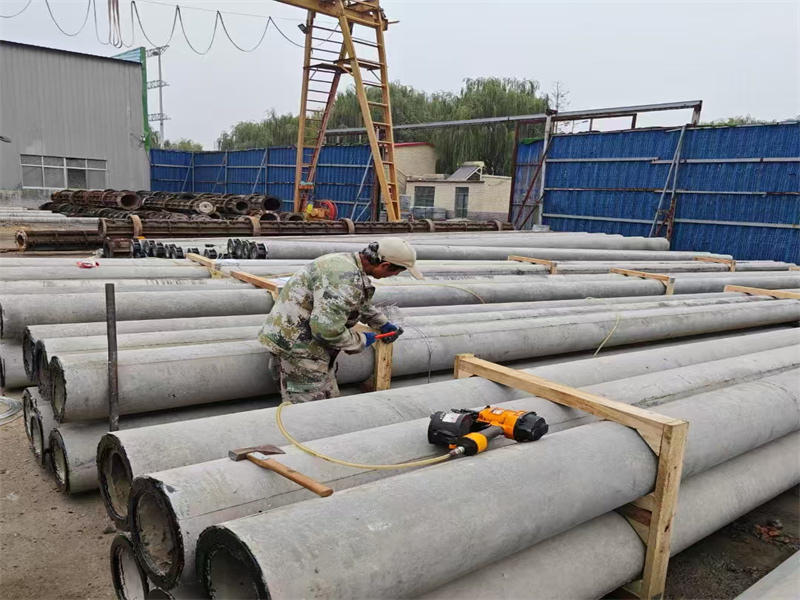
1. On-Site Assessment: Evaluate First, Act Later
When cracks or surface spalling are found, the first task is to conduct a professional assessment. According to industry maintenance codes, when rebar is exposed or concrete has spalled off, the rust on the steel bars should be removed and the concrete patched; in severe cases, the pole must be replaced. In particular, when the top displacement exceeds 1% of the pole height, it indicates structural tilting and an immediate risk of toppling, requiring urgent action.
For minor surface damage (not affecting the main reinforcement), repair measures can be taken. For example, cracks can be filled with specialized materials such as epoxy resin cement paste, which offers strong adhesion and is relatively environmentally friendly. If the damage is at the base and affects load-bearing capacity, an emergency reinforcement solution using steel sleeves with cement grouting can be considered to quickly restore pole strength.
2. Severe Damage: Standardized Replacement Procedure
If the damage is severe (e.g., mid-shaft fracture, crushed base), replacement is mandatory. Traditional replacement involves excavation, hoisting, and new pole erection, which is complex and requires long power outages. To improve efficiency, the industry now widely adopts the "cut-and-replace method" :
Bracing and de‑tensioning: Set up temporary support poles beside the old pole or use a crane to hold the top, and disconnect the conductors.
Cutting and removal: Cut off the damaged section and above using a cutter, and lift it away.
Inserting the new pole: Insert a new pole (e.g., wooden substitute or short concrete section) into the reserved hole or foundation of the original pole, and secure it with poured concrete.
Restoring the line: Reinstall the conductors onto the new pole and remove the temporary supports.
In emergency repair scenarios, ensure that the new pole model matches the original (tip diameter, length, load class), and check the bearing capacity of the foundation. If necessary, compact and replace the backfill to prevent the new pole from sinking again after erection.
3. Maintenance and Prevention Should Not Be Overlooked
Rather than reacting to emergencies, proactive maintenance is far better. Regular inspection is the best way to extend the service life of concrete poles. It is recommended to perform at least one pole-climbing inspection per year, focusing on cracks, bolt tightness, and grounding down-lead condition. In corrosive environments such as coastal areas or near chemical plants, it is advisable to apply anti-corrosion coatings on the pole surface or reinforce joint areas. Additionally, at roadsides prone to impact, install crash barriers or conspicuous signage to reduce the probability of accidental damage.
Professional Choice, Safety Foundation
Handling concrete poles is by no means a simple "take-down and put-up" operation; it involves comprehensive considerations of structural mechanics, materials science, and electrical safety. As a concrete pole manufacturer with years of industry experience, we offer full-chain services from site survey and solution design to emergency material supply (regular models in stock, deliverable within 48 hours). Whether repairing or replacing, choosing high-quality, national-standard poles and scientifically sound construction methods is the best long-term protection for grid safety.
