



- Publisher:mzadmin
- Published on:2026-09-01
- Pageviews:7581
Standard Installation Process for Concrete Poles
The installation of concrete poles is not a simple matter of "digging a hole, erecting the pole, and backfilling." It is a series of rigorous, interconnected procedures. From foundation excavation to pole erection, every step has clear process standards and quality requirements. A standardized installation process is the prerequisite for ensuring that the pole stands firmly in the open field for decades.
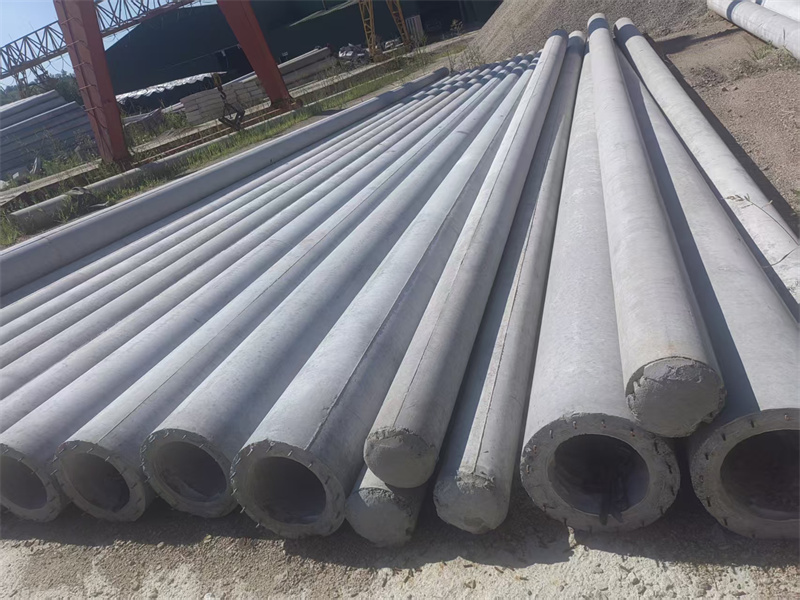
Step 1: Construction Preparation and Line Re-survey
Before installation begins, technical disclosure and construction plan approval must be completed. Construction personnel should familiarize themselves with the pole schedule and verify that the pole positions and types match the design drawings. On-site surveying instruments such as levels and theodolites should be used to re-survey the line, ensuring that the center pile positions of the poles are accurate. Meanwhile, a site investigation of underground pipelines and cables along the route should be conducted to avoid safety accidents caused by blind excavation.
Step 2: Foundation Excavation and Base Treatment
Foundation excavation is a critical part of concealed works and directly affects the bearing stability of the pole. Under general soil conditions, the pole embedment depth is approximately one-sixth to one-tenth of the pole length: for a 12-meter pole, the embedment depth is typically about 2 meters. The bottom of the foundation pit should be compacted and leveled to ensure uniform load distribution after the base plate is installed. For areas with soft soil, paddy fields, or high groundwater levels, reinforcement measures such as installing anchor plates or pouring concrete foundations should be adopted to prevent future settlement and tilting.
The base plate should be installed after the foundation pit passes inspection. Its circular groove surface must be perpendicular to the pole axis, and after alignment, backfilling and compaction should be carried out. The installation position and orientation of anchor plates should comply with design requirements, and the clamp nuts should be tightened to ensure the anchor plate arc surface fits closely against the pole.
Step 3: Pole Erection
Before erection, the pole must undergo a visual inspection: the pole surface should be smooth and even, free from longitudinal and transverse cracks, and the pole curvature should not exceed two-thousandths of the pole length. A designated person should be appointed for unified command during the erection operation, with clear signals and division of labor. Qualified lifting equipment and wire ropes must be used during hoisting, and overloading is strictly prohibited. After the pole is in place, its inclination and lateral displacement must be strictly controlled: the lateral displacement of straight-line poles should not exceed 20 mm, and the pole tip deflection should not exceed half of the tip diameter. Corner poles and terminal poles should be pre-tilted outward or toward the guy-wire side according to design requirements, and the inclination after tensioning must remain within allowable limits.
Step 4: Backfilling, Compaction, and Acceptance
Backfilling can only proceed after the pole has been corrected and qualified. Backfill soil should be compacted in layers, with compaction performed approximately every 30 cm of backfill, until it is about 20 cm above the ground surface to form a settlement-prevention mound. After backfilling is completed, the pole's root opening, step distance, inclination, and other indicators should be re-inspected and accepted to ensure all deviations comply with specification requirements.
The stability of a pole begins with the compaction of every inch of soil in the foundation pit and is perfected with every angle calibration during hoisting. A standardized installation process is the final quality checkpoint for the pole and a solemn commitment to its decades of steadfast service in wind and rain. We not only provide you with high-quality concrete poles but also offer full-process professional technical support from production to installation, ensuring that every pole stands straight and steady.
