



- Publisher:mzadmin
- Published on:2026-09-01
- Pageviews:1559
What to Do When Grout Leakage Occurs During the Production of Concrete Poles
During the centrifugal forming process of concrete poles, "grout leakage" is one of the most concerning issues for production personnel. Grout leakage refers to the phenomenon where the concrete slurry is expelled from the joint seams and end seals of the mold under high-speed rotation, resulting in surface defects such as honeycombing, localized material shortages, and even structural looseness. If not properly addressed, this issue can directly compromise the load-bearing capacity and durability of the pole.
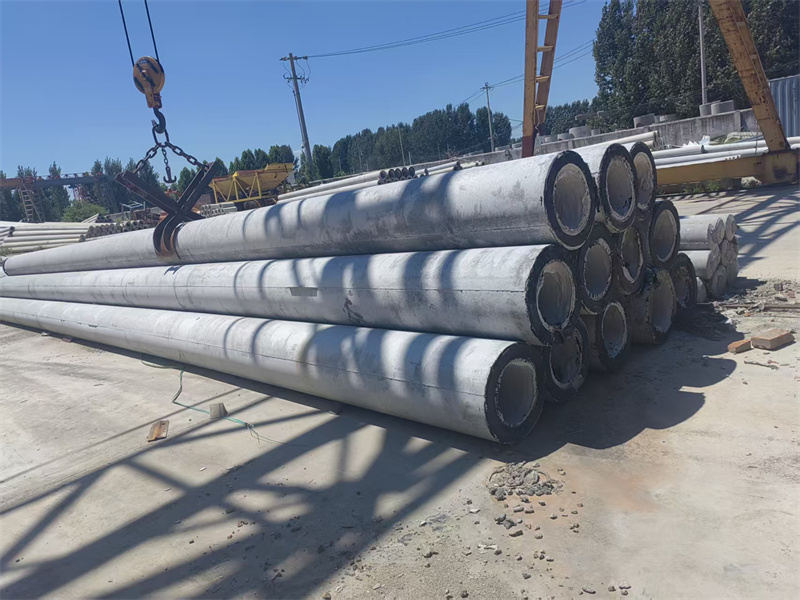
Grout leakage typically points to oversights in several critical areas. Mold wear and deformation are the most common causes—prolonged use leads to poor sealing at the mold joints, and the sealing rubber strips lose their elasticity, allowing the slurry to escape under centrifugal force. In addition, trapped stones or debris at the mold joint during closing, as well as overly thin or improperly placed sealing cotton ropes, can also cause localized leakage. On the mix design side, a high water-cement ratio results in a thinner slurry with excessive fluidity, making it more prone to being flung out during high-speed rotation.
When grout leakage does occur, scientific repair is essential. For minor surface defects, epoxy resin mortar can be used for restoration. The procedure involves thoroughly cleaning the leaked area to remove all loose paste and oil stains, keeping the substrate dry, then applying a layer of epoxy resin primer as a bonding interface, followed by manual filling and compaction with the prepared epoxy mortar. This repair material offers high strength and excellent adhesion after curing, bonding firmly with the concrete and resisting detachment. During the curing period, contact with water should be avoided. Once fully cured, the repaired area integrates seamlessly with the original pole body.
Yet more important than repair is systematic prevention. In production management, molds should be subject to regular straightness inspection and maintenance, with worn-out molds replaced promptly. Before mold closure, the joint surfaces must be carefully cleaned to ensure no stones or debris are trapped; sealing cotton ropes should be properly positioned and of appropriate thickness to guarantee effective sealing. In terms of mix design, the concrete slump should be strictly controlled within a reasonable range—ensuring sufficient fluidity for forming without being too thin and causing leakage. For end sealing, the use of baffle plates and anchor plates with raised ridge structures can significantly improve sealing performance, reducing leakage from the source.
Grout leakage is not an incurable problem; it tests a pole manufacturer's full-chain process capability—from prevention and monitoring to repair. Rigor in every detail is a commitment to product quality, because every high-quality pole that leaves the factory will stand in the open field for decades, bearing wind and rain, and living up to the trust placed in it.
Located in Qufu, Shandong, we are a national high-tech enterprise integrating R&D, design, production, and global supply of large-scale concrete power products. We are dedicated to solving the complex coordination challenges in pole-tower supporting systems for global power and communication projects, offering a "full-category, one-stop" procurement platform ranging from national-standard poles to specialized components. Our products are exported in bulk to countries along the Belt and Road Initiative, including Indonesia, Senegal, and Burundi, with our business footprint spanning Southeast Asia, Africa, the Middle East, and South America. Backed by strong production capacity and stable bulk quality, we have earned the trust of multiple state-owned power enterprises through long-term repeat orders. We continue to contribute the solid strength of "Made in China" to global infrastructure development.
