



- Publisher:mzadmin
- Published on:2026-08-29
- Pageviews:2789
How to store cement poles correctly
Cement poles often require a storage period from factory to installation. Proper storage directly affects the structural performance and service life of the electrical pole. Many customers neglect details, resulting in cracks, bends, and even scrapping of the poles before installation, causing economic losses. As a professional manufacturing enterprise, we have sorted out the correct storage points for you.
1、 Venue selection is the foundation
The storage site should be flat, solid, and well drained. Soft or uneven ground can cause uneven settlement of poles under their own weight, leading to bending of the pole body or stress concentration and cracking at the fulcrum. The ideal site is a compacted hard ground or a flat area with sleepers and crushed stone cushion layers. At the same time, avoid low-lying water accumulation areas - although electric poles are not afraid of rain, long-term immersion in mud and water will accelerate surface degradation.
2、 Wooden supports should be standardized
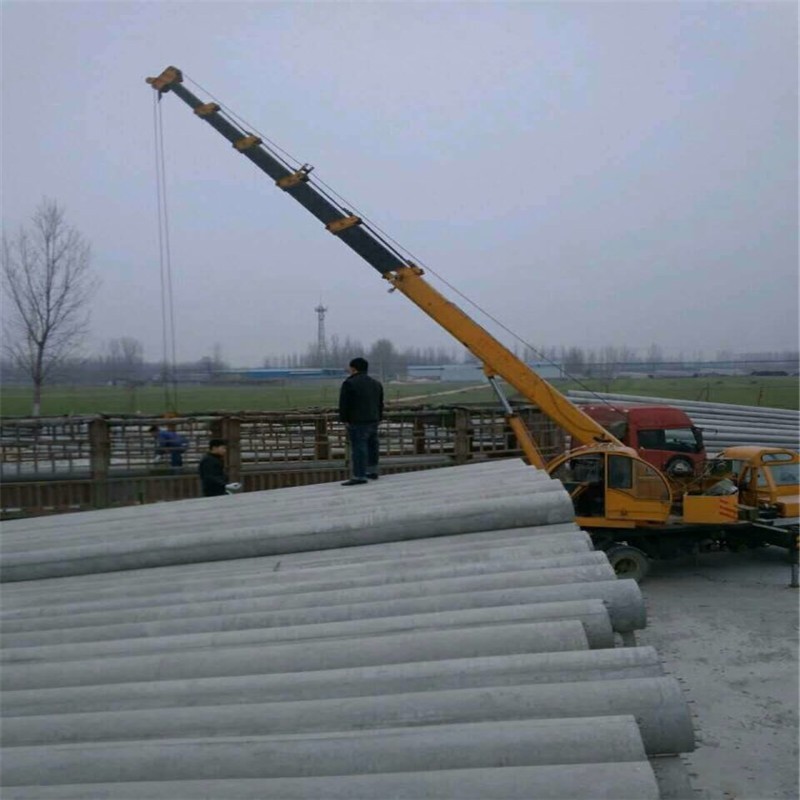
Electric poles cannot directly touch the ground, and supports must be placed underneath. The standard practice is to set two wooden pads at a distance of 1.5 to 2 meters from each end. When the length of the pole exceeds 12 meters, an auxiliary support should be added in the middle. The cushion wood should be made of square wood with a cross-section of not less than 150mm x 150mm, and the width direction should be perpendicular to the axis of the rod to prevent rolling. The upper and lower poles also need to be separated by wooden pads, and the upper and lower pads must be on the same vertical line to avoid twisting of the pole body. The position of the support point cannot be arbitrary: it is too close to the end and the middle is suspended too much, which can easily cause cracks; Being too far away from the end and having an excessively long cantilever at the end are also prone to damage.
3、 There are limitations on the number of stacking layers
Too many layers of stacking may cause hidden damage to the bottom pole due to the enormous pressure from the upper layer, which may exceed the compressive limit. Generally, poles with a tip diameter less than 190 millimeters should not have more than 4 layers, and poles with a tip diameter of 190 millimeters or more should not have more than 3 layers. The interlayer shims should be aligned vertically to form a vertical force transmission path and avoid eccentric compression. When the venue is limited, it is better to expand the stacking area than to take the risk of increasing the number of layers.
4、 Rainproof, moisture-proof and seasonal protection
The exposed steel bar heads and connecting flanges at the end of the pole are prone to rusting during the rainy season, which affects the quality of grounding or connection in the later stage. It is recommended to apply rust proof grease or cover the end metal parts with waterproof cloth. When stored outdoors for a long time, the dust and soil adhering to the surface should be cleaned before standing the pole, in order to check for any new damage. In winter in the north, it is necessary to avoid soaking electric poles in negative temperatures for a long time to prevent surface peeling caused by frost heave. If it suddenly rains after being exposed to high temperatures in summer, it may cause temperature differences and cracks, which can be covered and maintained appropriately.
5、 Regular inspections during storage
If stored for more than three months, it is recommended to conduct a visual inspection once a month, focusing on checking for new cracks, damage to the ends, and whether the wooden pads have sunk or deformed. If the settlement of the cushion wood causes deformation of the pole body, the support should be adjusted in a timely manner. After the rainy season, check whether the site has accumulated water and whether the rusting of metal parts at the ends has worsened.
6、 Precautions during transportation
When moving from the storage area to the transport vehicle, a crane or forklift should be used to lift smoothly. Rubber or hemp cloth should be added to the contact between the lifting rope and the pole to avoid the steel wire rope from scratching the concrete surface. It is strictly prohibited to roll or drag electric poles directly from the stack. The surface scratches and internal microcracks caused by such rough operations are often exposed only after the pole is subjected to force.
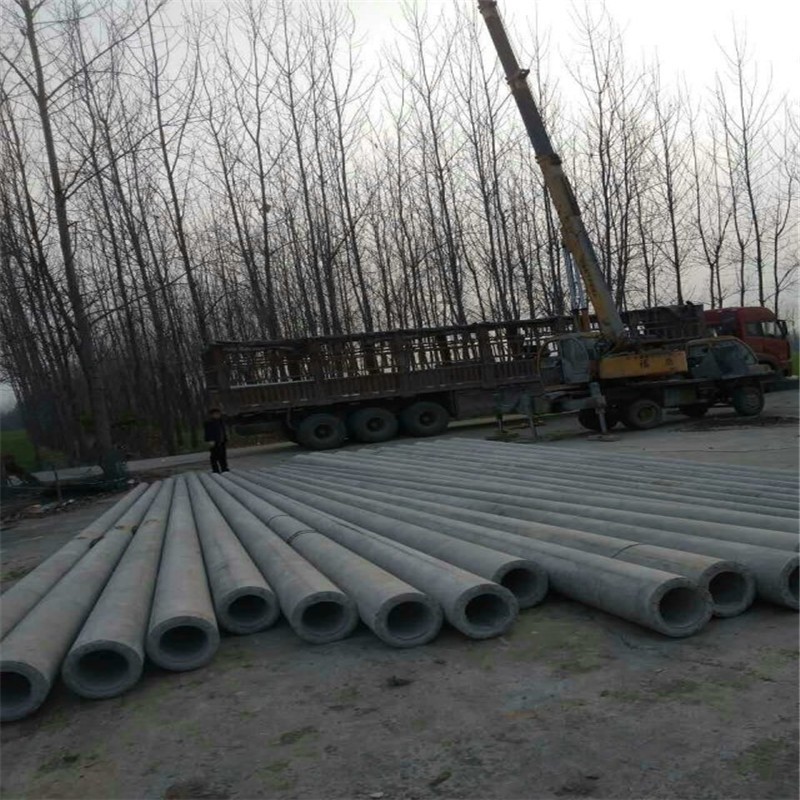
Qufu towering power tower Co., Ltd. - a one-stop intelligent manufacturing base for "cement power poles" in China, empowering global power infrastructure construction. We are located in Qufu, Shandong, and are a national high-tech enterprise that integrates the research and development, design, production, and global supply of large-scale concrete power products. We are committed to solving the tedious coordination problems in tower supporting systems for global power and communication engineering, and creating a "full category, one-stop" procurement platform from national standard poles to specialized components. The products are exported in batches to Indonesia, Senegal, Burundi and other countries along the "the Belt and Road", with business covering Southeast Asia, Africa, the Middle East and South America. With strong production capacity reserves and stable batch quality, we have won the trust of multiple state-owned power enterprises for long-term repurchase. We continue to contribute the solid strength of 'Made in China' to global infrastructure construction.
