



- Publisher:mzadmin
- Published on:2026-08-27
- Pageviews:1925
What Is the Difference Between Flanged Concrete Poles and Ordinary Poles?
In the transmission of electricity, utility poles stand as the most unassuming sentinels. Yet, as transmission line corridors grow increasingly narrow, and as cities raise higher demands for visual landscapes and land-use efficiency, a new type of pole—the high-strength concrete pole with a flange base—is quietly reshaping the industry's construction logic. Though it shares the same lineage as the ordinary poles we know, it differs fundamentally in its internal reinforcement and connection method.
I. Generational Difference in Connection Method: From "Buried in Soil" to "Bolted Anchorage"
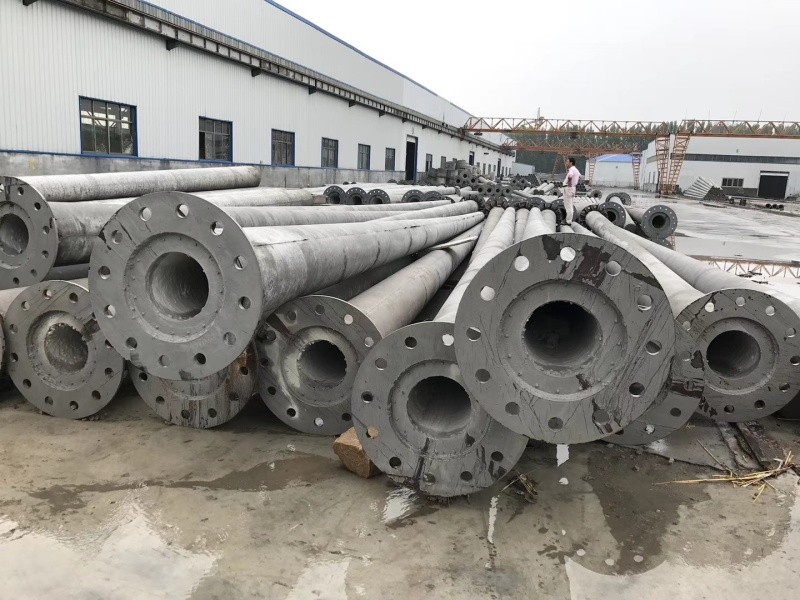
The installation of ordinary poles has traditionally relied on direct burial or shallow embedment, using the lateral pressure of the soil together with base plates and anchor plates to resist overturning moments. This method, while simple and straightforward, often requires guy wires to balance the forces—occupying a large footprint and being significantly affected by soil conditions. The core innovation of the flanged pole lies in the flange plate at its base, which connects to anchor bolts. Instead of depending on the passive earth pressure of the soil, it uses anchor bolts pre-embedded in a cast-in-place concrete foundation to precisely mate and fasten with the steel flange plate at the pole's root. This connection offers a balance of rigidity and flexibility—the bolted joint provides a certain stiffness while also cushioning instantaneous impact loads, greatly enhancing the pole's stability under severe weather.
II. Leap in Mechanical Performance: Bending Strength 2 to 4 Times That of Ordinary Poles
Ordinary poles, limited by their prestressed or conventional reinforcement configurations, have a relatively limited root bending moment capacity. Flanged poles, designed and manufactured in accordance with national standard GB4623, use rebar of φ20 or larger as the main reinforcement. Their root allowable bending moment is 2 to 4 times that of ordinary concrete tapered poles of the same specification. This high-strength characteristic enables them not only to serve as straight-line poles but also as straight-line tension poles, small-angle corner poles, and even terminal poles—far surpassing the application range of ordinary poles.
III. Construction Footprint and O&M Efficiency: Zero Guy Wires Along the Entire Line and Reusable Foundations
In urban areas where land is at a premium, or in retrofit projects with restricted line corridors, the advantages of flanged poles are particularly prominent. Thanks to the robust flange foundation bearing capacity, they achieve an entire line with no guy wires, dramatically reducing land occupation and lowering compensation costs for crop damage. Additionally, the pole sections (e.g., 9 meter and 6 meter segments) are also joined by flange plates, allowing flexible adjustment of the overall pole height as needed. For future maintenance, repair, or replacement, workers need only remove the flange bolts to exchange the main pole, while the underground foundation can be reused—substantially shortening construction cycles.
IV. Summary
If ordinary poles are the "affordable housing" of power lines, then high-strength flanged poles are the "precision-engineered solution" tailored for complex terrains and heavy-load lines. They represent not only an evolution in concrete product structural mechanics but also a profound response to the modern grid's demands for intensification and standardization. Choosing a flanged pole means choosing greater load capacity, less land occupation, and faster construction efficiency.
