
- Publisher:admin
- Published on:2026-08-25
- Pageviews:4715
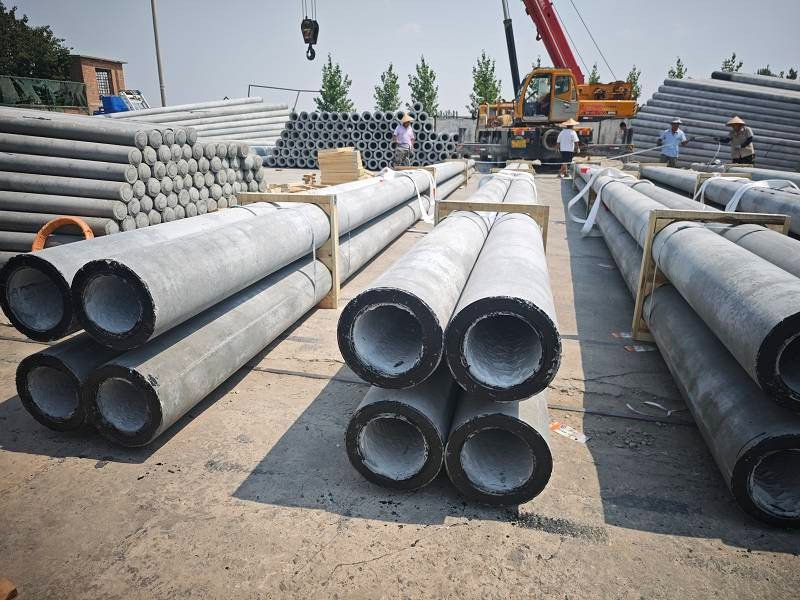
If concrete is the flesh and blood of a utility pole, then steel reinforcement is undoubtedly the backbone that keeps it standing firm. In the manufacture of cement poles, the choice of steel reinforcement not only affects the mechanical performance of the component but also profoundly influences the safety and service life of power transmission lines. The most widely used types today—prestressed poles and uniform-diameter (reinforced concrete) poles—though both belonging to the family of annular concrete members, embody distinctly different philosophies of material selection and process logic.
Prestressed Poles: The Tension Aesthetics of High-Strength Steel
The core advantage of prestressed poles lies in their crack resistance and rigidity, thanks to the use of high-strength prestressing steel. In the early days, grade-A cold-drawn low-carbon steel wires were commonly used; today, the mainstream choice has evolved to high-strength steel wires or spiral-ribbed wires for prestressed concrete, with an ultimate tensile strength of up to 1570 MPa. This type of steel possesses exceptional tensile strength. Before centrifugal casting, tension is applied to the steel; after the concrete sets and reaches the demolding strength, the release of the steel's tendency to retract generates circumferential and longitudinal compressive prestress on the pole, actively counteracting the tensile loads it will encounter during service.
According to national standards, prestressing steel may also include cold-drawn grade II to grade V bars, indented wires, and even steel strands. These materials are not only strong but must also comply with stringent specifications such as GB1499 and GB5223. Structurally, prestressing steel bars are strictly prohibited from having splices; they must be uniformly distributed along the circumference of the pole, and the concrete cover thickness is precisely defined to ensure adequate bond stress and durability under high-stress conditions.
Uniform-Diameter Poles: The Steady Path of Non-Prestressed Steel
Unlike tapered prestressed poles, uniform-diameter poles (also known as reinforced concrete poles) rely primarily on non-prestressed steel to carry external loads. The main longitudinal load-bearing bars are mostly hot-rolled ribbed bars (deformed bars) of grade HRB335 or HRB400, with diameters ranging from φ10 to φ22 mm, flexibly configured according to bending moment requirements.
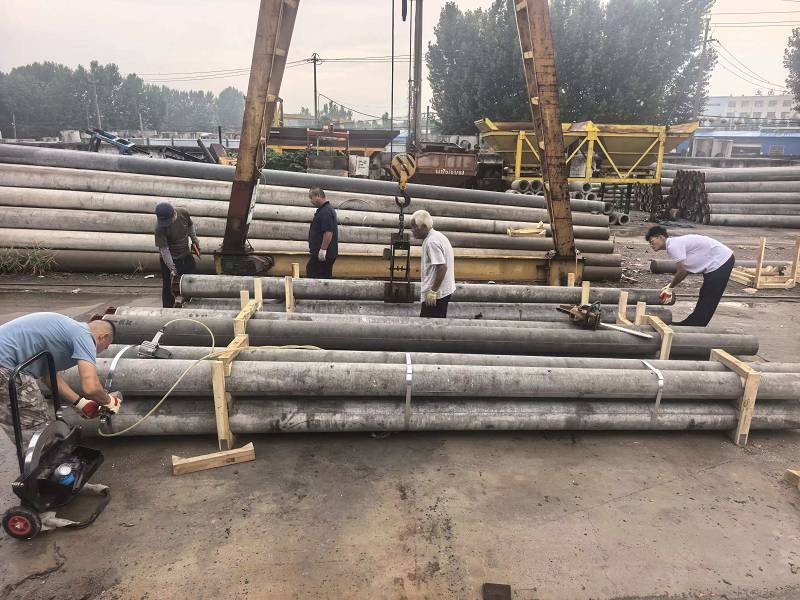
Compared with prestressed steel, these ordinary hot-rolled bars—though somewhat inferior in crack resistance (allowing cracks up to 0.20 mm under cracking test loads)—offer superior ductility and toughness, making them less prone to brittle fracture. For strain poles, angle poles, or dead-end poles that bear complex loads, the robust bond strength and post-anchorage performance of non-prestressed steel show distinctive advantages. In addition, the tie rings and spiral stirrups in uniform-diameter poles often employ HPB300-grade plain round bars or cold-drawn low-carbon steel wires, with structural detailing more focused on the skeleton's tying, forming, and concrete confinement.
A Shared Craftsmanship, Differing Paths
Whether it is the "tension prestressing and rigidity-first" approach of prestressed poles or the "solid reinforcement and stability-response" strategy of uniform-diameter poles, the difference in steel selection is essentially a precise response to different loading conditions. Prestressed steel, with its high strength, actively resists cracking and is well-suited for long-span straight-line sections; non-prestressed deformed bars, with their robust plastic deformation capacity, safeguard critical nodes along the line. As a pole manufacturer, only by mastering these principles can we forge the most suitable "skeleton" to build power grid corridors that stand for a century.
We are located in Qufu, Shandong, and are a national high-tech enterprise integrating R&D, design, production, and global supply of large-scale concrete power products. We are committed to solving the complex coordination challenges in pole-tower supporting systems for global power and communication projects, creating a "full-category, one-stop" procurement platform ranging from national-standard poles to specialized components. Our products are exported in bulk to countries along the Belt and Road, including Indonesia, Senegal, and Burundi, with our business footprint spanning Southeast Asia, Africa, the Middle East, and South America. With strong production capacity and stable batch quality, we have earned the long-term repeat trust of multiple state-owned power enterprises. We continue to contribute the solid strength of "Made in China" to global infrastructure development.
