



- Publisher:admin
- Published on:2026-08-24
- Pageviews:4056
In modern power grid construction, transmission lines must traverse mountains, plains, and rivers while coping with increasingly scarce land resources and more stringent engineering requirements. Traditional concrete poles and steel tubular poles have gradually revealed their limitations in certain complex scenarios—either requiring extensive guy wires that occupy land or entailing high costs that strain budgets. The emergence of the flange-type high-strength concrete pole, much like a steel backbone with both rigidity and flexibility, offers a brand-new solution that combines strength, efficiency, and aesthetics for power transmission.
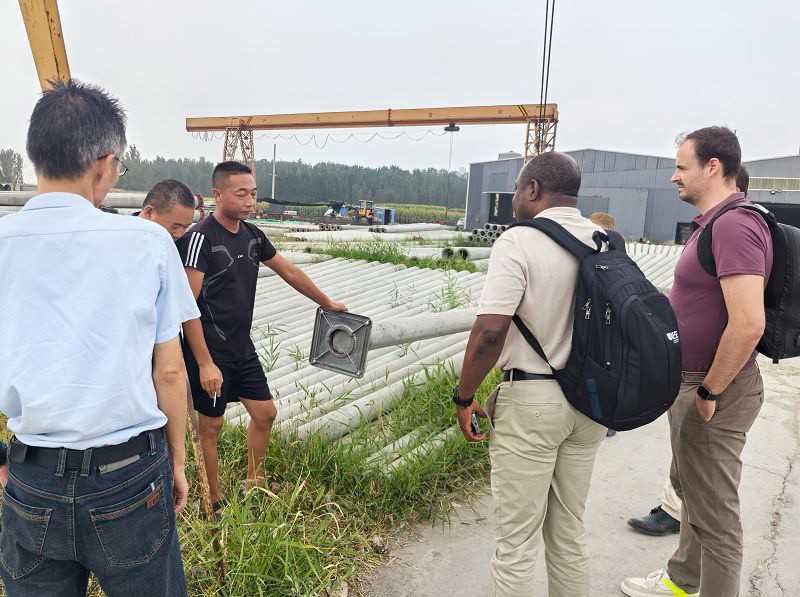
What Is a Flange-Type High-Strength Concrete Pole?
In appearance, it retains the classic tapered shape of traditional concrete poles, with a taper ratio of 75:1 and a top diameter of typically 270mm—familiar and reassuring. Yet its true sophistication lies in the details: pole sections are no longer joined by traditional welding or clamps, but through precision-cast flanges. Section lengths can be flexibly combined into 9‑meter or 6‑meter modules according to project needs, much like building blocks, greatly facilitating transportation and assembly.
The higher strength comes from its internal "reinforced skeleton." Designed in strict compliance with national standard GB4623-2006, the pole uses φ20 threaded steel as main reinforcement, combined with an optimized concrete mix, achieving a root bending moment 2 to 4 times that of ordinary concrete tapered poles of the same type. This means it can not only handle straight-line sections with ease, but also serve as straight-line strain poles, small-angle corner poles, and even terminal poles—fulfilling multiple roles and greatly enriching design options.
Guy‑Wire‑Free Design: Unlocking Land Value
The most remarkable advantage of the flange-type high-strength concrete pole is its revolutionary guy‑wire‑free design. Traditional poles rely on guy wires for balance, occupying significant land area and often driving up costs in urban or agricultural areas due to land acquisition difficulties. In contrast, the flange-type pole is rigidly connected at its base through flanges to anchor bolts embedded in cast‑in‑place trapezoidal concrete foundations, eliminating the need for base plates, guy anchor blocks, and guy wires—achieving a fully "guy‑wire‑free" line.
This feature is especially valuable in two‑grid renovation projects passing through urban areas or constrained corridors. For a double‑circuit 35kV line, conventional solutions may require dense guy wiring, whereas the flange-type pole stands singly and compresses the line corridor significantly, saving valuable land resources and compensation costs, thereby substantially enhancing both economic and social benefits.
Convenient Construction and Long‑Term Maintenance
Beyond its outstanding performance, the flange-type pole also impresses with its convenience. On site, the pole base flange is simply aligned with the embedded anchor bolts and tightened, enabling rapid erection far more efficiently than traditional methods. Cross‑arms are of arc‑shaped steel plate welded design, fixed to the pole body by clamps, making on‑site assembly extremely straightforward.
Even more noteworthy is its life‑cycle cost advantage. Under the same bending moment requirements, flange-type poles can partially replace costly steel tubular poles, significantly reducing material costs. Moreover, during decades of maintenance, if a pole body needs replacement due to external damage, only the main pole needs to be unfastened from the flange bolts and replaced, while the existing concrete foundation can be reused—shortening construction periods and avoiding wasteful re‑excavation and re‑casting.
Conclusion
The flange-type high‑strength concrete pole is a perfect synthesis of materials science and engineering mechanics. With its superior bending resistance, compact footprint, rapid construction process, and long‑term maintenance convenience, it responds to the comprehensive demands of modern power grids for safety, economy, and environmental sustainability. Choosing the flange-type high‑strength concrete pole is not just choosing a pole—it is choosing an efficient, intensive, and sustainable vision for power infrastructure. We sincerely invite you to witness how this innovative force safeguards the resilient future of power grids.
Located in Qufu, Shandong, we are a national high-tech enterprise integrating R&D, design, production, and global supply of large‑scale concrete power products. We are dedicated to solving the cumbersome coordination challenges in pole and tower supporting systems for power and communication projects worldwide, offering a "full‑category, one‑stop" procurement platform—from GB‑standard poles to specialized components. Our products are exported in bulk to Indonesia, Senegal, Burundi, and other countries along the "Belt and Road," with business spanning Southeast Asia, Africa, the Middle East, and South America. Thanks to our robust production capacity and consistent batch quality, we have earned long‑term repeat orders from multiple state‑owned power utilities. We continue to contribute "Made in China" strength to global infrastructure development.
