



- Publisher:admin
- Published on:2026-08-24
- Pageviews:5868
In the selection and design of power transmission lines, precise mastery of specification parameters often determines the safety and service life of the entire project. Prestressed concrete poles, a mature product validated by decades of field service, now boast a highly standardised and scientific specification system. Understanding the engineering logic behind these specifications helps us find the most suitable model for each unique project among a myriad of options. From a professional perspective, this article systematically outlines the core specification parameters of prestressed concrete poles.
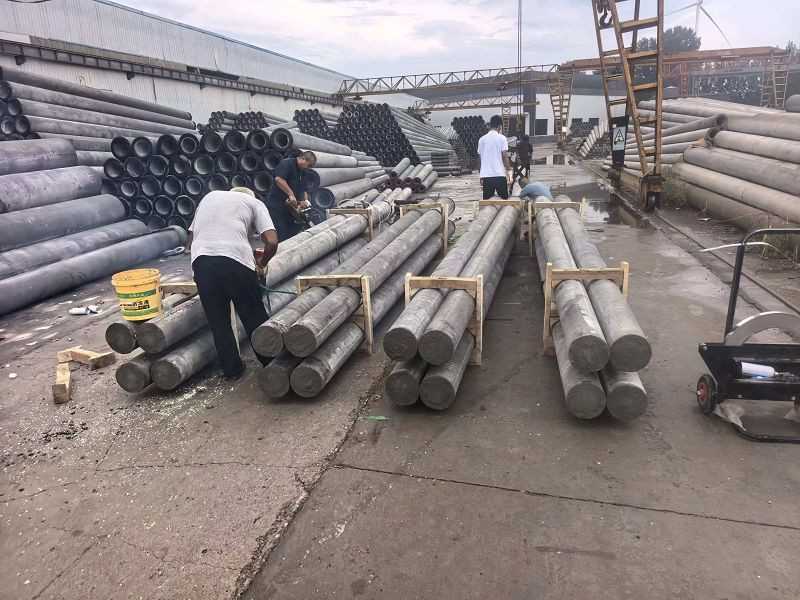
1. Length and Tip Diameter: A Philosophy of Sizing Driven by Function
The choice of specifications primarily depends on the line's voltage class, span, and geographical environment. Generally, prestressed concrete poles cover a wide length range, with common sizes spanning from 7 metres to 15 metres, and in some cases extending to 18 metres. In urban distribution networks and rural overhead lines, 8‑metre, 10‑metre, and 12‑metre poles are the most widely used "golden lengths"; for lines requiring larger spans or higher voltage ratings, 15‑metre and longer models become the mainstay.
Closely associated with length is the tip diameter (the minimum diameter at the pole top). Standard tapered poles typically feature tip diameters of 150 mm, 190 mm, 230 mm, and similar series. For instance, the φ190×12 m model is an extremely common classic choice in rural grid upgrades and urban 10 kV distribution lines. This designation indicates a tip diameter of 190 mm and a total length of 12 metres, striking an excellent balance between load‑bearing capacity and convenience in transport and installation.
2. Bearing Capacity and Crack Resistance: The Invisible Strength
If length and diameter represent the pole's "physique," then bearing capacity and crack resistance are its "sinews and bones." The national standard "Circular Concrete Poles" (GB/T 4623) sets strict grading requirements in this regard. Through pretensioning of high‑strength steel reinforcements, prestressed poles place the concrete in a favourable compressive state before it even bears external loads—this significantly delays the onset of cracks and enhances ultimate load‑bearing capacity.
In testing standards, the cracking verification bending moment and the bearing capacity verification bending moment are used as key indicators. Quality products are required to show no cracks on the pole shaft when loaded up to 80 % of the cracking verification moment; even at the cracking moment, crack widths must be controlled within an extremely narrow range (e.g., below 0.10 mm). This superior crack‑resistance is precisely the core advantage of prestressed poles over ordinary reinforced concrete poles.
3. Materials and Manufacturing: The Underlying Logic of Quality
Achieving these specified performance levels depends on rigorous material selection and process control. According to industry standards, the design strength of centrifugally cast concrete in prestressed poles shall not be less than grade C50, and the factory‑delivered strength must reach at least 80 % of the design strength. The cement used is typically Portland cement with a strength grade not lower than 42.5, while aggregates must be well‑graded medium‑coarse sand and crushed stone.
Centrifugal forming and steam curing are two critical processes. Centrifugal action expels excess water from the concrete during high‑speed rotation, producing a denser microstructure; steam curing accelerates strength gain and ensures reliable demoulding quality. A qualified production line for prestressed poles must precisely monitor every step of the process—from steel tensioning stress, concrete mix ratios, to curing temperature control.
Conclusion
Selecting the right prestressed concrete pole specifications is a comprehensive consideration of line loads, geographical conditions, economy, and durability. From the 7‑metre to 18‑metre length range, and from 150 mm to 230 mm tip diameters, every set of numbers embodies rigorous standardisation and accumulated engineering experience. As a professional concrete pole manufacturer, we strictly adhere to the GB/T 4623 national standard, offering a full range of standard products as well as customised non‑standard designs upon request. Choosing us means choosing safety, reliability, and lasting partnership—so that every pole standing between earth and sky becomes a masterpiece of craftsmanship that withstands the test of time.
Located in Qufu, Shandong, we are a national high‑tech enterprise integrating R&D, design, production, and global supply of large‑scale concrete power products. We are dedicated to solving the cumbersome coordination challenges in pole and tower supporting systems for power and communication projects worldwide, offering a "full‑category, one‑stop" procurement platform—from GB‑standard poles to specialised components. Our products are exported in bulk to Indonesia, Senegal, Burundi, and other countries along the "Belt and Road," with business spanning Southeast Asia, Africa, the Middle East, and South America. Thanks to our robust production capacity and consistent batch quality, we have earned long‑term repeat orders from multiple state‑owned power utilities. We continue to contribute "Made in China" strength to global infrastructure development.
