

- Publisher:mzadmin
- Published on:2026-11-06
- Pageviews:828
- Source:
Why are there more and more shapes of concrete utility poles?
The vast majority of concrete utility poles are circular, but occasionally square and octagonal ones are also encountered. Along railway lines, in specific industrial parks, or at old rural grid renovation sites, these "non-mainstream" shaped concrete poles are still in service. Since circular poles occupy an absolutely dominant position, why do manufacturers still produce other shapes? To answer this question, we must first start with the core mission of concrete utility poles: they must, at the lowest possible cost, steadily support conductors, insulators, crossarms, and the various forces brought by wind, frost, rain, and snow. The choice of shape is essentially a search for the optimal solution among mechanical performance, production technology, and usage scenarios.
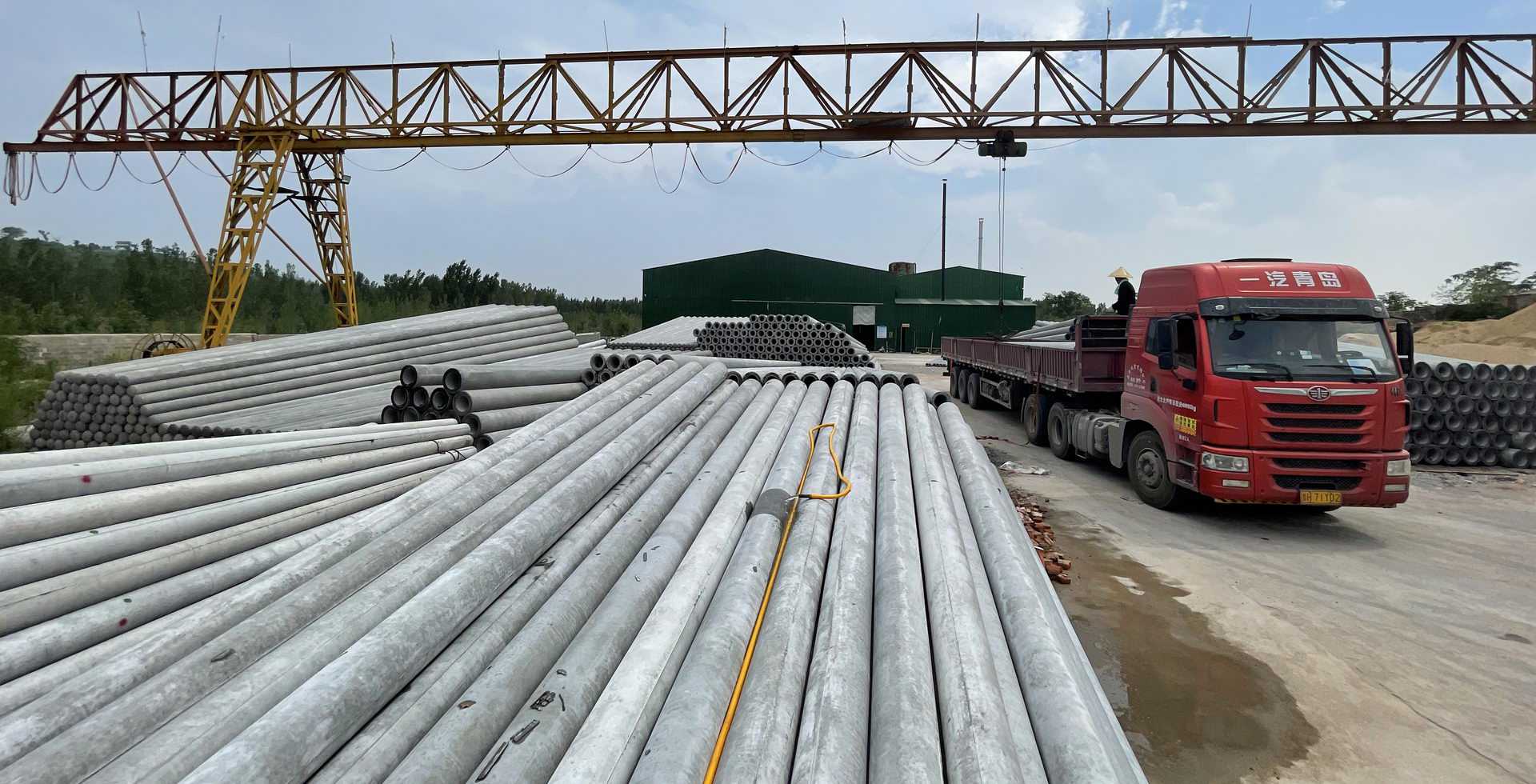
At present, the most widely used concrete utility poles are annular reinforced concrete poles, whose cross-section is a hollow circular ring. The reason this shape can become mainstream is first thanks to the centrifugal production process. During production, the steel reinforcement cage is placed into the steel mold, and after the concrete is evenly distributed, the steel mold is driven by a centrifuge to rotate at high speed. Under the action of centrifugal force, the concrete tightly adheres to the mold wall, naturally forming a hollow annular cross-section, while excess water is discharged, making the concrete denser. This process is naturally suitable for making circular poles; making square poles or special-shaped poles instead requires additional molds and processes, which is not cost-effective.
From the perspective of force, the circular cross-section is isotropic, and no matter from which direction the wind blows, the pole body's bending resistance is the same. Overhead lines year-round bear conductor tension, wind load, and ice coating load, and the directions are not fixed. The balanced force characteristics of circular poles exactly match this randomness. In contrast, square poles may have stronger bending resistance in one direction, but when the angle changes, they may become a weak link. In addition, with the same amount of material, the annular cross-section can obtain a larger moment of inertia with a smaller wall thickness, and material utilization efficiency is relatively high.
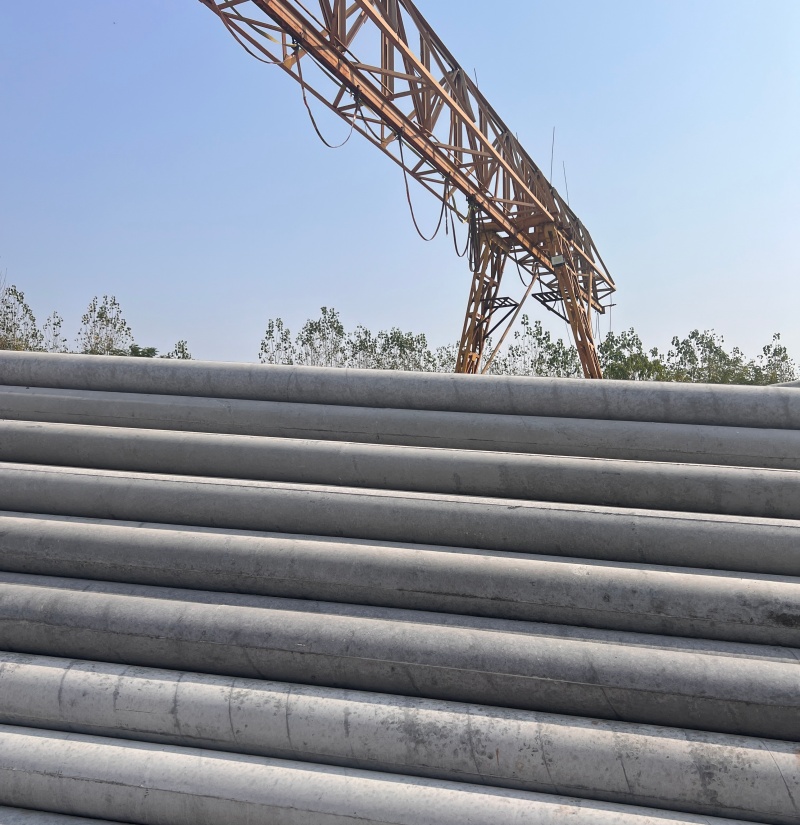
Circular poles also have two advantages that are easily overlooked. First, the convenience of transportation and installation: circular poles can roll when stacked, making it easy to adjust their position during loading and unloading; when erecting the pole, no matter which angle the pole body is rotated to, the adjustment of the crossarm mounting hole positions is also more flexible than with square poles. Second, safety: the cylindrical surface has no edges or corners, and the harm to the human body in the event of an accidental collision is relatively small. These factors together consolidate the mainstream position of the circular cross-section.
That being the case, why can square and octagonal cross-section concrete poles still exist? Square concrete poles were once used in large numbers in China's rural power system and belonged to early non-standard products, which were later gradually eliminated. Its existence had its historical rationality: in an era when the centrifugal process was not yet widespread or production conditions were limited, square poles could be formed by ordinary pouring methods, and mold making was simple, suitable for small-scale, local production. In some low-voltage rural grid lines, the mechanical performance of square poles was sufficient to meet demand. The situation of octagonal poles is similar; it lies between circular and square, retaining a certain angularity for easy installation of accessories while being closer to isotropy than purely square, and traces of it can be found in some communication lines or special support structures.
More noteworthy is the shape differentiation within the circular cross-section. Although all are circular poles, they are also divided into two major categories: tapered poles and uniform-diameter poles. Tapered poles are thinner at the top and thicker at the base, with a taper usually of 1:75, which exactly matches the bending moment distribution of a cantilever beam—the bending moment at the base near the ground is the largest and requires more material; the bending moment at the top is small, so making it thinner saves material and reduces weight. Uniform-diameter poles have the same diameter along the entire length. In situations where guy wires are needed, load distribution is relatively uniform, or where segmented assembly of extra-high poles is required, uniform-diameter poles have a higher degree of standardization and are more convenient to connect. This differentiation of "all circular, but different in form" is itself part of the shape evolution.
The diversity of concrete utility pole shapes ultimately reflects the diversity of application scenarios. In the early rural grid, loads were light and spans were small, so square poles were sufficient; later, as the scale of the power grid expanded, centrifugal-process circular poles became the standard due to their comprehensive advantages; the involvement of railways, communications, photovoltaics, and other fields then brought demands for mechanical performance in specific directions or special installation interfaces. The retention or abolition of each shape cannot be summarized simply by whether it is "good-looking" or "backward."
From the perspective of standardization, China's current national standards systematically specify the specifications and technical requirements of annular concrete poles, covering electric power, communications, lighting, signals, photovoltaics, and many other fields. This means that the degree of standardization of circular poles is already very high, and the product spectrum is quite complete, from top diameters of 150 mm to 550 mm and from ordinary reinforced concrete to prestressed concrete. Non-circular pole bodies exist more as a supplementary role, serving those segmented scenarios that standardized circular poles cannot perfectly cover.
