
- Publisher:mzadmin
- Published on:2026-11-04
- Pageviews:2250
- Source:
Concrete utility pole aging: where does it fail first?
Many people intuitively assume that, since utility poles are exposed to wind and sun year-round, the first part to fail should be the windward face or the pole shaft above ground. However, extensive engineering failure analyses and field inspection data point to a completely different and far more hidden answer: the first point of aging—and the most destructive starting point—in concrete utility poles is usually located below ground, in the "underground section" or "ground contact zone" near the surface moisture-air interface.
The deterioration at this location is the most critical because it simultaneously withstands a triple assault of physical stress, chemical attack, and electrochemical corrosion, and it is extremely difficult to detect through routine visual inspections.
The buried portion of a concrete utility pole, especially the section extending from the ground surface downward by several tens of centimeters, is subject to frequent alternation between wet and dry conditions. Unlike a soil environment that is completely submerged underwater or completely dry, the soil pores near the surface are filled with both air and moisture. Rainwater accumulation, irrigation water, or fluctuations in the groundwater table cause the concrete in this zone to repeatedly undergo "water absorption and saturation—drying and moisture loss" cycles. This wet-dry alternation greatly accelerates the process of concrete neutralization and also provides channels for the penetration of harmful ions. More critically, modern concrete utility poles are mostly prestressed or partially prestressed concrete structures with high-strength steel reinforcement embedded inside. Concrete itself is strongly alkaline and can form a dense passivation film on the surface of the steel bars, protecting them from rusting. However, when the concrete at the ground surface interface absorbs moisture containing dissolved oxygen and chloride ions (such as de-icing salt and chlorides in domestic wastewater) through microcracks or capillary pores, the passivation film is locally destroyed. Once protection is lost, the steel bars rapidly undergo electrochemical corrosion in a moist environment, producing rust that expands in volume and thereby cracks the concrete cover.
A hidden chain reaction: from internal rust fracture to sudden pole collapse. The danger of this aging mode lies in its extreme concealment. During routine patrol inspections, maintenance personnel can usually only see whether the pole shaft above ground is tilted, whether there are cracks, or whether concrete has spalled. Corrosion in the underground section is completely invisible in the early stages. When it develops to a certain degree—when the concrete cover spalls and the steel bar cross-section is significantly reduced due to corrosion—the load-bearing capacity of the pole body has already seriously declined.
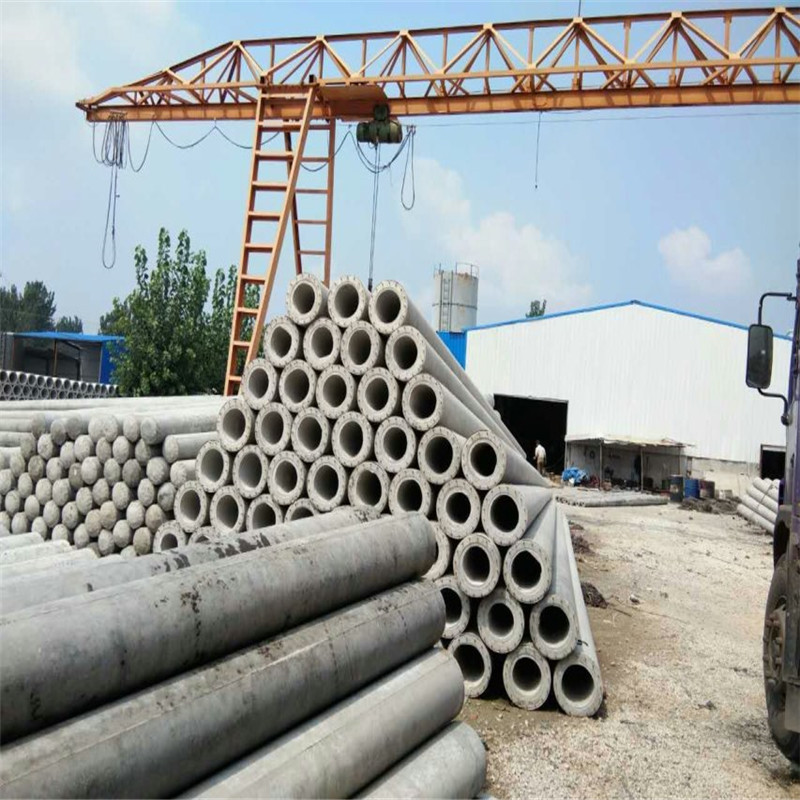
In addition to erosion from the soil side, aging inside the pole body itself cannot be ignored. Many concrete utility poles are centrifugally formed with an annular cross-section, and the pole body is hollow. If the top seal is not tight or the joint seals fail, rainwater can seep downward along the inner wall of the pole and eventually accumulate inside the pole base. In cold northern regions or areas with large day-night temperature differences at high altitudes, internal accumulated water expands in volume when it freezes in winter, generating enormous frost-heave forces. This force acting from the inside outward often causes longitudinal through-cracks at the pole base; in severe cases, the concrete cover spalls off in chunks and the steel bars are directly exposed. This superimposed effect of "internal trouble and external threats" makes the underground section at the pole base the weakest link in the entire life cycle of a utility pole. By comparison, although the pole shaft above ground is also affected by sun and rain, the carbonation rate of concrete is relatively slower, and even if surface cracking occurs, its inward development rate is usually far lower than the rate at which steel bars rust through due to electrochemical corrosion in the underground section.
For the operation, maintenance, and safety management of concrete utility poles, recognizing the principle that "failure occurs underground first" has important practical significance. When inspecting aging lines—especially pole towers that have been in service for more than twenty years or are located in low-lying, humid areas, paddy fields, or coastal zones—it is not enough to be satisfied with the observation that "the pole shaft looks like it hasn't fallen." When necessary, excavation should be carried out to inspect the condition of the pole body within a certain depth below ground, observing whether there are signs of concrete looseness, spalling, or steel bar corrosion. For pole types with a high risk of internal water accumulation, drainage holes can be provided at appropriate positions near the pole base, and the pole top seal should be ensured to be intact.
In addition, the acidity and alkalinity of the soil significantly affect the service life of the underground section. In acidic soil or areas long soaked in industrial wastewater or domestic sewage, the rate of concrete neutralization and steel bar corrosion increases exponentially. In such locations, using cement with a higher corrosion resistance grade or applying additional anti-corrosion coating treatment to the pole base is an effective means of extending the service life of utility poles.
