


- Publisher:mzadmin
- Published on:2026-10-25
- Pageviews:9339
- Source:
How Much Does a Concrete Utility Pole Weigh? After Reading This, You’ll Never Underestimate That Pole by the Road Again
First, the most direct answer: a common concrete utility pole can weigh anywhere from 300–400 kg to more than five tonnes. The one you see by the road most likely falls between 800 kg and 1.5 tonnes; if it is on a main road or a higher-voltage line, it may be far above that range. This weight is not a rough guess—it is jointly determined by pole type, length, tip diameter, butt diameter, wall thickness, reinforcement scheme, and concrete strength grade. Different regions, manufacturers, and line designs can all cause obvious differences in poles of the same length.
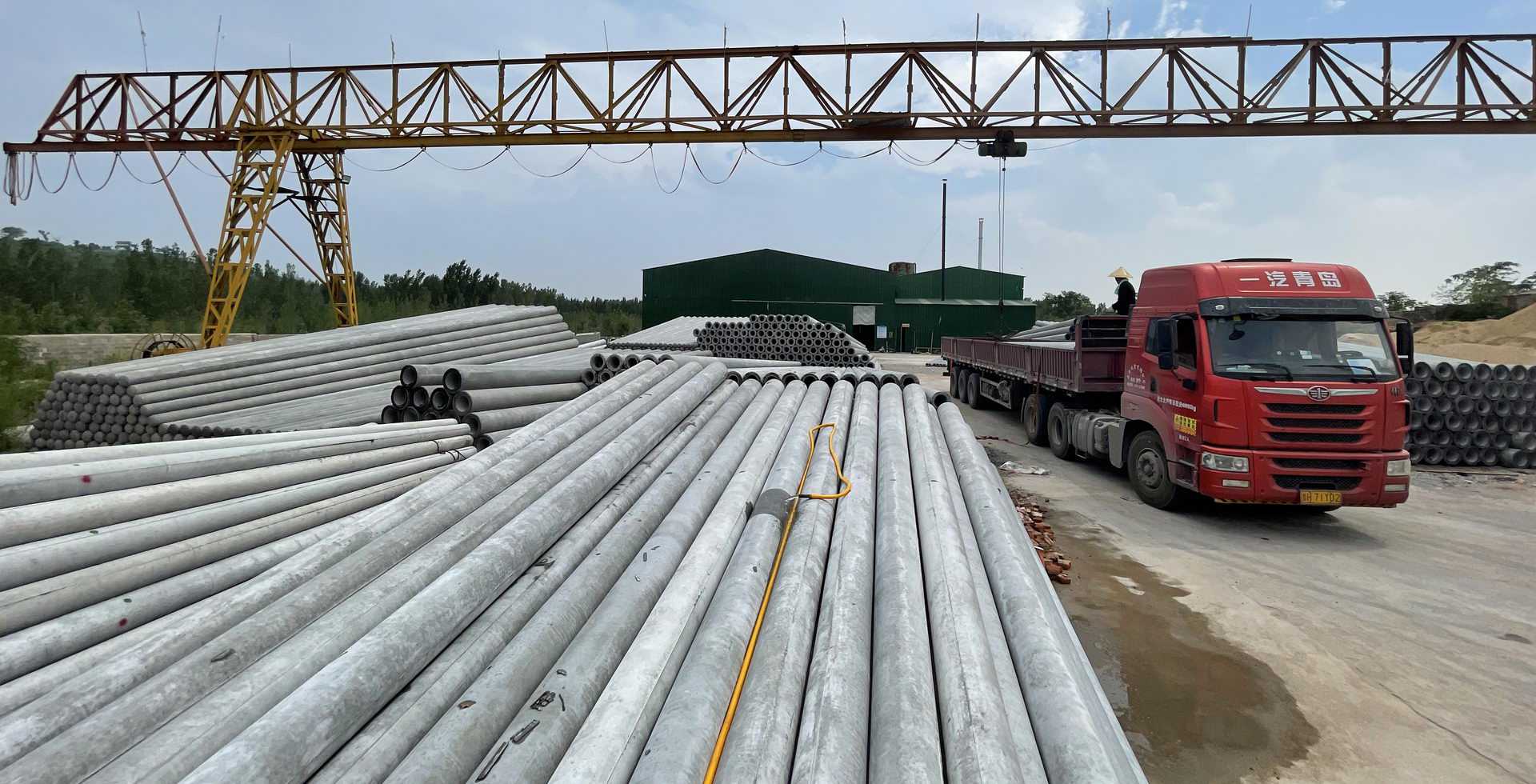
At present, the vast majority of utility poles on roads are annular concrete utility poles. Taking the most common tapered pole as an example, a set of common engineering specifications illustrates the point well: a tapered concrete pole with a tip diameter of 190 mm, a butt diameter of 350 mm, a length of 12 m, and a wall thickness of 50 mm weighs about 1,120 kg. With the same tip diameter of 190 mm, if the length is reduced to 10 m and the butt diameter is 323 mm, the weight drops to about 860 kg; if the length is extended to 15 m and the butt diameter is 390 mm, the weight rises to about 1,525 kg. If the tip diameter is increased to 230 mm and the butt diameter is 390 mm, a 12 m pole weighs about 1,325 kg. In other words, within the single category of tapered concrete poles alone, the common weight of a single 12 m pole ranges from around one tonne to more than 1.3 tonnes. As length continues to increase, weight climbs faster. For an 18 m non-prestressed tapered pole with a tip diameter of 230 mm and a butt diameter of 470 mm, the theoretical weight can reach 5,000 kg—that is, five tonnes—and it will be slightly higher if the reinforcement is made thicker. This is also why, in transportation and lifting, concrete utility poles are often treated as special cargo characterized by “long length and heavy weight.” Common lengths range from 8 m to 21 m, and weights from one to five tonnes.
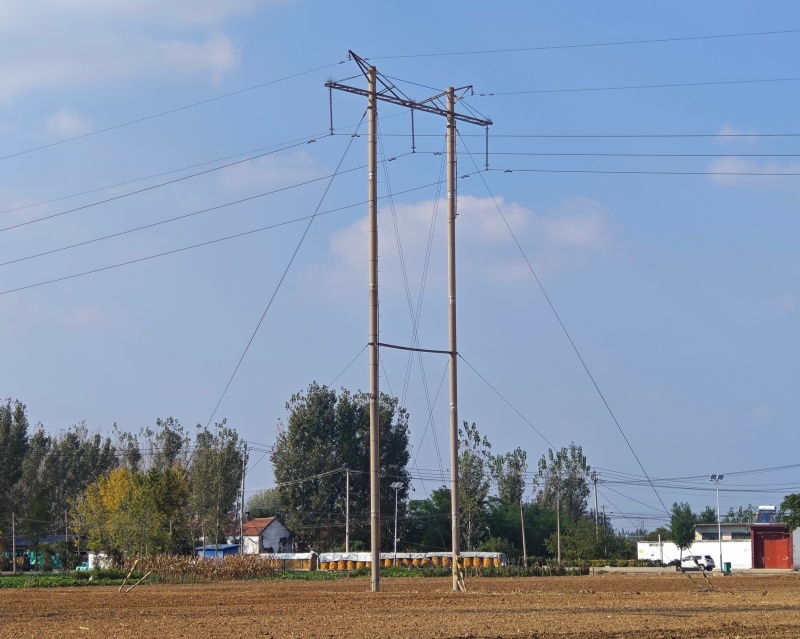
Prestressing technology makes the pole body “slimmer.” For the same 12 m tapered pole with a tip diameter of 190 mm and a butt diameter of 350 mm, the prestressed version weighs about 1,000 kg, while the non-prestressed version weighs about 1,100 kg; each meter of prestressed pole is about 10–15 kg lighter than an ordinary reinforced pole. Do not underestimate this difference of one or two hundred kilograms: at an annual usage scale of tens of thousands of poles, it means substantial savings in steel and cement. But regardless of the process, the pole body will never be light enough to be moved casually, because what it must satisfy first is structural safety, not convenience of handling.
Why must it be so heavy? The answer lies in the word “loading.” A utility pole is not “a column standing still”; it must simultaneously withstand the self-weight of conductors, wind load, ice load, the impact load when a conductor breaks, and possible temporary eccentric loads during construction and maintenance. Concrete itself is very strong in compression but very weak in tension, so steel reinforcement or prestressing wire must be arranged inside the pole body to bear tensile stress. Wall thickness, reinforcement amount, and concrete strength grade are all derived backward from the design bending moment and bearing capacity; they cannot simply be reduced to make the pole “lighter.” The tapered pole’s “thin at the top and thick at the bottom” shape is itself a weight-efficiency design: the bending moment is greatest at the base, so the diameter and wall thickness are correspondingly increased; the bending moment at the tip is small, so the dimensions are narrowed. It concentrates material where it is most needed, but even so, the concrete volume and steel weight of a 12 m pole add up to easily exceed the one-tonne threshold.
If we shift our view away from concrete poles, the weight picture becomes completely different. A preservative-treated wooden utility pole of about 8 m weighs only about 80 kg, while a concrete pole of corresponding specifications weighs about 400 kg. A wooden pole is light enough that several people can move it short distances with simple tools, whereas a concrete pole must rely on a crane or special lifting gear. This also explains why preservative-treated wooden poles still retain a place in some communication lines and terrain-limited situations. Steel tubular poles are another extreme. For steel tubular poles used in distribution and transmission lines, the design weight of a single base is commonly 2–4 tonnes or more, and large pole types are even heavier. They use the high strength of steel to achieve a slimmer pole shaft and more flexible crossarm arrangement, but the absolute weight has not become friendlier just because they are “hollow steel tubes.”
Once you know how much a pole weighs, you can understand why every step from leaving the factory to being erected requires serious treatment. During transportation, the lashing force usually needs to reach more than 1.5 times the pole’s own weight, and support points must be set precisely according to pole length: poles under 12 m need at least two supports, while those over 12 m need three or even four; otherwise, the bending moment generated by their own weight is enough to crack the pole body on the truck. During lifting, lifting points must not be chosen arbitrarily. For poles under 15 m, the binding point is usually selected 1–2 m above the center of gravity, and the wire rope must be fitted with a protective sleeve to prevent cutting into the concrete. Transportation speed must be controlled; when passing bridges and tunnels, their load capacity must be checked; extra-long poles require advance route planning and traffic coordination. The source of all this trouble is the weight of the pole. From the moment it is manufactured, it is no longer an object that can be “moved casually,” but a structural component that must be treated seriously in terms of lifting plans, transportation routes, and foundation design.
