



- Publisher:mzadmin
- Published on:2026-10-16
- Pageviews:8965
- Source:
How to Use a Concrete Utility Pole Clamp for Hoisting Concrete Utility Poles?
In power construction and communication line construction, the handling and installation of concrete utility poles is a fundamental step. An ordinary concrete utility pole often weighs hundreds of kilograms, so manual handling is inefficient and dangerous. The concrete utility pole clamp, also called a concrete utility pole hoisting clamp or gripping device, is used together with a crane or hoist to safely and efficiently complete loading, unloading, and short-distance transfer.
I. Basic Principles and Common Types of Concrete Utility Pole Clamps
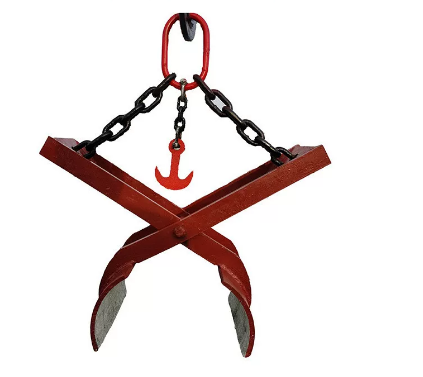
The core of a concrete utility pole clamp is a self-locking or clamping mechanism. Most hoisting clamps use lever transmission and a load-based self-tightening principle: when the clamp is lifted, the weight of the concrete utility pole itself is converted into clamping force, so the jaws clamp tighter and tighter. A hinged structure with left and right clamp bodies is common. When the clamp descends to the two sides of the pole, the jaws open; after the hook rises, the lifting rope pulls the clamp bodies together to embrace and tighten the pole, achieving a tighter grip as the load increases.
According to the driving method, there are three main types. The mechanical self-tightening type relies on the weight of the pole to clamp through levers; it has a simple structure and requires no external power. The electric clamping type uses a servo motor to drive a left-right threaded screw, causing the arc-shaped jaws to tighten inward; it can precisely control the clamping force and reduce the risk of the pole cracking due to excessive force. The forklift or crane dual-use type has a crossbeam with forklift pockets and lifting rings, so it can be lifted by forklift or hoisted by crane, making it flexible and convenient.
Selection must be based on the pole diameter. Common specifications cover diameters from 160 mm to 400 mm; for example, some are suitable for 160–190 mm, and others for 280–300 mm. If the clamp is too small, the grip is unstable; if it is too large, it cannot clamp tightly. Neither is acceptable.
II. Pre-Use Inspection and Preparation
Safety begins with inspection beforehand. For the concrete utility pole clamp, focus on checking: whether the hinge shaft is flexible and not rusted solid; whether the friction plates or rubber pads on the inner side of the jaws are intact and not severely worn; whether load-bearing parts such as lifting rings and lifting lugs have cracks or deformation; and whether bolts and nuts are complete and tight. The concrete utility pole itself must also be confirmed. Its surface should be smooth and even, with no exposed reinforcement, honeycombing, or longitudinal or transverse cracks. A damaged pole may break under concentrated stress during hoisting, with serious consequences. The work area should be cleared in advance, warning signs set up, and unauthorized personnel kept out. The crane outriggers should be supported stably. Before operation, conduct a trial lift: lift the concrete utility pole about 10 to 20 cm off the ground, check whether the clamp is tight, whether the pole is balanced, and whether the lifting sling is under normal stress. Only after confirming there is no abnormality should lifting continue.
III. Installation of the Concrete Utility Pole Clamp and Hoisting Operation
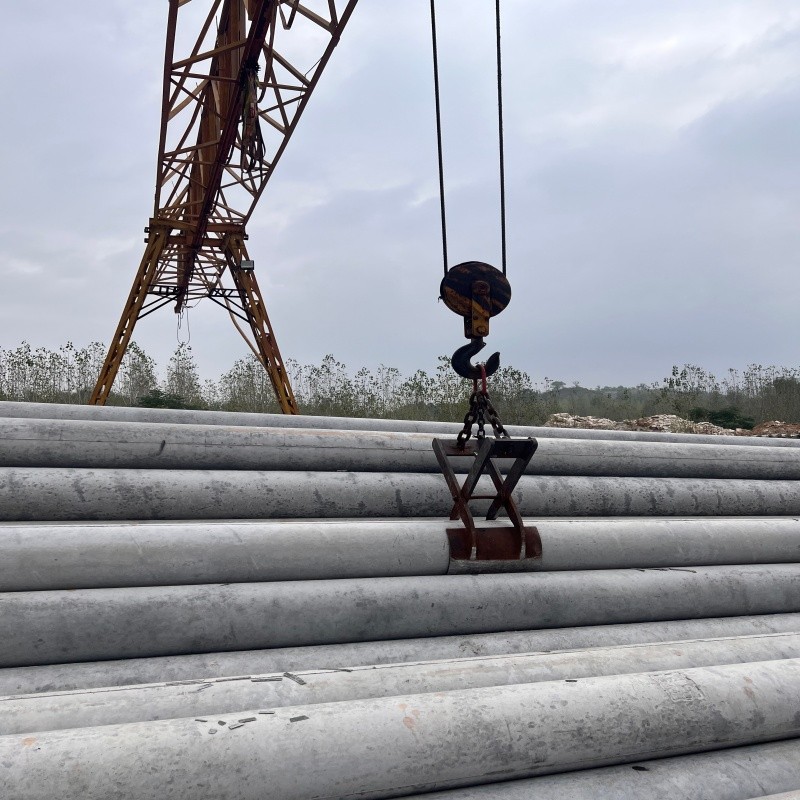
The installation position of the clamp directly affects stability. It should be clamped near the center of the concrete utility pole, that is, in the center-of-gravity area, to ensure that after lifting the pole is horizontal or inclined at a predetermined angle, avoiding excessive bending moment that could cause cracking. If the angle needs to be adjusted when entering a pit, a controllable pulley or tag line can be used as an auxiliary.
Taking the mechanical self-tightening type as an example: first hang the release hook on the clamp hinge shaft, so that the upper ends of the left and right clamp bodies open, and the lower jaws open to slightly larger than the pole diameter; lower the clamp so that the two jaws reach parallel to the two sides of the pole’s center of gravity; after confirming the position is correct, slowly raise the hook, and ground personnel detach the release hook from the hinge shaft. The tension of the lifting rope causes the upper ends of the clamp bodies to close, and the lower jaws close around and clamp the pole; continue lifting, and the concrete utility pole steadily leaves the ground.
The electric clamping type is more direct: hoist the clamp above the concrete utility pole, start the servo motor, and through gear transmission and a left-right threaded screw drive the two arc-shaped jaws inward to tighten. After clamping, lift. In either type, the order is position first, clamp second, then lift; it must not be reversed.
After the concrete utility pole is hoisted to the target position, placement must also be careful. Lower it slowly; before landing, ground personnel use a tag line to control direction, and after confirming it is stable, release the clamp. If in erection construction, the bottom end of the pole needs to be aligned with and slowly inserted into the prefabricated hole. After the pole stands stable and backfilling and tamping are completed, fully release the clamp.
IV. Safety Precautions and Common Misunderstandings
Do not clamp the end at will. Clamping at the end of the pole rather than near the center of gravity will cause one end to droop and the other to rise, generating excessive bending stress, and the concrete utility pole may crack or break. Do not omit the trial lift. Some people rush progress and directly hoist at height; once the clamp is not tight or the pole slips, the consequences are unimaginable. During hoisting, it is strictly forbidden for anyone to stand or walk below the concrete utility pole or within the slewing range of the crane boom. Do not lift poles with cracks or obvious defects. Cracks will expand rapidly under stress; choosing a concrete utility pole in good condition is the prerequisite for safety. Do not overload. Operate according to the rated load and applicable diameter of the clamp, and do not modify it at will.
V. Daily Maintenance and Storage
A concrete utility pole clamp is a load-bearing tool, and maintenance cannot be ignored. After each use, clean mud and cement residue from the jaws, and check whether moving parts are flexible and whether bolts are loose. For long-term storage, place it in a dry, ventilated place, and apply a small amount of anti-rust oil to the working surfaces of the jaws to prevent rust from affecting clamping force. If severe jaw wear, a loose hinge shaft, or a cracked lifting ring is found, stop using it immediately, and send it for repair or replace it. Do not make do with it; in hoisting operations, any weak link may become the starting point of an accident.
The concrete utility pole clamp is an indispensable tool in the hoisting of concrete utility poles. Correct use concerns not only construction efficiency but also personal safety. From model matching and pre-operation inspection, to standardized installation, careful lifting, and daily maintenance, every step must be taken seriously. We hope this article helps you clearly understand this tool and, in actual operation, have a clear understanding and exercise proper control.
