



- Publisher:mzadmin
- Published on:2026-10-09
- Pageviews:6064
- Source:
Is Steel Rebar Hidden Inside a Concrete Utility Pole? Many People Guess Wrong!
When people see a broken concrete utility pole by the roadside, many instinctively look at the fracture surface. If they see only grayish-white concrete, or only a single thin wire, they may suspect: Has this pole been made with cut corners? Is there any rebar inside at all? In fact, this kind of judgment is easily mistaken. Concrete utility poles usually do contain reinforcement; it is just that different types of poles differ greatly in the shape, quantity, and position of the reinforcement, and their appearance after fracture also differs. The real reason is that the reinforcement retracts at the moment of fracture. Especially in prestressed concrete utility poles, the high-strength steel wires inside are tensioned very tightly during manufacturing. After the concrete breaks apart, the wires retract into the pole body, making them less likely to be seen on the fracture surface. It is not that there is no reinforcement; rather, the reinforcement is hidden deeper.
To understand this, one must first distinguish between two common types of concrete utility poles.
The first is the ordinary reinforced-concrete utility pole. Its longitudinal load-bearing reinforcement usually uses ribbed steel bars, commonly known as deformed rebar. When this type of pole breaks, the rebar generally remains in the concrete, and individual bars are fairly visible on the fracture surface. Because the bars are thicker and relatively numerous, people can identify them easily.
The second is the prestressed concrete utility pole. Its longitudinal load-bearing reinforcement uses high-strength steel wire or strand, whose diameter is much thinner than ordinary deformed rebar, but whose strength is very high. In a prestressed concrete utility pole more than ten meters long, the total weight of the steel wire used inside may be only a few dozen kilograms, while the concrete weighs nearly a ton. The wires are few and small in diameter, and they retract after fracture, so the fracture surface looks “bare,” which is what causes the misunderstanding.
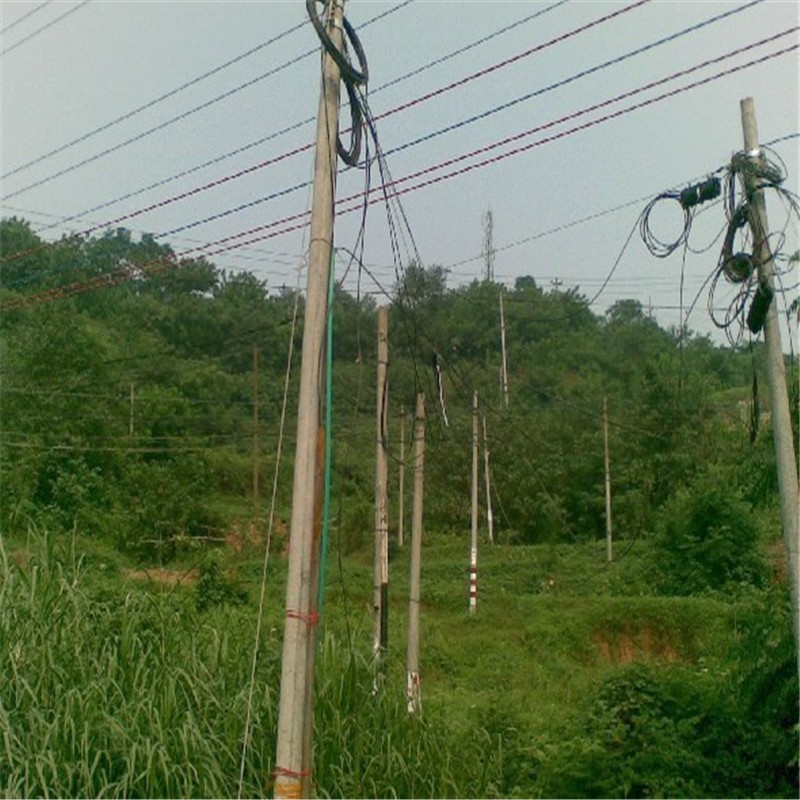
The prestressing process is the key to understanding reinforcement in concrete utility poles. Simply put, before the concrete is poured, the reinforcement is first tensioned to a very high tensile stress and fixed in place. Then the concrete is poured, and after it hardens to sufficient strength, the reinforcement is released. As the reinforcement rebounds and contracts, it transfers compressive stress to the concrete, putting the concrete into a precompressed state. What is the use of this precompressed state? In actual use, a concrete utility pole mainly bears bending loads. Wind, conductor tension, and ice weight all cause one side of the pole to be in tension and the other side to be in compression. Concrete is very strong in compression but relatively weak in tension. The precompressive stress acts like an advance protection for the concrete; when external tensile force appears, the precompressive stress first offsets part of it, making the concrete less likely to crack. Therefore, prestressed concrete utility poles have better crack resistance and can also save steel and concrete. This also explains why the reinforcement in prestressed concrete utility poles appears sparse. High-strength steel wire itself has high load-bearing capacity, and with prestressing, a small amount of wire can achieve a very good load-bearing effect. Less does not mean weaker; the key lies in material strength and the way forces are carried.
Whether ordinary reinforced-concrete utility poles or prestressed concrete utility poles, the longitudinal load-bearing reinforcement must be arranged evenly around the circumference of the pole. In addition to the longitudinal main bars, there are also spiral reinforcement and hoop reinforcement inside, used to fix the position of the main bars, confine the concrete, and participate in the overall load-bearing behavior. Together they form a three-dimensional reinforcement cage. This cage is encased in concrete, and the thickness of the cover layer is also subject to technical requirements. If the cover is too thin, the reinforcement is prone to moisture and corrosion; if the cover is too thick, it will reduce the efficiency of load bearing. Relevant standards seek a balance between durability and structural performance.
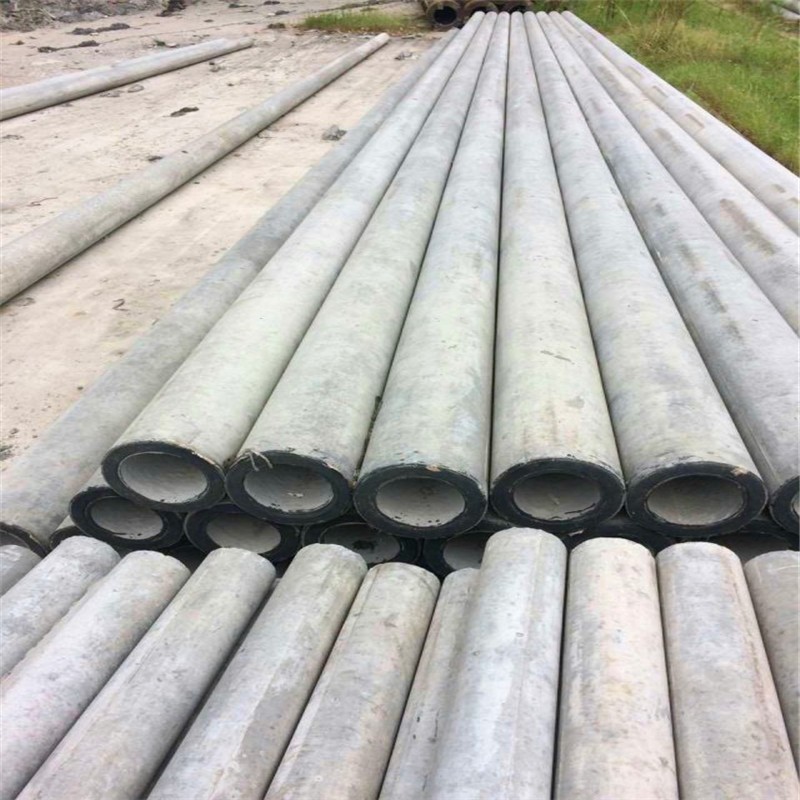
The manufacture of concrete utility poles is not simply pouring concrete into a mold. Take prestressed concrete utility poles as an example: first, the reinforcement is processed—straightened from coils, cut, and headed—then the reinforcement cage is made. After the cage is placed in the steel mold, tensioning is carried out, applying great tensile force. Next comes centrifugal molding. The mold rotates on a centrifugal machine from low speed to medium speed and then to high speed. Under centrifugal force, the concrete is thrown against the inner wall of the mold, forming a dense annular tube wall with a hollow cavity inside. Centrifugal force not only shapes the pole’s form but also determines the position of the reinforcement in the concrete. After molding, it also undergoes steam curing so that the concrete reaches its design strength as quickly as possible. Only after the entire process is completed is a concrete utility pole with a hidden reinforcement cage inside truly finished.
The fact that the reinforcement is completely encased in concrete is itself a form of protection. The alkaline environment inside the concrete allows a passivation film to form on the surface of the reinforcement, resisting corrosion. In coastal high-salinity areas or industrially polluted areas, the requirements for reinforcement corrosion protection are higher, and engineering measures such as coated rebar, galvanized treatment, or high-performance concrete are used to extend the service life of concrete utility poles. These details are rarely seen by ordinary people, yet they determine whether a pole can work outdoors for a long time. What kind of reinforcement is actually hidden inside a concrete utility pole? The answer varies with the type of pole. In ordinary reinforced-concrete utility poles, it is relatively thick deformed rebar; in prestressed concrete utility poles, it is thin but strong high-strength steel wire. What they have in common is that they are all rigorously calculated and configured according to standards, all encased in a concrete cover of sufficient thickness, and all silently supporting power lines. The design logic of a concrete utility pole has never been “the more rebar, the better”; rather, it is about using the right material, in the right place, with the right force.
