



- Publisher:mzadmin
- Published on:2026-09-30
- Pageviews:8738
- Source:
How Concrete Utility Poles Are Made
Every day, as you pass a street corner, you may rarely notice the gray concrete utility pole. It stands silently, holding up power lines, enduring wind and sun, and standing guard for decades. It looks simple, but behind it is a precise manufacturing process. From high-grade cement to high-strength steel reinforcement, from centrifugal forming at hundreds of revolutions per minute to steam curing with carefully controlled temperature, the birth of a concrete utility pole is essentially an engineering experiment in density, strength, and durability.
Raw materials: not just any cement will do. Concrete utility poles have higher requirements for raw materials than ordinary building components. For prestressed poles, the cement is usually Portland cement or ordinary Portland cement with a strength grade of not less than 42.5, and the concrete design strength grade is generally not lower than C50. The sand uses medium-coarse sand with a fineness modulus of 2.6 to 3.0, and the mud content is controlled within 1%. Crushed stone uses continuous grading of 5 to 20 mm, with a crushing value below 12%. For steel reinforcement, the longitudinal main bars are mostly spiral-ribbed high-strength steel wires, while the circumferential spiral reinforcement uses cold-drawn steel wire, with diameters ranging from 3 mm to 6 mm depending on the specification. The mechanical properties of these materials must meet the requirements of international standards such as ASTM C1089 for centrifugally cast prestressed concrete poles.
First Step: Reinforcing Cage Fabrication
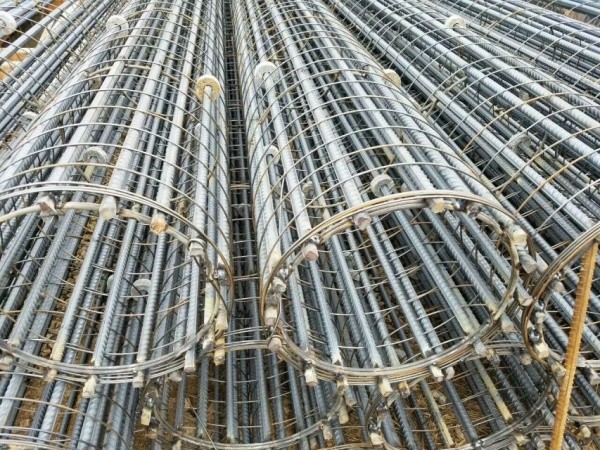
Manufacturing begins with the reinforcing cage. Workers cut the longitudinal main bars according to drawings, and the relative error in cut length is controlled within 1.5/10,000. The main bars and circumferential spiral reinforcement are welded into shape by a roll welding machine, forming a cylindrical reinforcing cage. Welding quality directly determines the bending resistance of the concrete utility pole, and the joint strength must not be lower than the strength of the steel itself. Steel hoops are also welded to both ends of the cage, and two tightly wound turns of spiral reinforcement are added at the ends to enhance local bearing capacity.
Second Step: Prestressing Tensioning
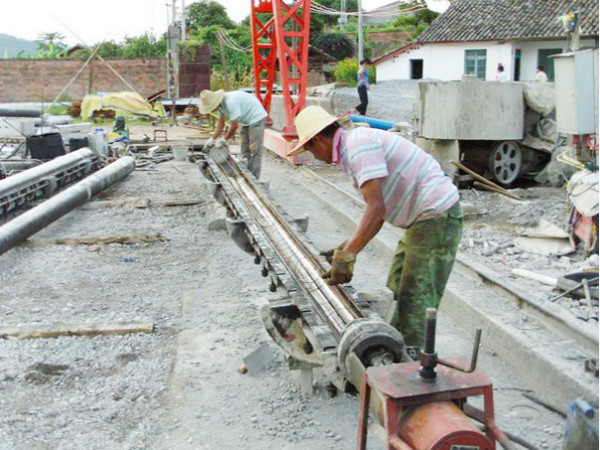
After the reinforcing cage is placed into the steel mold, the key process is prestressing tensioning. A tensioning machine applies tensile force to the main bars, stretching them to a preset stress value and then locking them. This process injects precompressive stress into the concrete utility pole. When the pole later bears wind loads and conductor tension, the precompressive stress stored inside the concrete can offset part of the tensile stress, thereby improving crack resistance and ensuring that no harmful cracks appear during line operation. During tensioning, the load must be applied evenly and the elongation must be measured repeatedly. If anything abnormal occurs, the process must be stopped immediately. The tensioning force is usually between 1,000 and 1,900 kN, depending on the design load class of the pole.
Third Step: Concrete Pouring and Mold Closing
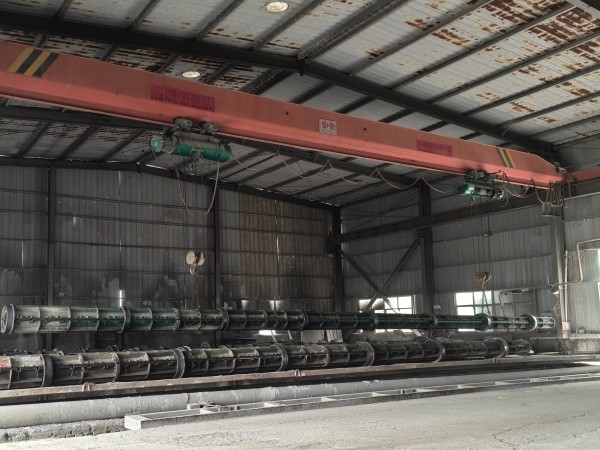
After the reinforcing cage is positioned in the mold and prestressing has been applied, the prepared concrete mixture is poured into the mold. Concrete utility pole manufacturing uses low-slump concrete. It has low flowability and a low water content, which is necessary to obtain a highly dense structure during the subsequent centrifugal process. After pouring is completed, the mold is closed and tightened to form a sealed cylindrical cavity.
Fourth Step: Centrifugal Forming
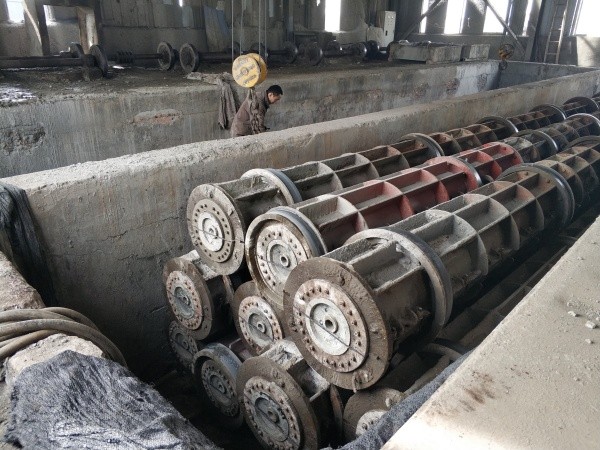
This is the most recognizable part of the entire manufacturing process. The mold filled with concrete is hoisted onto a centrifugal machine, which drives the mold to rotate at high speed around its own longitudinal axis. The centrifugal process is carried out in stages. A typical speed scheme is: first rotate at about 100 rpm for 2 minutes at low speed so the concrete is initially distributed evenly; then increase to about 300 rpm for 2.5 minutes; finally increase further to 400 rpm and continue rotating for about 9 minutes. Some processes use a higher final speed, such as 600 rpm for about 10 minutes. Under the centrifugal force generated by high-speed rotation, the concrete is pressed tightly against the inner wall of the mold, excess water is forced out, and a hollow, highly dense annular cross-section is left behind. The density of centrifugally formed concrete is significantly higher than that of ordinary vibrated concrete, and its compressive strength can be increased by more than 30%. Its permeability is extremely low, providing excellent corrosion protection for the internal steel reinforcement. At the same time, the hollow structure greatly reduces the self-weight of the concrete utility pole without significantly sacrificing bending strength.
Fifth Step: Steam Curing
After centrifugal forming is completed, the mold and concrete enter the steam curing stage. The goal of curing is to allow the concrete to quickly reach its design strength under controlled temperature and humidity conditions. The curing process is divided into four stages: static standing, heating, constant temperature, and cooling. In the static standing stage, the concrete is left at room temperature for 2 to 3 hours so that initial setting becomes stable. The heating rate is usually controlled within 15 degrees Celsius per hour to avoid cracks caused by sudden temperature changes. In the constant temperature stage, the temperature is generally controlled between 55 and 80 degrees Celsius and maintained for 4 to 6 hours, allowing the concrete to fully undergo hydration and reach the strength required for demolding. The cooling stage must also proceed slowly, ensuring that the temperature difference between the curing chamber and the outside does not exceed 15 degrees Celsius before the mold is opened. After curing is completed, the concrete strength must reach more than 70% of the design strength before demolding. After demolding, natural curing must continue until the 28-day age reaches the full design strength.
Sixth Step: Demolding and Inspection
After demolding, every concrete utility pole must undergo strict appearance quality inspection and mechanical performance testing. Appearance inspection focuses on surface cracks, grout leakage, exposed reinforcement, honeycomb, and other defects. Among these, Class A defects, including surface cracks, grout leakage, and exposed reinforcement, must not appear at all. The concrete cover to reinforcement should not be less than 15 mm, with a tolerance of plus or minus 5 mm. This is a key line of defense to ensure that the steel reinforcement does not corrode over the long term. Mechanical performance testing verifies the load-bearing capacity of the pole through full-scale bending and torsion tests. ASTM C1089 clearly specifies that acceptance of centrifugally cast prestressed concrete poles must be based on the results of full-scale bending and torsion tests.
Seventh Step: Factory Release
After passing all inspections, the concrete utility pole is marked with its specification, production date, and batch number, then stacked and waiting for shipment. From raw material entry to finished product release, the manufacturing cycle of a concrete utility pole is usually several days to about one week, while its service life can easily exceed half a century.
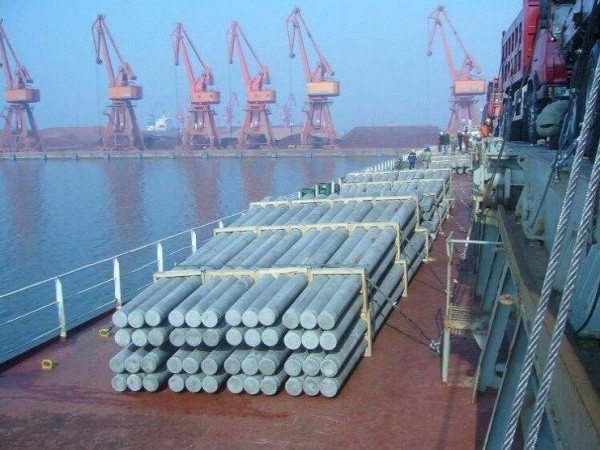
Next time you pass that gray concrete utility pole, take a second look. The seven processes it has gone through are all meant to keep it standing steadily in place for decades to come.
