



- Publisher:mzadmin
- Published on:2026-09-26
- Pageviews:7250
- Source:
How Long After Concrete Utility Pole Erection Can Stringing Begin?
After a concrete utility pole is erected, stringing often cannot immediately follow. When the pole is erected, conductors and accessories have not yet been installed, and the load borne by the pole body is relatively simple. Once stringing begins, tensioning operations apply horizontal pull at the top of the pole and transmit it through the foundation as an overturning moment. If the foundation concrete has not yet reached sufficient strength, the pole may tilt in mild cases or the foundation may be damaged in severe cases. Therefore, the waiting time is not a matter of experience but a matter of strength control.
Current construction acceptance specifications have clear requirements for this: before stringing construction, the foundation concrete strength must reach 100% of the design strength. This requirement is higher than that for the erection process. During piece-by-piece tower erection, concrete strength reaching 70% is sufficient; for whole-tower erection, 100% is required. Stringing, as a subsequent process with more complex load conditions, uniformly uses 100% as the threshold, with no room for flexibility.
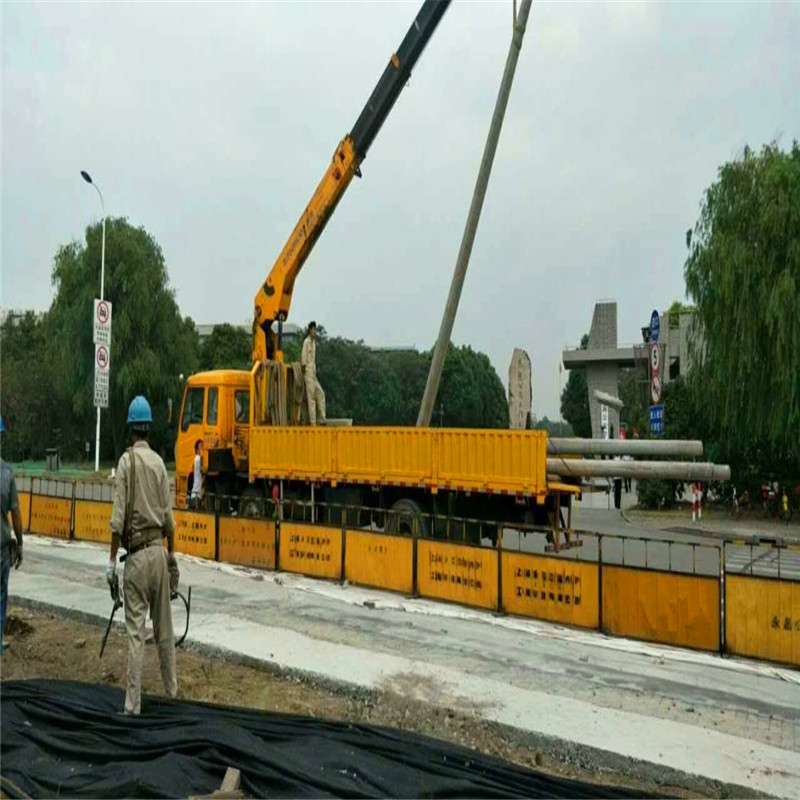
Whether the strength meets the standard is not determined simply by counting days, but by the compressive strength of test blocks cured under the same conditions. The test blocks are sampled and made at the pouring site, and their curing conditions are the same as those of the foundation. No fewer than two groups are required per shift, and the test block report serves as the basis for proceeding to the next procedure. In terms of curing time, concrete mixed with ordinary Portland cement must be water-cured for no fewer than seven days, and concrete with admixtures for no fewer than fourteen days. However, completion of the curing period does not mean the strength has reached the standard; the actual measured data from the test blocks must still be used as the criterion. Under normal temperature conditions, C25 foundation concrete usually reaches design strength in seven to fourteen days; during winter construction, strength growth slows significantly, and the waiting period may be extended to several weeks.
Prestressed concrete poles have an advantage at the material level in this regard. Their pole bodies undergo autoclave curing, and the concrete strength reaches the design requirement before leaving the factory, so there is no problem of an uncured pole body. The stringing waiting time depends entirely on the strength development of the cast-in-place foundation, not on the pole body itself. The pole body strength of ordinary reinforced concrete poles is also completed before leaving the factory, and the logic of on-site waiting is the same. In actual construction, to shorten the construction period while ensuring quality, two methods are commonly used. First, optimize the concrete mix ratio, use an early-strength admixture, or increase the strength by one grade, so that the foundation reaches design strength in a shorter time. Second, reasonably arrange the construction sequence, completing conductor pay-off preparation, fitting assembly, and tension and puller site layout during the foundation curing period, and immediately proceeding to tensioning after curing ends.
