



- Publisher:mzadmin
- Published on:2026-09-19
- Pageviews:2666
- Source:
What Is the Difference Between Flange Poles and Concrete Utility Poles?
Many people think that flange poles and concrete utility poles are two different things, but this is actually a common misunderstanding. To be precise, a flange pole is a type of concrete utility pole; it differs from the common welded pole only in the way the segments are connected. Ordinary concrete utility poles are limited by transportation and are usually divided into standard 6-meter or 9-meter segments delivered to the site. In the traditional method, the steel rings of two pole segments are aligned and welded together with electric welding to form a complete pole. With a flange pole, a flange plate with bolt holes??usually galvanized??is pre-embedded at the end of each pole segment. After delivery to the site, the upper and lower flange plates are mated, bolts are inserted, and they are tightened.
This difference may seem to be merely a matter of welding versus bolting, but its actual impact is significant. Welding one pole requires certified welders, a welding machine, and a power supply; after welding, slag must be cleaned and anti-rust paint applied, and work must stop in wind and rain. Flange connection requires only a wrench or an electric wrench: align the bolt holes and tighten, and installation is much faster, with lower requirements for the construction environment and personnel skills. In terms of anti-corrosion maintenance, the weld of a welded pole is the most vulnerable point. If the anti-rust paint is not applied thoroughly after the weld cools, the steel ring will soon corrode and become the weak point of the entire pole. The connecting parts of a flange pole are galvanized before leaving the factory, and the standard requires the average thickness of the galvanized layer to be no less than 86 microns. After tightening on site, the joint itself is corrosion-resistant and requires no additional maintenance.
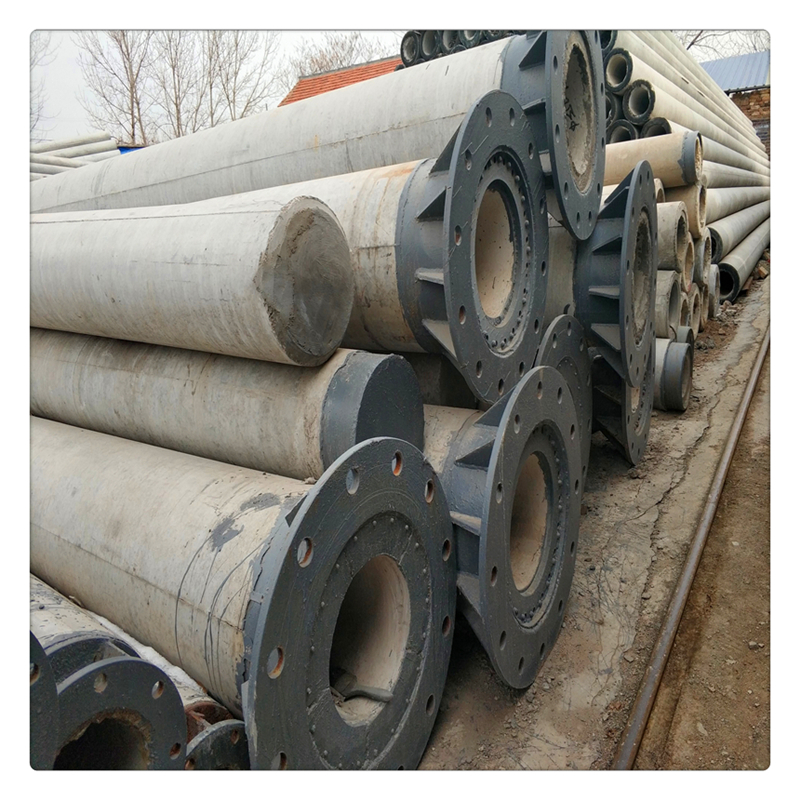
From the perspective of structural forces, the joint of a welded pole is a rigid connection; once welded properly, it is almost the same as an integral pole. The bolted connection of a flange pole is theoretically slightly lower in stiffness, but as long as the flange plate is designed properly and the bolts are tightened correctly, it can fully meet the load-bearing requirements of the pole. The current national standard GB/T 4623-2025, "Annular Concrete Poles," clearly specifies the classification, dimensions, and performance of flange connectors, and flange poles are a standard-recognized form of pole. A flange pole is a concrete utility pole, but a concrete utility pole is not necessarily a flange pole. Whether to choose welding or flanges mainly depends on construction conditions. At sites in mountainous areas or with inconvenient transportation where welding equipment is difficult to bring in, flange poles have obvious advantages; for projects with tight schedules and a desire to reduce on-site work, flange poles are also more suitable. If construction conditions are convenient and cost is sensitive, traditional welded poles remain a reliable choice. Flange poles also have a cost. The flange plate increases material and processing costs, so the price is usually higher than that of a welded pole of the same specification. In addition, the flange plate protrudes as a ring on the pole body, which has some impact on climbing and appearance, but most line projects can accept this.
