

- Publisher:mzadmin
- Published on:2026-09-17
- Pageviews:7256
- Source:
Load-Bearing Behavior of Main Reinforcement and Spiral Stirrups in Concrete Utility Poles
The main reinforcement, also called longitudinal load-bearing steel, refers to the steel bars arranged along the length of the pole. They typically use prestressed or non-prestressed high-strength steel bars, evenly distributed around the circumference of the circular cross-section. The core task of the main reinforcement is to resist bending moments. When a pole is subjected to lateral wind forces, the pole body undergoes bending deformation, with one side in tension and the other in compression. Although concrete has strong compressive strength, its tensile strength is weak, and it will crack once the tensile stress exceeds the limit. The role of the main reinforcement is to bear this tensile force in the tension zone, pulling the concrete back from the brink of cracking. In other words, without main reinforcement, a pole would fracture like a brittle beam under even moderately large lateral loads. For prestressed poles, the main reinforcement is tensioned before pouring, causing compressive stress to be pre-induced inside the concrete. When external loads arrive, this pre-compressive stress must first be offset before the concrete can enter a tensile state. This is equivalent to giving the pole a pre-stored capacity to resist deformation, significantly improving its crack resistance and stiffness.
If the main reinforcement is the longitudinal load-bearing skeleton, then the spiral stirrup is the confinement system wrapped around the outer periphery of the main reinforcement. The spiral stirrup is continuously wound along the entire length of the pole, forming a spiral-shaped reinforcement cage. Its role can be understood from three aspects. First, it fixes the main reinforcement bars scattered around the circumference together, ensuring that the main reinforcement does not move from its designed position and maintaining correct spacing and protective layer thickness during pouring and centrifugal forming. Second, it confines the lateral deformation of the core concrete. When the pole is under compression, the concrete tends to expand outward, and the spiral stirrup, like a tightly stretched ring, restricts this expansion, placing the core concrete in a triaxial compression state, thereby improving its compressive strength and ductility. Third, in bending or shear zones, the spiral stirrup bears shear forces, preventing the development of diagonal cracks and avoiding brittle shear failure of the pole.
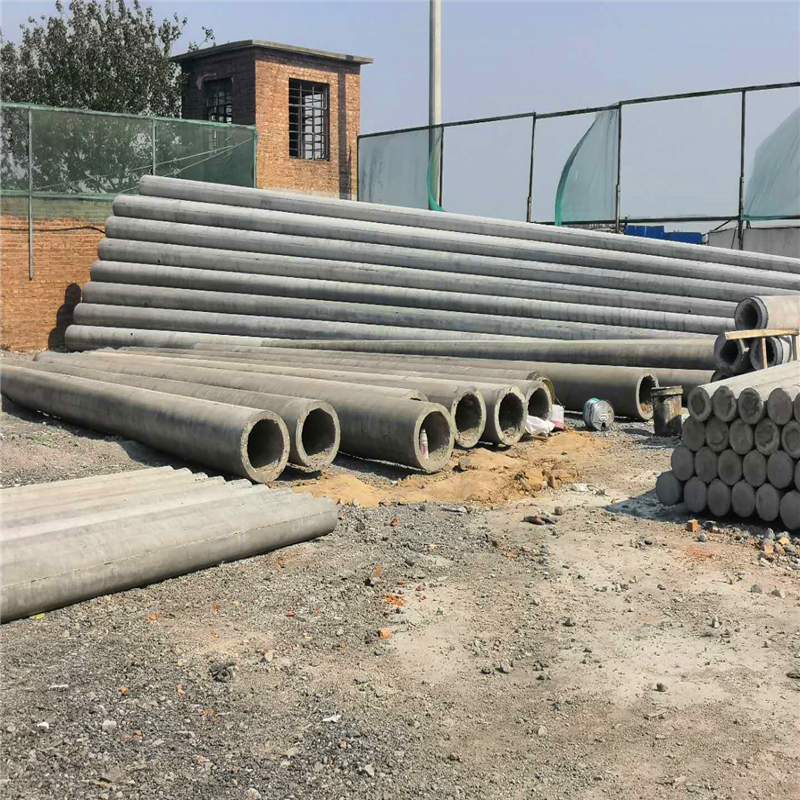
The synergistic relationship between the main reinforcement and the spiral stirrup can be understood through a simple analogy. The main reinforcement is like the longitudinal pillars inside a column, responsible for bearing the tensile and compressive stresses caused by bending; the spiral stirrup is like the rope wrapped around the outside of the pillars, binding them into a whole while providing lateral confinement under compression. Neither can be dispensed with. If there were only main reinforcement without sufficient stirrups, the main reinforcement would easily buckle outward under pressure, the concrete protective layer might spall, and the load-bearing capacity of the entire cross-section would drop significantly. Conversely, if the stirrups are adequately provided but the main reinforcement is insufficient, the pole's bending resistance would likewise be inadequate, and it would still crack or even break under relatively large lateral loads. In actual design, the diameter, quantity, and arrangement position of the main reinforcement are determined according to the bending moment distribution of the pole. Usually the bending moment is greatest at the base, and the main reinforcement is most densely arranged there; as it extends toward the top, the bending moment gradually decreases, and the number or diameter of the main reinforcement can be adjusted accordingly. The diameter, pitch, and winding density of the spiral stirrup are likewise calculated. In zones with greater shear force, the pitch is appropriately reduced to provide stronger confinement and shear resistance. If the pitch is too large, the confinement effect is insufficient; if the pitch is too small, it increases manufacturing costs and construction difficulty, so a balance must be found between safety and economy.
