



- Publisher:mzadmin
- Published on:2026-09-17
- Pageviews:7763
- Source:
Inner Wall Treatment of Concrete Utility Poles
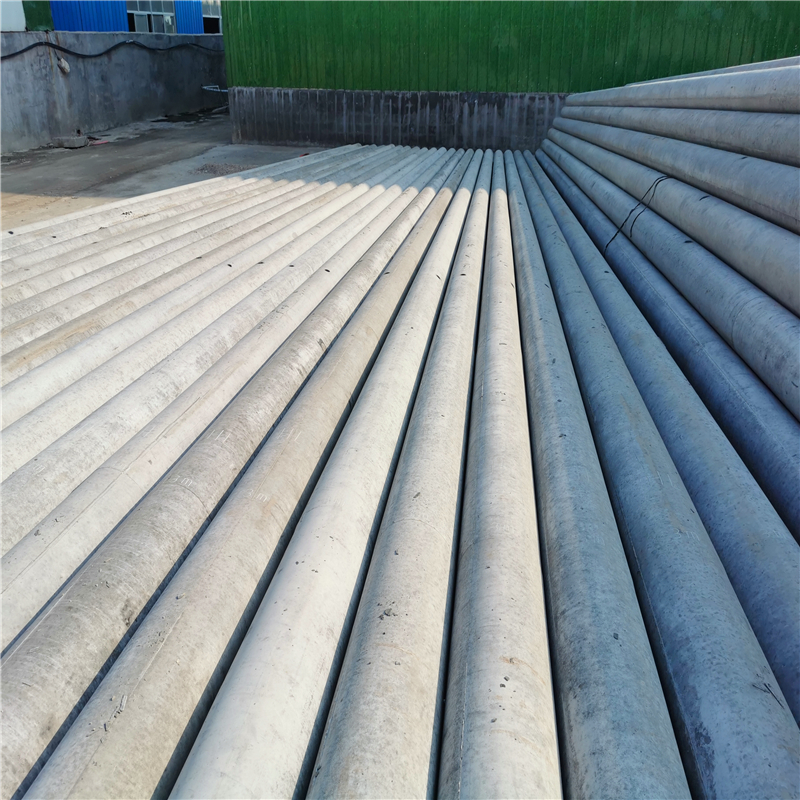
Concrete utility poles can be seen everywhere, lining highways and railways, supporting power and communication cables. Most people only see the smooth gray outer surface, but the interior of these hollow structures also plays a crucial role. How the inner wall is treated during manufacturing determines whether a pole can last for decades or deteriorate prematurely.
The inner wall of a concrete utility pole is not merely the surface left behind by the centrifugal forming process. During production, concrete is distributed onto the mold wall under centrifugal force, and the inner surface is formed as excess water and fine particles migrate inward. This causes the inner layer to be more porous and less dense than the outer shell. If left untreated, this inner surface is susceptible to moisture intrusion, chemical attack, and freeze-thaw damage. Water that enters the hollow core through unsealed joints or microcracks accumulates at the bottom. When temperatures drop, this water freezes and expands, exerting pressure on the concrete from the inside. After repeated cycles, this internal pressure leads to cracking, spalling, and eventually exposure of the reinforcing steel. To prevent this, manufacturers first apply a release agent to the inner wall of the mold. This release agent serves a dual purpose: it allows the hardened concrete to separate cleanly from the mold after curing, and it also affects the texture and quality of the inner surface. On modern production lines, automated equipment moves along the mold, applying the release agent evenly to the cylindrical wall and mold edges through brush mechanisms that adapt to the mold diameter. Uneven application leaves areas where the concrete bonds to the mold, resulting in a rough inner surface, exposed aggregate, or surface defects.
For poles used in more demanding environments, additional inner surface treatments are specified. Some manufacturers apply anti-corrosion coatings to the interior of the pole. Polytetrafluoroethylene (PTFE) is used for this purpose due to its chemical resistance and low friction properties. Other methods include applying epoxy-based coatings or linings to seal the concrete surface and prevent moisture penetration. In one patented design, an epoxy resin layer is placed under pressure between the load-bearing concrete shell and an outer protective layer, allowing the resin to penetrate cracks and self-heal over time as temperature changes. The inner surface also receives attention during maintenance and repair. When cracks develop in a pole that allow moisture to enter, the interior may need to be cleaned, dried, and coated with a primer or adhesive before applying a reinforcing liner. Such repair work is more complex than external repairs because working inside a narrow hollow pole involves limited space and a difficult operating environment. Relevant standards for concrete utility poles have explicit requirements for the inner surface. The standards stipulate that the inner surface must not have exposed reinforcing steel, and must not exhibit concrete slumping or segregation. These requirements exist because a defective inner wall compromises the structural integrity of the entire pole. Although the inner surface is invisible after installation, its condition determines how long the pole can remain in service.
