



- Publisher:mzadmin
- Published on:2026-09-15
- Pageviews:8640
- Source:
How to Select the Model of a Concrete Utility Pole
The selection of a concrete utility pole is essentially about finding the balance point between "being able to withstand the load" and "being suitable for the application." If the pole is chosen too thin, it may tilt or crack when strong winds come; if chosen too thick, it results in unnecessary cost waste. Understanding the meaning behind the model is the first step in making a reasonable choice. The model of a concrete utility pole is usually composed of several core parameters, and by understanding them, one can grasp the basic capability of a pole. The tip diameter refers to the diameter at the top of the pole, measured in millimeters, with common specifications being 150 mm and 190 mm. The larger the tip diameter, the thicker and stronger the pole body as a whole, and the greater its load-bearing capacity. The pole length is measured in meters, ranging from 6 meters to 18 meters, and determines the erection height and crossing capability of the line. The load grade reflects the bending resistance of the pole; the larger this value, the stronger the conductor tension and external impact forces the pole can withstand.
In actual selection, the voltage level and line type are the most direct bases for judgment. Communication lines and low-voltage lighting usually use 8-meter or 10-meter poles, and a tip diameter of 150 mm is sufficient to meet the requirements. Rural 380V low-voltage main lines mostly use 10-meter or 12-meter poles, with tip diameters mainly of 190 mm. The 10kV distribution line is the most widely used scenario for concrete poles, and a 12-meter pole with a 190 mm tip diameter is a common combination. When a line needs to cross highways, rivers, or railways, heightened poles of 15 meters and above come into use, as a taller pole body can ensure sufficient safe clearance between the conductor and the ground.
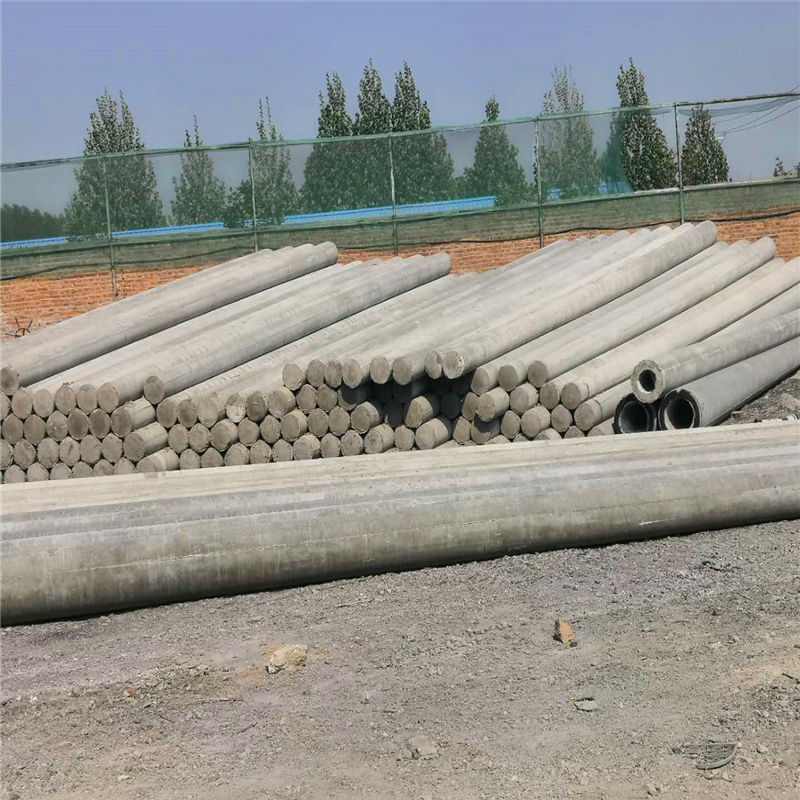
In addition to height and thickness, the process type also affects the selection decision. Prestressed poles are manufactured by pre-applying tensile force to the steel reinforcement, putting the concrete in a compressed state, which provides better crack resistance and makes them suitable for areas such as urban-rural fringe zones where they may suffer external scraping. Non-prestressed poles have a more uniform distribution of steel reinforcement and relatively better corrosion resistance; in environments with strong soil corrosiveness such as saline-alkali land or irrigation districts, their service life may actually be longer. When selecting, one should not blindly pursue prestressed poles, but should weigh the options according to specific working conditions. There is also a detail that is easily overlooked: the matching of burial depth and pole length. The burial depth of a utility pole is generally one-fifth to one-sixth of the pole length. If a 10-meter pole is buried only 1.5 meters instead of the required 1.7 meters, the risk of collapse in heavy rain and strong wind weather will increase significantly. The pole length determined during selection already implicitly includes the requirement for burial depth, and this must be strictly implemented during construction.
