



- Publisher:mzadmin
- Published on:2026-09-14
- Pageviews:6159
- Source:
The Development History of Concrete Utility Poles
Walking through streets and alleys, concrete utility poles are among the most inconspicuous pieces of infrastructure. They stand silently by the roadside, holding up the lights of countless homes, and few people give them a second glance. But if we trace their origins, behind this gray, unassuming pole lies a century-spanning history of material evolution. The birth of the concrete utility pole originally stemmed from a very practical problem: wood was running out??or rather, good wood had become too expensive. In the early days of electrification, most utility poles were wooden, but wood rots easily, is susceptible to insects, and has a limited lifespan. As power grids expanded, demand grew larger and larger, and cost pressures followed. The emergence of the concrete utility pole was, in essence, a product of "necessity being the mother of invention."
In the early twentieth century, various parts of the world began experimenting with using concrete to make utility poles. Early concrete poles were mostly square, solid columns??wider at the bottom and narrower at the top??with embedded steel reinforcement and a rough surface. But after being erected and tested, their performance exceeded that of wooden poles. This phase of exploration laid the foundation for the later large-scale application of concrete poles. Square poles solved the problem of "whether we had any at all," but their drawbacks were obvious: heavy, material-intensive, and structurally inefficient. The real technological turning point occurred at the level of manufacturing processes. In the 1950s and 1960s, concrete utility poles evolved from "solid square" to "hollow circular." The beauty of the circular cross-section lies in this: with the same weight of material, a circular ring's bending resistance is far greater than that of a solid square column, and the centrifugal casting process makes the concrete denser. An even greater breakthrough came with the introduction of prestressing technology. Simply put, prestressing means tensioning the steel reinforcement before pouring the concrete, so that the steel is "pulled taut" in advance. Poles made this way have greatly improved crack resistance and can also save a significant amount of steel. Thereafter, concrete poles moved from "clumsy and bulky" to lightweight and high-strength, becoming the dominant pole type for distribution grids in many regions around the world.
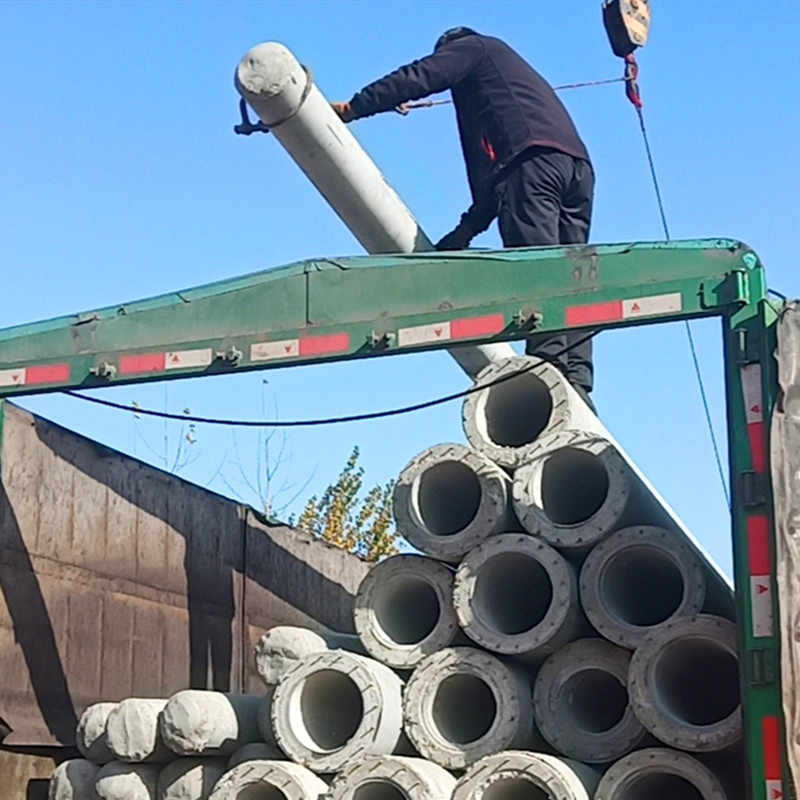
Some of those earliest square poles are still in use today. In many parts of the world, examples can be found of elderly concrete poles still standing, having endured decades of wind, sun, and geological tests. Their "ultra-long standby" precisely proves the natural advantage of concrete products in durability. From wooden poles to square poles, from square poles to circular poles, from ordinary reinforced concrete to prestressed concrete, each iteration of the concrete utility pole was not some earth-shattering invention, but the accumulation of "optimizing just a little more" in engineering practice. Today, in the field of ultra-high-voltage transmission, steel towers and steel pipe poles play the main role; but in low- and medium-voltage distribution grids in both urban and rural areas, concrete utility poles remain one of the most cost-effective and low-maintenance choices. They may not be "advanced" enough, but they are reliable enough??and that, precisely, is the most important quality of infrastructure.
