



- Publisher:mzadmin
- Published on:2026-09-12
- Pageviews:6274
- Source:
Understanding Bending Moment in Concrete Utility Poles
Many people, upon seeing the term "bending moment," assume it is something only engineers care about. But if you have ever watched a utility pole swaying in a typhoon, or seen one bent under heavy snow, you have already witnessed a bending moment in action. Understanding bending moment means understanding why concrete utility poles break, where they break, and how they are designed not to break. Hold a chopstick with both hands and press down on both ends. The chopstick bends, and at a certain point, it snaps. A concrete utility pole works the same way ?? wind blows from the side, conductors pull from the top, and the pole bends. This internal force that makes it bend and want to snap is the bending moment. It is not simply force, but force multiplied by distance. For example, if the top of a pole receives 100 kg of wind force and the pole is 10 meters tall, the bending moment at the base is 100 kg times 10 meters, equal to 1,000 kg??m. The same 100 kg of force, applied at a higher point, creates a greater bending moment at the base. Therefore, the taller the pole, the more demanding the strength requirements at its base.
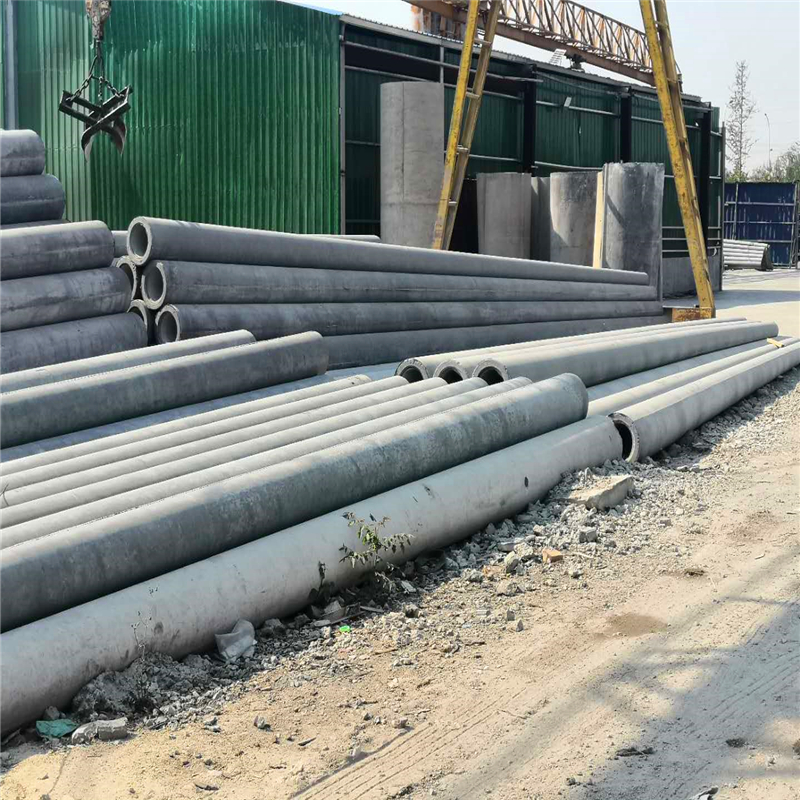
So where is the bending moment greatest? Usually near the ground. Because the ground is the pole's fixed end, all forces must ultimately be "absorbed" here. The higher up you go, the smaller the bending moment that must be borne; the lower you go, the greater the bending moment. This is also why the vast majority of pole failures occur just above the ground, not at the top. Once you understand where the bending moment comes from and where it is greatest, you can understand several key design moves in concrete poles. Most concrete poles are tapered ?? thinner at the top and thicker at the bottom. This is not for appearance, but because the bending moment at the base is large and requires a larger cross-section to resist. Where the bending moment is smaller at the top, making it thinner saves material and reduces self-weight. Concrete is very strong in compression but very weak in tension. When a pole bends, one side is compressed while the other is stretched. If the tension side has no steel reinforcement to hold it, the concrete will quickly crack. The role of prestressed steel reinforcement is to apply a compressive force to the concrete in advance, offsetting part of the tension and making the pole less prone to cracking when subjected to bending. Concrete utility poles are also hollow, not solid. For the same weight of material, a circular hollow section has a much higher bending resistance than a solid cylinder. This is like how a hollow steel tube is harder to bend than a solid iron rod of the same weight ?? the material is placed farther from the center, making it more efficient.
Finally, it is important to distinguish between two concepts: cracking moment and ultimate moment. The cracking moment is the bending moment value at which cracks begin to appear on the pole's surface, while the ultimate moment is the bending moment value at which the pole completely fails. In design, it is necessary to ensure that cracking does not occur under normal service conditions, and also that the pole does not fail under extreme conditions. These two values are among the most core parameters in factory inspection and engineering design of concrete utility poles.
