



- Publisher:mzadmin
- Published on:2026-09-12
- Pageviews:2803
- Source:
Why Can Concrete Utility Poles Last Over 50 Years?
A qualified concrete utility pole often has a design life of more than 50 years. Why can a seemingly simple concrete column outlast many sophisticated metal devices? The answer lies in the material itself and its manufacturing process. The core secret of a concrete utility pole is the combination of "steel reinforcement + concrete." The steel reinforcement bears tensile forces, while the concrete bears compressive forces and wraps around for protection. Together, they form an extremely durable composite material. But that is not enough. What truly gives a concrete utility pole its "long life" are two key steps in the manufacturing process.
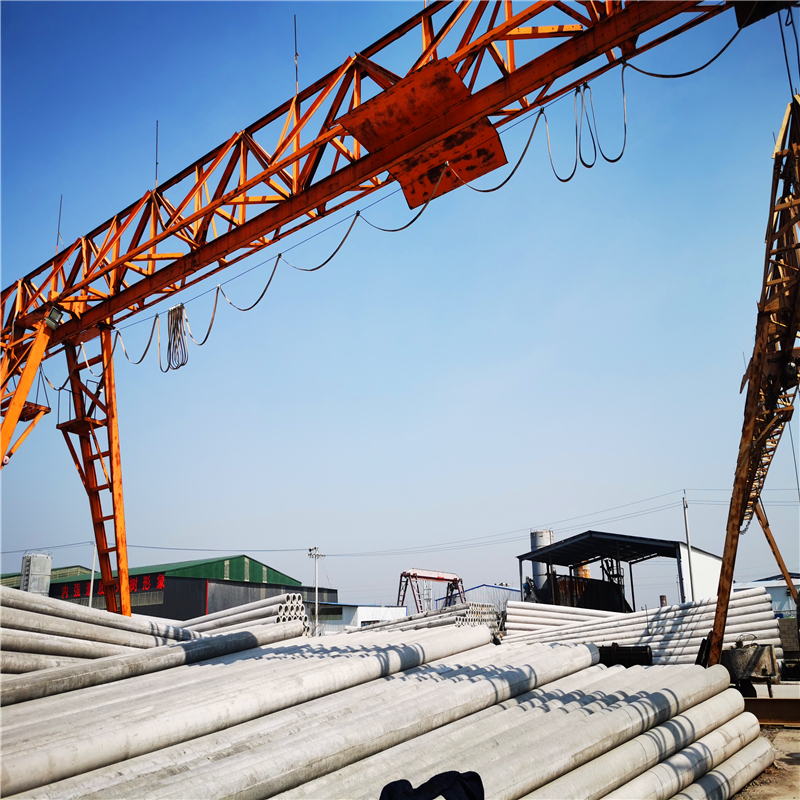
The first is centrifugal casting. When producing a concrete utility pole, workers place the steel reinforcement cage into a steel mold, pour in concrete, and then spin the mold at high speed. Under centrifugal force, the concrete is pressed tightly against the inner wall of the mold, excess water is squeezed out, and the remaining concrete becomes extremely dense. What does density mean? It means that outside moisture, oxygen, and corrosive substances find it very difficult to penetrate. The denser the concrete, the safer the steel reinforcement inside. The second is steam curing. Ordinary concrete needs 28 days of water curing to reach its design strength, but a concrete utility pole cannot wait that long. Factories use steam curing, in which the cement hydration reaction is accelerated in a high-temperature, high-humidity environment, allowing the concrete to reach high strength grades such as C40 or even C50 in just a few days. The higher the strength, the greater the ability to resist external damage and internal aging.
Of course, 50 years is only a design target, not something that happens automatically. A concrete utility pole also has its "natural enemies"??cracks. Once cracks appear in the pole body, moisture will seep in along the cracks, freeze and expand in winter, dissolve and wash away in summer, and "gnaw away" at the concrete year after year. More dangerously, after moisture reaches the surface of the steel reinforcement, the steel will rust and expand, gradually pushing open the concrete cover layer and eventually causing the entire pole to be scrapped. Therefore, those concrete utility poles that truly last 50 years are supported by a complete guarantee system: factories must use qualified cement and steel reinforcement and produce strictly in accordance with national standards; during construction, base plates and kick blocks must be properly buried, and where guy wires are needed, no corners can be cut; during operation, power supply departments must also conduct regular inspections and repair cracks in time. In coastal salt-spray areas and salt-lake zones, ordinary concrete poles may also "not adapt to the local environment," but engineers can specially develop "enhanced" poles with anti-corrosion properties by adjusting the concrete mix, allowing them to also achieve a 50-year lifespan in these harsh environments.
