

- Publisher:mzadmin
- Published on:2026-09-01
- Pageviews:4511
- Source:
Compatibility of Concrete Poles with High-Voltage Transmission Lines
In the planning and design of high-voltage transmission lines, pole selection is never arbitrary??it concerns the comprehensive balance of line safety, operational lifespan, and investment efficiency. Whether a pole is "compatible" with a line depends on the precise matching of multiple factors, including voltage class, conductor loads, and meteorological conditions.
Voltage Class Determines the Threshold for Pole Selection
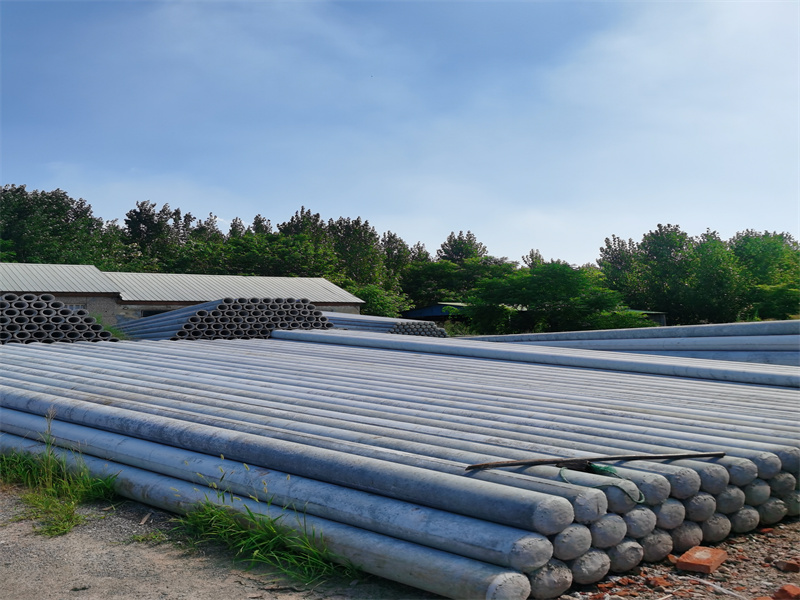
Different voltage classes impose distinctly different technical requirements on poles. For distribution lines at 10kV and below, conventional circular concrete poles with a tip diameter of 190mm and lengths of 10?C15m are commonly used??these are the most widely applied pole types in urban and rural distribution networks. However, when the voltage class rises to 35kV or even 330kV, ordinary poles are no longer sufficient??large-moment partial prestressed concrete poles must be adopted, which have higher standards in raw material selection, reinforcement detailing, and bearing capacity design. For lines at 110kV?C750kV in high-altitude areas (3,000?C5,500m), specialized design technical regulations must be followed.
Load Calculation Is the Core Basis for Compatibility
The compatibility between concrete poles and high-voltage lines is essentially a mechanical calculation problem. The loads that a pole must bear include the conductor's self-weight, ice coating weight, wind pressure, and line tension. Taking a 10kV single-circuit tangent pole as an example, designers must calculate the bending moment and shear force the pole will withstand based on horizontal span (typically 60?C80m), vertical span, and meteorological zone conditions, and then select the pole type against its load rating. In national standard pole designations such as "??190??12??M??G," the load grade codes (I, K, M, N, etc.) correspond directly to different flexural bearing capacities. During selection, it must be ensured that the pole's design bending moment exceeds the maximum bending moment actually generated by the line.
Process Type Affects Long-Term Compatibility Performance
There is also a difference in compatibility between ordinary reinforced concrete poles (Type G) and prestressed concrete poles (Type Y) in high-voltage lines. Prestressed poles, by applying pre-tensioning stress, significantly improve crack resistance and stiffness. With lighter self-weight and longer service life under equivalent load conditions, they have become the mainstream choice for high-voltage lines. For corner poles, terminal poles, and other positions with complex force conditions, guy wire systems are often required to jointly bear unbalanced tensions??this is also part of the "compatibility" solution.
The compatibility between concrete poles and high-voltage transmission lines is not about "bigger is better" or "stronger is safer," but rather a scientific matching based on rigorous load calculations and standard systems. We have in-depth knowledge of the differentiated performance requirements for poles across different voltage classes, meteorological zones, and pole positions. Relying on the national standard GB/T 4623 and industry design codes, we provide customers with precise pole type selection recommendations and full-process technical support??ensuring that every pole fits perfectly with the line it is meant to carry.
