- Publisher:mzadmin
- Published on:2026-08-31
- Pageviews:9288
- Source:
The significance of pole tip diameter and base diameter
When choosing cement utility poles, the first technical parameters that users are often exposed to are "tip diameter" and "base diameter". For example, the common electric pole with a diameter of 190-12 meters refers to the tip diameter. Many non professionals easily understand them as size descriptions of "how thick the top is and how thick the bottom is", but in reality, these two numbers are the underlying code for the mechanical performance, usage scenarios, and manufacturing costs of the entire pole. As a professional cement pole manufacturer, today we will delve into the true meaning of tip diameter and base diameter for you.
The tip diameter, which is the outer diameter size of the small head of an electric pole, is the primary basis for determining the classification and selection of electric poles. The national standard divides circular concrete poles into different series according to their tip diameter, with commonly used specifications such as ?? 150, ?? 190, ?? 230, and ?? 310. The core role of the tip diameter is reflected in two aspects: firstly, it determines the lateral stiffness of the pole. The thicker the tip diameter, the smaller the horizontal displacement of the pole top, and the more controlled the bending deformation under wind load and wire tension; The second is to match the wire fittings, such as crossarms, clamps, and heads, which are designed according to the tip diameter. Incorrect selection will result in inability to install or insufficient fastening force. For poles of the same height and load level, a larger tip diameter usually means a larger cross-sectional moment of inertia, significantly improving wind resistance, but also increasing material usage and transportation difficulty. Therefore, a balance needs to be struck between performance and economy.
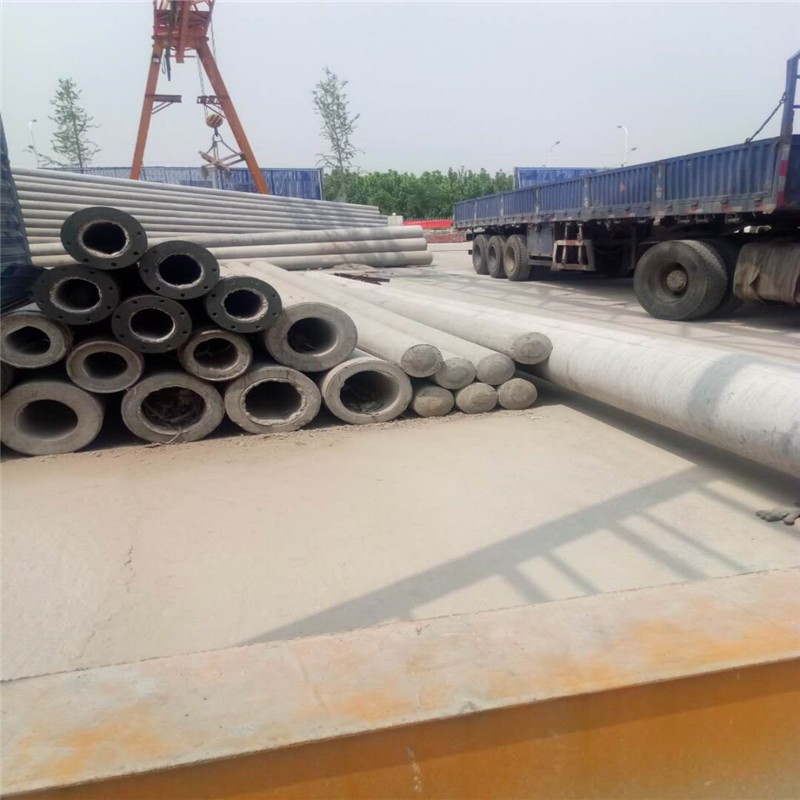
The base diameter, also known as the outer diameter of the large end of the pole, together with the tip diameter, determines the taper of the pole. Circular poles are usually designed with equal taper, with a common taper of 1:75, which means the diameter increases by about 13.3 millimeters per meter of length. The bottom diameter is not an isolated parameter, it directly affects three key performance indicators: bending capacity - the larger the bottom diameter, the greater the resistance moment of the root section of the pole, and the stronger the ability to resist overturning bending moment; Stability of burial depth - The thicker root diameter increases the contact area with the soil, improving the anchoring effect against overturning and uplift; Reinforcement arrangement space - The large base diameter provides sufficient cross-section for the dispersed arrangement of prestressed main reinforcement, avoiding excessive concentration of reinforcement and affecting the gripping force.
The relationship between tip diameter and base diameter is essentially a taper curve. For fixed length poles, the difference between the tip diameter and the base diameter is uniquely determined by the taper. This means that under standard taper, selecting the tip diameter is equivalent to indirectly determining the base diameter, and manufacturers cannot adjust it separately without changing the design. But different lines have different performance requirements for the upper and lower sections - high-voltage transmission requires more rigid pole tops to control wind deflection, while large spans require stronger root resistance to bending moments. This is precisely the core of actuarial matching required in pole design.
When selecting, please make sure to choose the tip diameter according to the actual working conditions. The use of top diameter as an economic benchmark and bottom diameter as a safety guarantee should not be neglected. Do not choose non benchmark rods with smaller tip diameters to save costs, as this will weaken both the top stiffness and root bearing capacity of the rod, leaving safety hazards. As a professional manufacturer, we provide a complete set of national standard series products and can customize and optimize the tip diameter and bottom diameter according to your line conditions. If you have any selection questions, please feel free to contact our technical department for professional advice.