

- Publisher:mzadmin
- Published on:2026-08-29
- Pageviews:7032
- Source:
How to choose high-quality cement poles
Cement poles are fundamental components of power and communication engineering, and their quality directly affects the safety and service life of the power lines. How to choose truly safe and durable high-quality electric poles in the face of uneven products in the market? As a professional manufacturing enterprise, we have sorted out several key points for you.
1?? Check qualifications and standards
High quality electric poles in our country must be produced strictly in accordance with the national standard GB/T 4623 "Circular Concrete Electric Poles". When making a purchase, the manufacturer is required to provide a third-party type inspection report to verify whether the product labeling clearly indicates the manufacturer, specifications, and applicable standards. Legitimate manufacturers will proactively provide raw material inspection records, concrete strength reports, and steel reinforcement mechanical performance reports.
2?? Look at the appearance and craftsmanship details
Visual observation is an intuitive initial screening method. High quality electric poles have a smooth and even surface, uniform color, and no defects such as honeycomb, rough surface, cracks, exposed stones, etc. Pay special attention to whether there are circumferential or longitudinal cracks in the rod body - circumferential cracks may be caused by stress concentration, while longitudinal cracks often indicate improper maintenance or insufficient reinforcement. Check if the end is flat and if the wall thickness is uniform. Electric poles with excellent centrifugal molding technology have smooth and dense inner walls, and a crisp knocking sound, indicating high density of concrete; If the sound is dull, there may be voids or looseness inside.
3?? Look at the steel reinforcement skeleton and protective layer
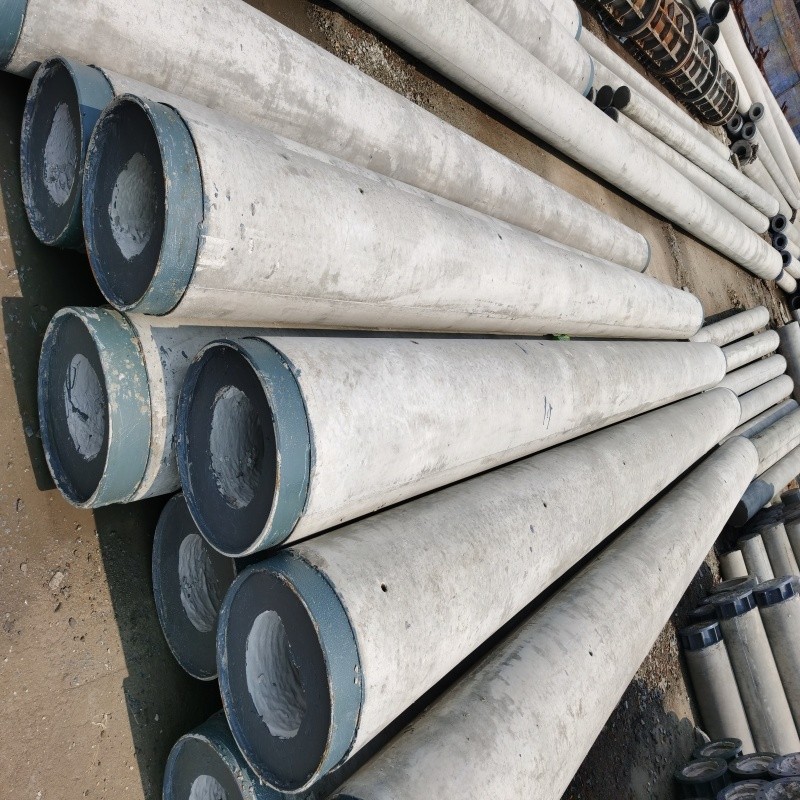
Steel bars are the 'skeleton' of electrical poles. High quality electric poles use high-strength threaded steel as the longitudinal main reinforcement, with uniform spacing between spiral hoops and firm welding. The main reinforcement must not be severely corroded. More importantly, the thickness of the protective layer is required by the national standard to be no less than 15 millimeters. Steel bars that are too thin are prone to corrosion, while those that are too thick will reduce their flexural bearing capacity. Observe the cross-section of the rod end, and ensure that the steel bars from reputable manufacturers are positioned in the center and arranged evenly. Poor quality electric poles often have reduced hoop diameter or increased spacing, which seriously affects crack resistance.
4?? Match the intensity level with the scene
Electric poles are classified into Class I, II, III, etc. according to their bending strength, corresponding to different load requirements. When making a purchase, one should not rely solely on experience or price, but should calculate the required bending moment level and parameters such as tip diameter, root diameter, and pole length based on design drawings or line loads. Blindly pursuing the idea of 'thicker, heavier, better' is not economical and may also lead to installation difficulties; Choosing low-grade electric poles for the sake of cheapness will bury serious safety hazards.
5?? Judging from the manufacturer's strength and service
Assess whether the manufacturer has automated centrifugal equipment, steam curing systems, and laboratory testing methods, and whether they have the ability to supply in bulk and deliver on time. Responsible manufacturers will provide a full process service from selection consultation, transportation plan to on-site installation guidance. Whether cushioning protection and layered loading are adopted during transportation also reflects the level of professionalism - minor damage caused by rough loading and unloading may expand into major problems after service.
6?? Check the reasonableness of the price
The principle of 'you get what you pay for' also applies in the electric pole industry. The cost of cement, steel, and sand is transparent. If the price is significantly lower than the market average, it often means that the cost of materials or maintenance has been reduced - shortening the steaming time, lowering the cement grade, reducing the diameter of steel bars, etc. These hidden defects are difficult to detect, but they can greatly shorten the service life. Suggest considering cost-effectiveness comprehensively instead of blindly pursuing low prices.