



- Publisher:mzadmin
- Published on:2026-08-28
- Pageviews:9164
- Source:
Key Points for Wall Thickness Control in Centrifugal Forming of Concrete Poles
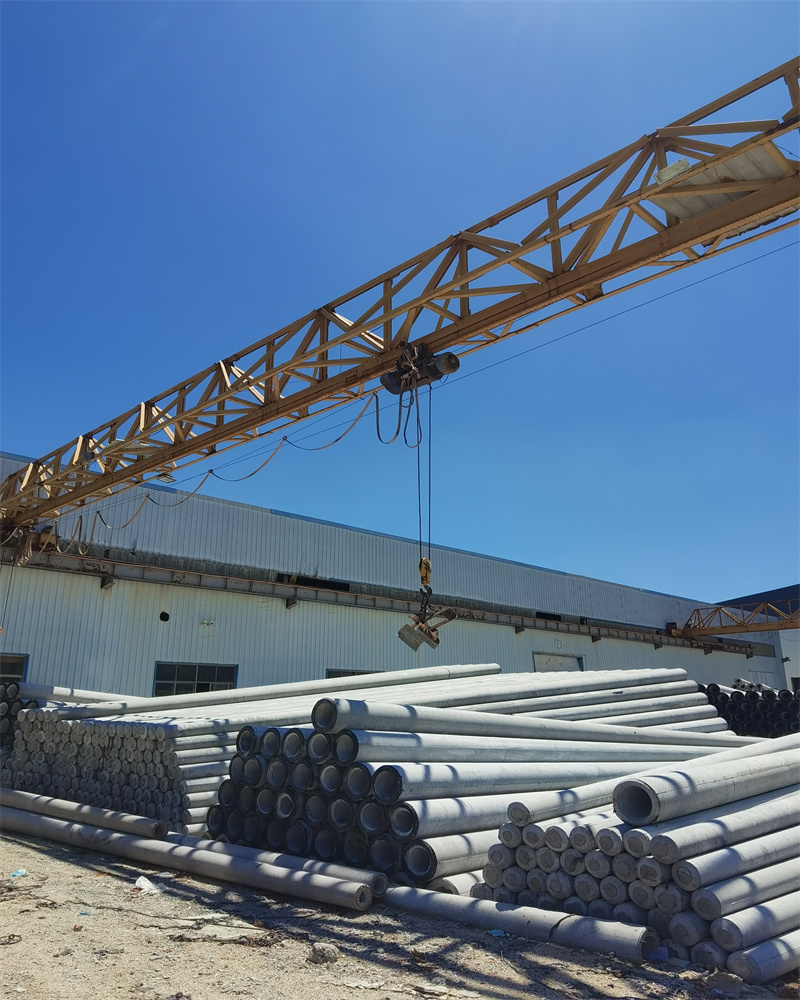
In the production process of concrete poles, wall thickness uniformity is a critical quality indicator. It directly affects the load-bearing capacity and service life of the pole, as well as raw material consumption and production cost control. As the mainstream technology for concrete pole production, centrifugal forming involves wall thickness control across multiple aspects including mold design, centrifugation regimes, and material properties. This article systematically reviews the core technical points of wall thickness control in centrifugal forming from a technical perspective.
1. Mold Design: The First Line of Defense in Wall Thickness Control
Traditional centrifugal forming processes use a single outer mold, leaving the inner concrete surface in a free state during centrifugation. Excess slurry is discharged from both ends of the mold, while remaining slurry flows along the inner wall, easily causing uneven wall thickness??an inherent shortcoming of the traditional process.
To address this, high-precision molds adopt a "double-mold structure" combining an outer and inner mold. The conical outer mold, coaxial conical inner mold, large-end prestressing tension ring, and small-end sealing plate together form a closed annular cavity. This closed cavity design fundamentally eliminates the free-flow issue on the inner wall, allowing cement mortar to form under mold constraint, resulting in smooth inner and outer surfaces and significantly improved wall thickness uniformity. Coaxiality calibration during mold assembly is particularly critical??any axial deviation between the inner and outer molds will directly manifest as circumferential wall thickness variation in the finished product.
2. Centrifugation Regime: Precise Matching of Speed and Time
Centrifugal forming is by no means a simple "spin and done" process. A scientifically sound centrifugation regime is the key to ensuring uniform concrete distribution along the mold wall and adequate compaction. Based on practical process experience, centrifugation typically proceeds in three stages:
Low-speed stage (approximately 2.5 minutes): Centrifuge speed at approximately 210 r/min, steel mold speed at approximately 85 r/min, for initial concrete distribution;
Acceleration stage (approximately 4.5 minutes): Gradual speed increases every minute, with steel mold speed not exceeding 300 r/min;
High-speed stage (approximately 10 minutes): Steel mold speed reaching approximately 450 r/min for full compaction under high centrifugal force.
Total centrifugation time should be no less than 17 minutes. Insufficient speed leads to inadequate concrete compaction, while excessive speed may cause aggregate segregation. In recent years, some manufacturers have introduced energy-efficient centrifugal devices with air-bag extrusion vibratory mechanisms, using high-frequency micro-vibration to help expel internal air bubbles and voids, further improving compaction and wall thickness uniformity.
3. Special Challenges of Conical Structures
Concrete poles are predominantly conical in shape, with significant diameter differences between the large and small ends. During horizontal centrifugation, the centrifugal forces at the two ends differ, causing cement mortar to continuously flow from the small end toward the large end??a key challenge in conical pole wall thickness control. The adoption of a closed annular cavity effectively mitigates this issue, as the slurry is constrained within a fixed cavity, eliminating wall thickness deviations caused by flow.
Additionally, the stability of centrifugal equipment is equally important. If the mold experiences vertical vibration during operation, it causes "eccentricity," directly affecting wall thickness uniformity. Therefore, precision calibration of support rollers and positioning rollers during routine equipment maintenance is essential.
4. Concrete Mix Design and Curing Coordination
Wall thickness control is not limited to the forming stage??it also depends on concrete fluidity and stability. Parameters such as water-cement ratio and slump must be specially designed according to centrifugal process characteristics??excessively low fluidity makes distribution difficult, while excessively high fluidity causes slurry segregation during centrifugation. The steam curing regime (temperature, duration, heating and cooling rates) similarly affects the final morphology and dimensional stability of concrete, with improper curing potentially leading to thermal cracking or deformation.
