

- Publisher:mzadmin
- Published on:2026-08-27
- Pageviews:3673
- Source:
How long is the service life of cement utility poles?
Amidst the alternation of dawn and dusk, at the intersection of rural paths and urban overpasses, those silent and towering concrete utility poles have long become the most faithful footnotes to modern civilization. They carry electricity and signals, connecting the daily lives of countless households. As deep explorers in this field, we are often asked a simple yet profound question: how long can this seemingly ordinary concrete pillar stand firm in the wind and rain? Today, let us use professionalism as a yardstick and time as a mirror to explore the scientific secrets behind the service life of concrete utility poles.
Design benchmark: a commitment of half a century
According to China's current national standards and internationally accepted design specifications, the design service life of circular concrete utility poles is typically set at 30 to 50 years. This figure is not arbitrary, but rather scientifically derived based on the durability design theory of concrete structures, taking into account material properties, load effects, and long-term environmental influences. With the dual support of high-quality raw materials and lean manufacturing processes, the actual service life of many utility poles can even reach 60 years or longer, silently witnessing the growth and changes of two or three generations.
The source of longevity: The "century-long commitment" between concrete and steel bars
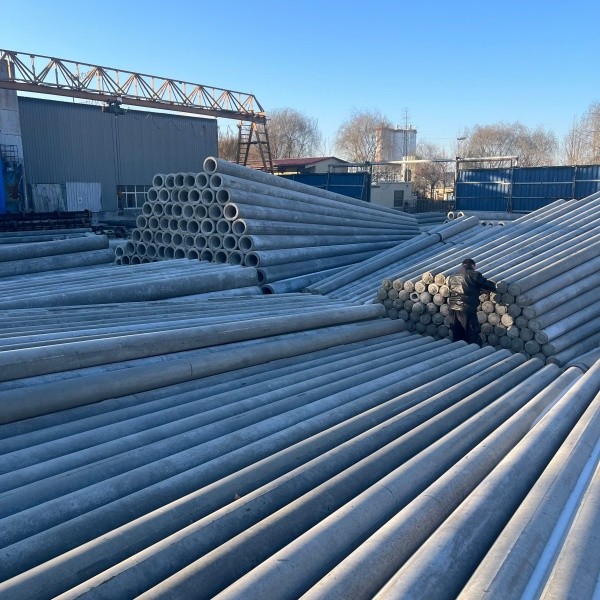
The lifespan of cement utility poles is essentially a long-term game between the concrete protective layer and the internal steel reinforcement. The reason why reinforced concrete has become the preferred material for century-old foundations is due to the close similarity in thermal expansion coefficients and excellent collaborative performance between the two. However, the erosion of time never stops. Carbon dioxide in the atmosphere slowly penetrates into the pores of concrete, undergoing carbonation reaction with calcium hydroxide therein, gradually reducing the alkalinity of the concrete. When the carbonation front reaches the surface of the steel reinforcement, the passive film on the steel is destroyed, leading to corrosion. The volume expansion of corrosion products can reach several times the original volume, eventually cracking the concrete protective layer and causing a decrease in structural bearing capacity. Therefore, the thickness of the protective layer, the compactness of the concrete, and crack control become the three core elements that determine the lifespan of utility poles.
Differences in Destiny: What Causes the Variation in Lifespan?
Since the design lifespan is clearly defined, why do some utility poles show signs of fatigue after just over 20 years, while others remain upright for half a century? The answer lies in the following three dimensions:
Firstly, the innate foundation - manufacturing quality. The lifespan of the electric pole is already determined from the beginning of concrete mixing. High-quality electric poles use Portland cement with a strength grade of not lower than 42.5, strictly controlling the water-cement ratio and slump, and obtaining a high-density, low-porosity concrete structure through centrifugal molding process. However, products that are cut corners, contain inferior admixtures, or are improperly cured are like buildings with shaky foundations, unable to withstand the test of time.
Secondly, the foundation of construction and installation. As the saying goes, "Only with deep roots can the leaves flourish." The burial depth of the pole, the setting of the foundation base and chuck, and the arrangement of the guy wires all affect its stress state. Improper installation leading to eccentric stress or loose foundation will accelerate the fatigue damage of the root concrete, significantly reducing its lifespan.
Thirdly, environmental changes - the tempering of wind, frost, rain, and snow. The freeze-thaw cycle in severe cold regions of the north, chloride erosion in coastal areas, and acid rain deposition in industrial zones are all "accelerators" of the lifespan of utility poles. During the freeze-thaw process, moisture repeatedly freezes and expands in microcracks, akin to countless tiny wedges continuously tearing apart the concrete structure. Because of this, for harsh environments, it is necessary to use concrete of higher strength grade (such as C50 and above), mixed with air entraining agents and rust inhibitors, to build multiple durable defense lines.