

- Publisher:admin
- Published on:2026-08-25
- Pageviews:4808
- Source:
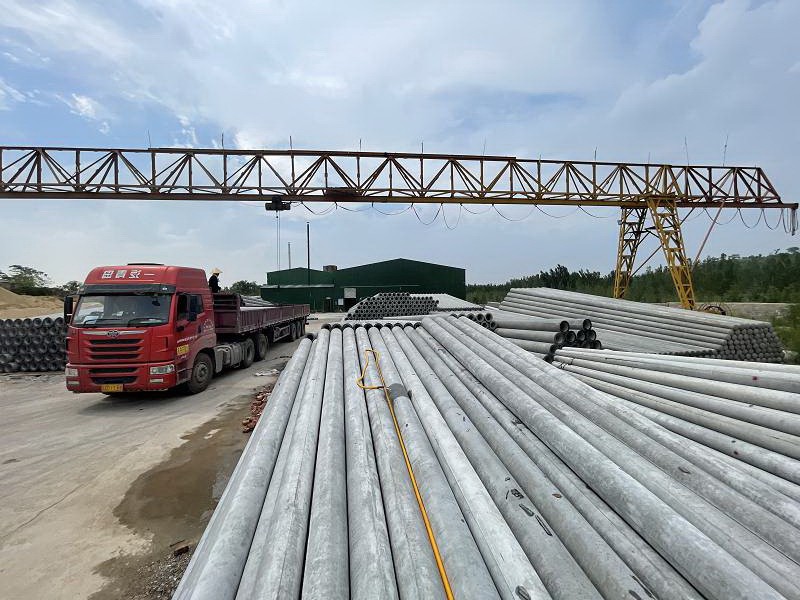
In the grand landscape of power transmission and information delivery, cement poles stand as indispensable supporting backbones. They tower across open fields and mountain ridges, enduring wind, rain, and the test of time. The starting point of all this resilience lies in the rigorous selection of raw materials. For cement pole manufacturers, a deep understanding and strict implementation of raw material technical standards are not only a commitment to product quality but also a responsibility to public safety. This article, based on the current national standard GB/T 4623-2025 "Circular Concrete Poles" and related material specifications, systematically analyzes the technical requirements for the core raw materials of cement poles.
I. Cementitious Materials: The Quality Cornerstone of Cement
Cement, as the "soul" of concrete, directly determines the strength and durability of the pole. According to technical standards, cement poles should be produced using Portland cement or ordinary Portland cement with a strength grade not lower than 42.5. Under specific conditions, slag Portland cement or sulfate-resistant Portland cement may also be used, with their performance strictly conforming to GB175, GB748, and other specifications. For prestressed poles, to meet the long-term stability under high stress, high-grade cement with a strength grade not lower than 53.5 MPa is generally required, ensuring that the concrete forms a dense and robust microstructure after centrifugal molding and prestressing tensioning. High-quality cement not only provides early demolding strength but also ensures volume stability and corrosion resistance throughout the pole's long service life.
II. Aggregate System: Nature's Gift of Sand and Stone
Sand and stone form the skeletal framework of concrete, and their gradation and cleanliness are crucial. Fine aggregates should preferably be medium-coarse sand with hard texture and good gradation, with a fineness modulus controlled between 3.2 and 2.3. The use of sea sand containing impurities such as shells is strictly prohibited to prevent potential corrosion of steel bars by chloride ions. Coarse aggregates should use crushed stone or pebbles with a particle size not exceeding 25 mm, and the maximum particle size must be less than 3/4 of the clear spacing between steel bars, ensuring that the concrete uniformly encases the reinforcement and is compacted through vibration. Aggregate quality must comply with GB/T 14684 and GB/T 14685, with mud content and harmful substances kept at extremely low levels. Though humble, aggregates serve as the solid backing that endows the pole with compressive strength and volume stability.
III. Reinforcement Materials: The Steel Backbone of Reinforcement
Steel bars are the core framework for withstanding bending moments and tensile stresses. In selecting steel bars, a distinction must be made based on the pole's design type: prestressed steel bars typically use high-strength cold-drawn bars, indented wires, or steel strands, conforming to GB/T 5223 and GB/T 5224. Through prestressing, the concrete is placed in a favorable compressive state before bearing loads, significantly enhancing crack resistance. Non-prestressed steel bars commonly use Grade I or II hot-rolled bars for structural and auxiliary reinforcement. The steel processing stage is particularly meticulous, requiring straightening, cutting, and a controlled cold-drawing rate strictly between 1% and 4%. Skeleton welding employs flash butt welding to ensure joint strength no less than that of the base material. The precise positioning and firm tying of each steel bar faithfully reproduce the mechanical calculation model.
IV. Functional Components: Admixtures and Mineral Additives
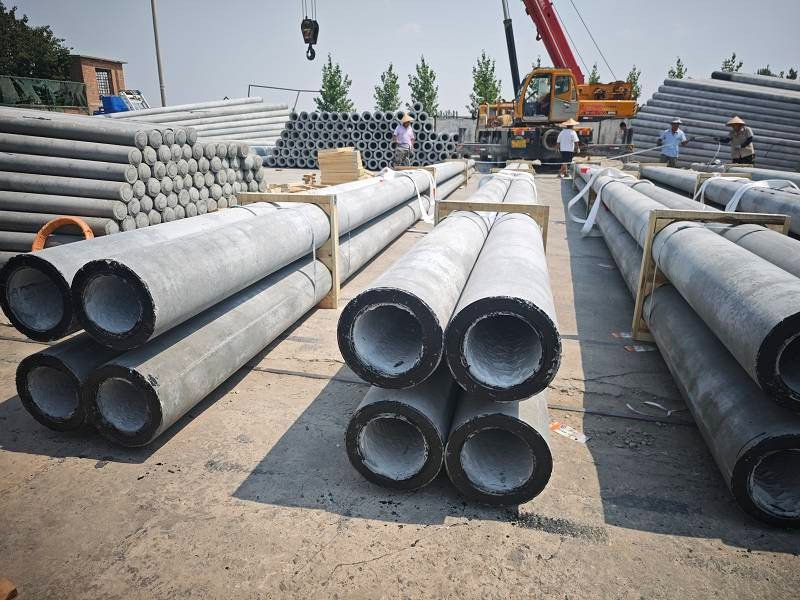
Modern pole production relies on precise blending of chemical admixtures and mineral additives. To improve workability, regulate setting time, and enhance durability, admixtures such as water reducers and early-strength agents conforming to GB8076 may be incorporated. However, the use of admixtures containing chloride salts or those corrosive to steel bars is strictly prohibited. Additionally, appropriate amounts of Class I or II fly ash conforming to GB/T 1596 may be added as mineral additives, improving long-term durability and pumpability without compromising strength. Notably, mixing water must comply with JGJ63, using potable water to fundamentally eliminate impurities that could affect the hydration reaction of cementitious materials.
Conclusion
From a grain of sand to a bag of cement, from a steel bar to a ton of admixture, every raw material for cement poles carries clear and stringent standard benchmarks. Following current national standards such as GB/T 4623-2025, and implementing full-chain inspection and control over raw materials, is the only path to manufacturing qualified, safe, and durable circular concrete poles. As professional manufacturers, we deeply understand that only by treating every material with reverence and measuring every specification with scientific precision can we forge the solid backbones that support countless households and global information connectivity.
