



- Publisher:admin
- Published on:2026-08-25
- Pageviews:1550
- Source:
Behind the surging currents of modern civilization, amid the crisscrossing fields and rural landscapes, rows of silently standing concrete utility poles are the most faithful guardians of power transmission. Braving wind and rain, they uphold the lights of countless households. And the unyielding backbone that empowers them lies hidden within the concrete??the unseen "skeleton of steel." Today, let us step into the production frontline of concrete poles and trace the transformative journey from a single rebar to a finished reinforcement cage (commonly known in the industry as the "rebar cage"), experiencing the precision and craftsmanship that flow through the industrial bloodline.
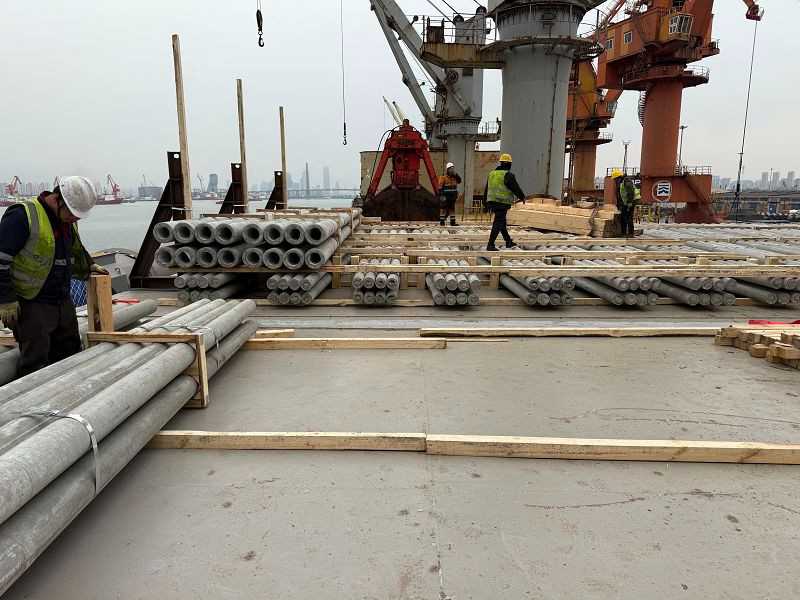
I. Mastery of Materials: The Art of Rebar Pretreatment
All sturdiness originates from the very beginning. The steel bars used to craft the pole's skeleton must first undergo rigorous inspection. The specifications and strength of raw materials must comply with national standards??this is the first line of defense for quality.
Subsequently, these rebars enter the processing area. Under the precise "command" of CNC rebar straightening and cutting machines, the originally coiled or bent bars are stretched straight and cut to designed lengths with pinpoint accuracy. This step demands extreme precision, with tolerances controlled within 1.5/10,000 of the total length??any minor deviation could compromise the skeleton's load-bearing performance. For prestressed poles, the main rebars undergo an additional heading process: a robust upset head is cold-forged at the bar end. This small protrusion becomes the "anchor point" that transmits immense force during subsequent tensioning, with its strength and dimensions controlled to the micron level.
II. Interweaving Structure: Welding and Forming the Rebar Cage
If a single rebar is a bone, then welding and forming is the joint that brings the skeleton to life. In modern rebar cage processing zones, workers arrange the treated main rebars in a circular pattern, fixing them onto the hanging plates at both ends of the mold. For tapered poles, the main rebars must strictly follow a 1:75 taper ratio, creating an elegant form that broadens at the base and narrows toward the top.
Next come the positioning rings (stiffening rings) and spiral stirrups. The positioning rings act like ribs, propping up the main rebars from within, typically spaced no more than 500 millimeters apart, ensuring the skeleton remains undistorted during pouring. The spiral stirrups, like agile serpents, coil tightly around the outer perimeter of the main bars and are securely tied with wire. Their presence effectively restrains lateral deformation of the concrete, substantially enhancing the pole's crack resistance. At this moment, the scattered rebars, through spot welding and tying, are woven into a rigid-yet-flexible three-dimensional load-bearing ensemble.
III. Prestressing: The "Pre-Compression" Magic That Bestows a Soul
For high-quality prestressed poles, skeleton formation is merely the beginning. After being placed into the mold, the production line employs tensioning jacks to stretch the rebars to their limits. When the tension force reaches 75% of the steel's standard strength, a tremendous amount of energy is "locked" into the rebars. This process infuses the skeleton with an internal "power": when the pole bears loads in the future, this pre-applied compressive stress counteracts external tensile forces, thereby delaying the emergence of concrete cracks and allowing the pole to face violent storms with greater composure. After tensioning, carefully placed spacers are inserted between the main rebars and the mold, ensuring sufficient concrete cover thickness to protect against corrosion and extend service life.
IV. The Finished Product Emerges: An Industrial Backbone as Solid as Rock
When the rebar cage, carrying the "residual might" of prestressing, is hoisted into the steel mold and fused with high-strength concrete??undergoing centrifugal molding and steam curing??a batch of hollow, compact, steel-reinforced concrete poles is born.
We deeply understand that behind every single pole lies a heavy trust in safety and responsibility. From rebar straightening and cutting, to precise positioning of stiffening rings, to the exact application of prestress??we treat every process with the devotion befitting a work of art. For what we manufacture is not merely a carrier for power transmission, but an industrial backbone that safeguards the warmth and light of countless homes.
