



- Publisher:admin
- Published on:2026-08-25
- Pageviews:4258
- Source:
In the construction of power and communication infrastructure, concrete poles play the role of "steel bones." However, from the factory to the job site, these seemingly indestructible concrete components must endure a rigorous journey. As the saying goes, "Quality counts for three points, but transportation counts for seven." Improper packaging and transportation methods can leave "internal injuries" on high-quality poles before they even reach their destination. As a professional concrete pole manufacturer, we understand that packaging and logistics represent the "last mile" of product delivery and are a crucial part of testing a manufacturer's overall capability. Today, we will provide a detailed analysis of the essence of concrete pole packaging and the key considerations for land and sea transportation.
I. Packaging Methods: Custom-Made "Armor"
Concrete poles are large in size and heavy in weight, and their prestressed concrete structure is extremely sensitive to stress points. Therefore, the primary principles of packaging are secure fixation and cushioning against damage.
1. High-Standard Packaging for Export by SeaFor export orders, especially those shipped by sea, packaging directly determines whether the goods can withstand long-distance turbulence. Since standard international containers are typically 11.9 meters long, poles under 12 meters (e.g., 11.65-meter specifications) are suitable for container transport as "full container load" cargo. For ultra-long poles exceeding 11.9 meters, they must be loaded on bulk carriers. In this case, channel steel frame packaging is the internationally preferred solution??welding or bundling several poles together with sturdy channel steel into a single unit. Although this "steel skeleton" has a higher cost, it greatly resists squeezing and collision during dock loading and shipping. For cost considerations, simple wire rope bundling can also be used, but rubber pads or burlap pieces must be inserted between the poles and at points of contact with the wire ropes to prevent abrasion.
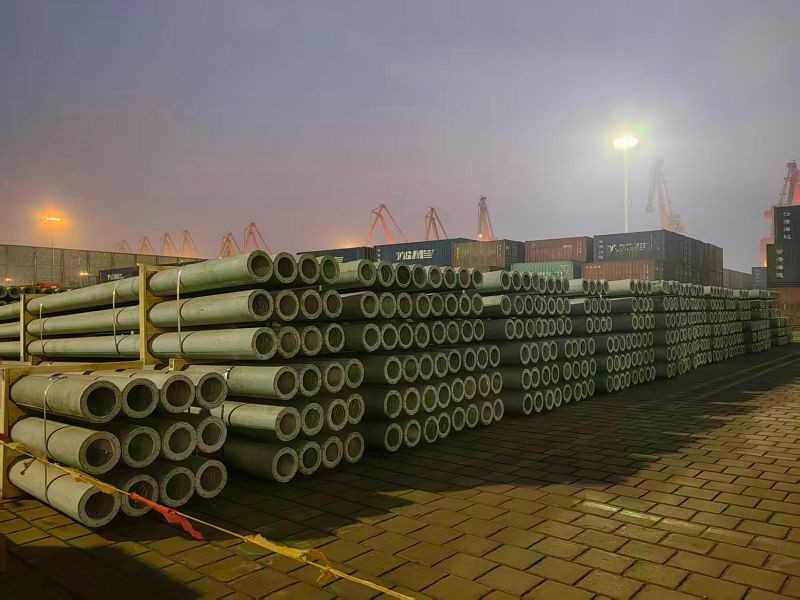
2. Layered Staggered Fixing and Waist-Binding Compression ReinforcementFor centralized shipment of large batches of poles via railway or long-distance land transport, professional technical solutions are recommended. For example, layered staggered fixing arranges upper and lower layers of poles in a staggered pattern to disperse stress points. Combined with waist-binding compression reinforcement, wire ropes or tensioners apply downward pressure at the middle of the poles, ensuring they remain "immovable" within the carriage. Loading must follow the principle of "long poles at the bottom, short poles on top, heavy poles in the middle," and stacking layers must not exceed three. Between layers, rubber plates or straw mats with a thickness of no less than 20mm must be laid to absorb vibration. Additionally, adjustable wooden or metal supports should be placed at the tip and base stress points to prevent sliding caused by inertia during sudden braking.
II. Land Transport Precautions: Avoiding On-Road Risks
Inland transportation (highway and railway) is characterized by complex road conditions and frequent starts and stops, placing extremely high demands on the pole's resistance to instantaneous impact.
1. No "Hard Friction" or "Point Loading"During loading, it is strictly prohibited to directly tighten wire ropes against the pole surface. Wide nylon slings or wire ropes wrapped with burlap must be used for binding; otherwise, stress cracks can easily form on the pole body. Binding points should be set at least 0.5 meters away from the pole ends, and the contact angle between the wire rope and the pole should not be less than 45 degrees, ensuring that the binding force is vertical rather than transversely cutting.
2. Route Planning and Height Clearance InspectionBefore transportation, strict route surveys must be conducted, particularly regarding bridge weight limits on rural roads, tunnels, and overhead line height restrictions. Ultra-long poles of 12 or even 15 meters have an extremely large turning radius, so flatbed trailers of corresponding lengths must be used (e.g., 15-meter poles require 17.5-meter trailers), accompanied by escort vehicles. The rear of the transport vehicle must display prominent red-on-white "Dangerous Goods" signs and reflective warning strips to alert following traffic.
III. Sea Transport Precautions: Combating Tides and Turbulence
When concrete poles go abroad, the complexity of sea transport far exceeds that of land transport, with major risks arising from moisture corrosion and hull rolling.
1. Moisture Protection and CushioningAlthough concrete itself is not afraid of water, the steel reinforcement inside the poles and the exposed steel ring flanges at both ends are highly susceptible to corrosion from sea salt spray. When loading containers, it is recommended to lay moisture-proof film or thick wooden pallets on the floor to elevate the poles and prevent direct contact with condensed water at the bottom. For bulk shipping, the poles should be properly covered with waterproof tarpaulins, and rubber pads or anti-rust oil should be applied between the fixing wire ropes and the pole bodies.
2. Professional Secondary SecuringFor bulk shipping, the packaging's channel steel frame alone is insufficient; shipboard wire ropes must be used for secondary securing, pulling the bundled poles tight through fixed posts welded to the deck or hold floor to prevent cargo displacement during rolling. For ultra-long poles that cannot fit into standard containers and must be shipped via flat-rack containers or using "BBK" (bulk bundling) methods, the cargo center of gravity must be precisely calculated to ensure balanced stowage in the hold.
From factory loading to overseas site unloading, every step of a concrete pole's movement involves professional technical considerations. As a manufacturer, we not only deliver high-quality concrete products but also are committed to providing a full-process logistics solution covering precise packaging, compliant transportation, and on-site guidance, ensuring that every pole stands in its designated place in perfect condition.
