
- Publisher:admin
- Published on:2026-08-24
- Pageviews:3199
- Source:
Across the vast urban and rural landscapes, concrete poles stand like silent sentinels, bearing the vital mission of delivering light and energy. They line roadsides, sit deep within farmlands, or stand at the edges of construction sites, enduring wind and rain, geological shifts, and even accidental impacts. As the backbone of power infrastructure, the safety and durability of concrete poles are directly tied to the stable operation of the power grid and public safety. Therefore, a scientifically sound protection and support strategy is not merely a technical matter??it is a solemn commitment to the lifeline and to the bottom line of safety.
Prevention First: An Active External Protection System
Exposed to the outdoors for extended periods, concrete poles face their most direct threats from physical impact and environmental erosion. To address the risk of vehicle collisions, modern protection technology has shifted from "passive resistance" to "active deflection." For instance, an innovative external guard structure employs curved protective shells paired with annular airbags. Rollers on the inner wall deflect impact forces, while the outer airbags effectively absorb and cushion the shock. Reflective strips further warn oncoming traffic at night, minimizing damage. Additionally, to counter erosion at the pole base from moist soil and chemicals, applying anti-corrosion coatings proves a simple yet effective strategy, sealing out moisture and corrosive agents to slow aging.
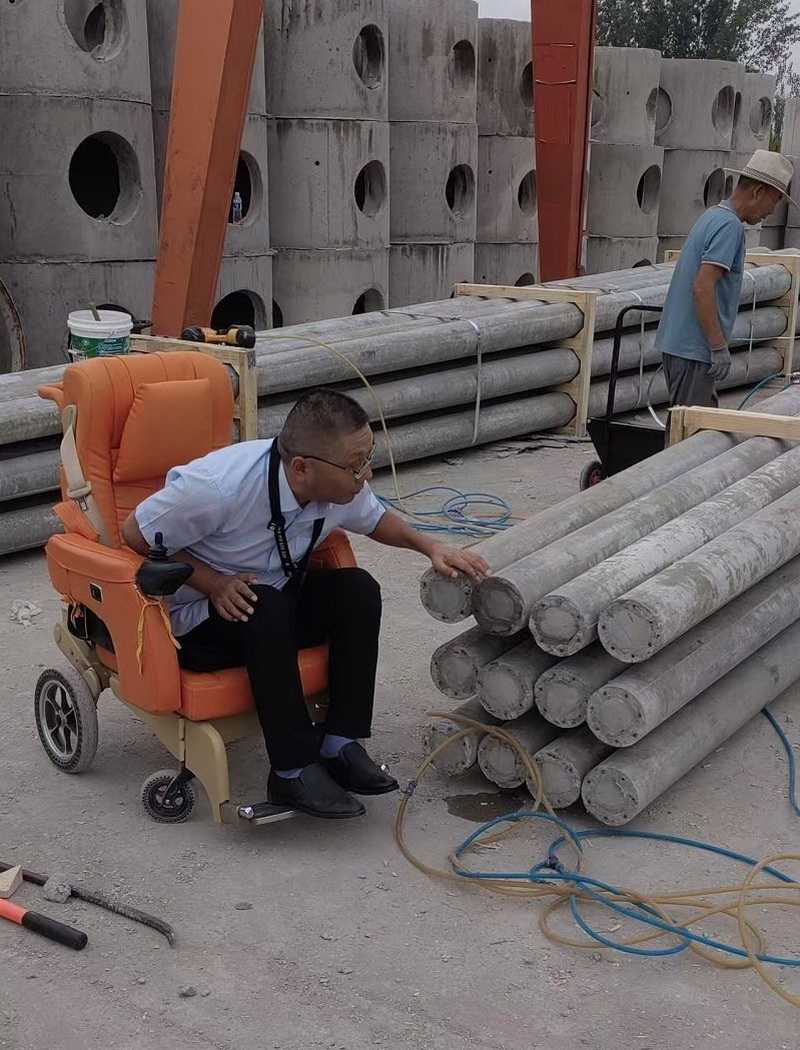
When cracks or localized damage do appear on the pole body, timely "suturing" is required. Wrapping the cracked section with semi-annular steel plates and securing them with tightening clamps creates a strong physical constraint that prevents cracks from expanding, avoids spalling of concrete fragments, and preserves the structural integrity of the pole. During manufacturing and storage, using grout caps to seal the pole ends prevents debris and moisture from entering the hollow interior, safeguarding its "inner health" from the very start.
Foundation Strengthening: A Passive Ground Support Strategy
When poles are located near deep excavation zones or on soft ground, foundation instability becomes the greatest safety hazard. At such times, temporary or permanent support measures are crucial. In practice, for protecting poles beside excavation pits, steel sheet pile retaining is often adopted: long channel steel beams are driven tightly around the pole to form a steel wall, effectively resisting lateral earth pressure and preventing base sliding caused by excavation. Simultaneously, wire rope and ground anchor diagonal bracing are applied to the upper section of the pole. By fixing the pole with hoops and connecting it to concrete anchor blocks on the ground, an additional anti-overturning moment is provided, achieving a dual safeguard of "upper bracing and lower supporting."
Under more complex conditions, such as soft-soil areas or constrained sites, anchored rebar piles or micro-piles may be employed. By drilling around the pole base, inserting steel bar bundles, and grouting them in place, a root-like reinforced mass is formed that anchors the pole foundation and the deep stable soil layers into an integrated whole. This approach significantly enhances bearing capacity and effectively counteracts tilting caused by soft soil or farming activities.
Conclusion
The protection and support of concrete poles represent a systematic engineering effort encompassing materials science, structural mechanics, and geotechnical engineering. From the fine coating on the pole surface to flexible energy dissipation upon impact; from steel-sheet piling beside excavation pits to deep anchoring in soft-soil areas??every technique embodies an unwavering pursuit of safety. As a provider of premium concrete poles, we not only deliver robust pole bodies but also offer life-cycle protection expertise, ensuring that every pole stands firm and endures long, safeguarding the lifelines of modern society.
